
NASA is preparing to replace a critical part of its spacecraft communications network without forcing satellites already in orbit to change their radios. On November 4, 2026, the agency awarded three fixed-price concept contracts for commercial Ka-band space relays that could serve existing missions as its Tracking and Data Relay Satellite (TDRS) fleet ages. Astranis Space Technologies, Global Enterprise Solutions and Viasat received awards under a program called NEXUS. The awards begin engineering work; they do not establish that a replacement constellation has launched or entered NASA service.
NASA Goddard’s original animation shows ISS data passing through the existing TDRS network to White Sands and mission control. Historical system explanation, not footage of the new awards. Watch on YouTube.
Why a satellite needs another satellite to reach Earth
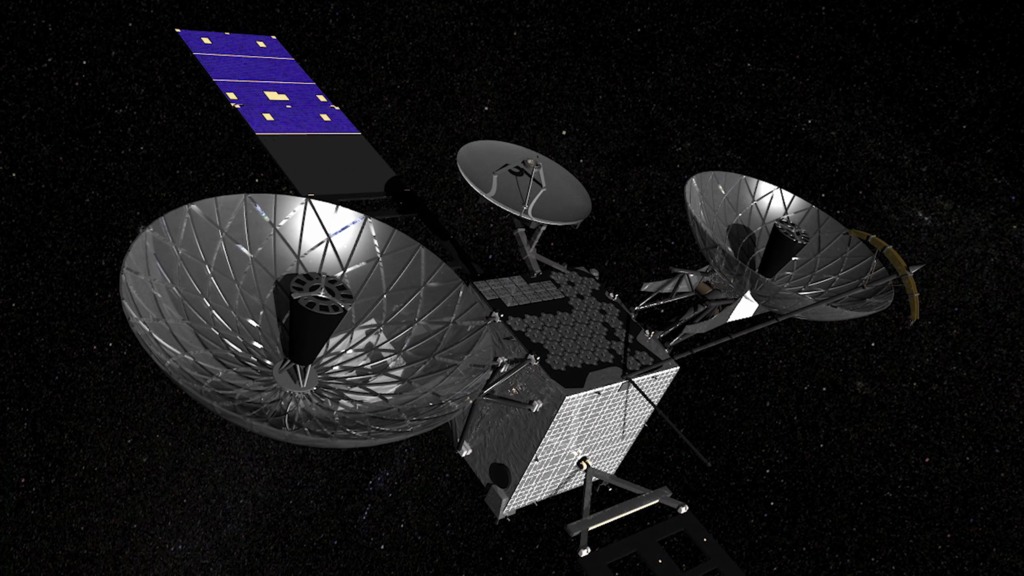
Low-Earth-orbit spacecraft travel around the planet quickly. A direct ground antenna can lose line of sight when the spacecraft drops beneath its local horizon. NASA’s current solution places dedicated relay satellites in geosynchronous orbit, where they can see broad regions of Earth and retransmit mission data through terrestrial ground stations. The architecture supports astronaut communications, science downloads, tracking and spacecraft commands.
The Ka-band portion matters because some active satellites already carry antennas, amplifiers, receivers and control software designed around NASA’s legacy relay links. Replacing that flight hardware may be impractical or impossible after launch. NASA’s NEXUS solicitation therefore seeks backward-compatible service for at least 15 years. Commercial operators must satisfy the interface requirements, not just offer a fast broadband satellite connection.
Three companies, three contract ceilings
NASA named Astranis with a $264.3 million maximum, Global Enterprise Solutions with $340.4 million, and Viasat with $460.9 million. The three maximums total $1.0656 billion, including priced future options. They should not be reported as immediate payments, a guaranteed spending commitment or the cost of an already deployed network.
The initial period runs from November 4, 2026, through May 3, 2027, focusing on concept maturation and risk reduction. NASA can later exercise options for system integration, in-orbit flight demonstration and service verification, potentially extending work into 2029. A contractor’s selection does not mean that its architecture has passed orbital testing or will necessarily win long-term operational service purchases.
NASA’s historical TDRS film explains how government relay satellites support communications and scientific data. It is technical background, not evidence of a commercial NEXUS flight demonstration. Watch on YouTube.
The difficult engineering sits between antennas and software
Ka-band can support comparatively wide communications channels, but link quality depends on antenna pointing, radio-frequency compatibility, amplification, coding, Doppler handling, scheduling and weather-affected ground links. A usable successor must also connect the relay spacecraft to ground facilities, mission operations and secure command pathways. Reliability requirements for an orbiting scientific spacecraft differ from those of ordinary consumer satellite internet.
The shift does not mean NASA will abandon every government communication asset overnight. Its Communications Services Project is conducting multiple commercial-relay demonstrations while the legacy TDRS fleet continues to support existing missions. BitcoinVersus.Tech previously covered Viasat’s Maxwell satellite-relay demonstration, a related but separate effort. The new NEXUS awards focus specifically on sustaining compatibility for spacecraft already in orbit.
The broader digital-infrastructure consequence
The transition resembles upgrading a data-center backbone while old servers remain attached: new infrastructure must understand interfaces its users cannot replace. Similar constraints appear in our coverage of long-distance high-speed data transfer and new optical-network switches. In space, the compatibility problem carries an additional constraint: the customer’s communications equipment may be hundreds of kilometers above the technicians.
NASA’s commercial Mars communications plans illustrate a different destination and architecture; near-Earth Ka-band continuity should not be confused with deep-space relay coverage. The next evidence to watch is a completed interface design, hardware-in-the-loop testing, a successfully exercised demonstration option, and verified communication with a representative existing mission.
Primary documentation: NASA contract release C26-016, November 4, 2026; NASA NEXUS procurement and requirements; NASA Communications Services Project; NASA TDRS fleet overview.
We volunteer daily to ensure the credibility of the information on this platform is Verifiably True. If you would like to support to help further secure the integrity of our research initiative, please scan the QR code below.



Leave a Reply