
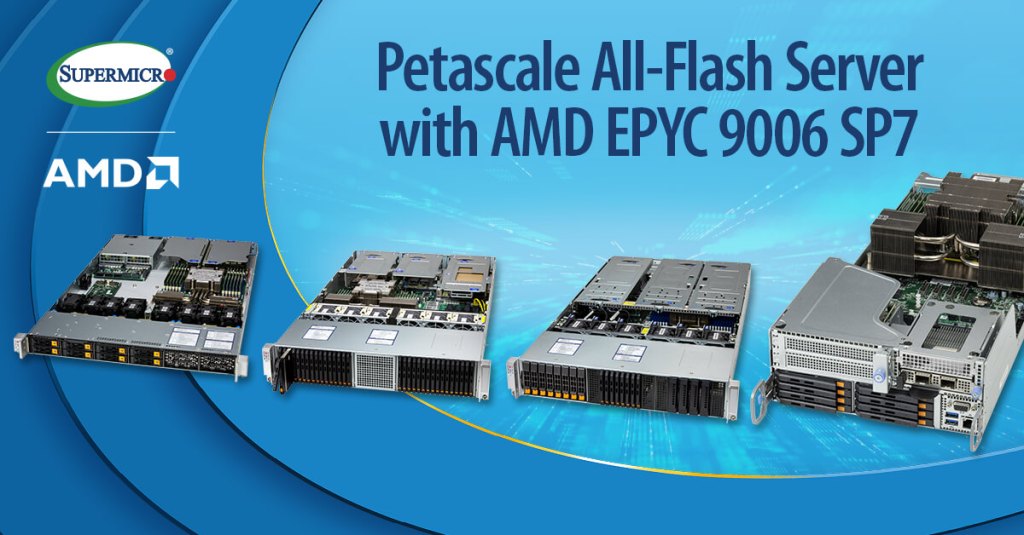
AI data centers cannot keep GPUs busy if storage delivers model files, training data and inference state too slowly. On November 18, 2026, Supermicro announced that its new Petascale all-flash storage server is shipping, built around AMD’s sixth-generation EPYC 9006 processors and PCI Express 6.0 connectivity. The headline hardware is a 2U system supporting 32 hot-swap E3.S NVMe drives and a manufacturer-quoted maximum raw capacity of 3.93 petabytes. The system targets AI and high-performance computing rather than Bitcoin SHA-256 hashing.
Supermicro’s November 18 announcement links to the video above as its release summary. Playback has not been independently verified. Watch directly on YouTube if the embedded player is unavailable.
Thirty-two flash drives in two rack units
The chassis supports up to 32 E3.S solid-state drives. At approximately 122.88 TB per drive, 32 units provide roughly 3,932 TB, or 3.93 PB in decimal units. The figure is a maximum raw configuration, before parity, filesystem metadata, spare capacity and failure reserves reduce usable storage. Supermicro also specifies up to four x16 high-performance networking cards to carry data beyond the chassis.
The I/O transition matters. According to PCI-SIG’s PCIe 6.0 specification, generation six raises signaling to 64 GT/s, double the preceding generation’s 32 GT/s rate. PAM4 signaling, fixed-size flow-control units and forward error correction support the faster link. Gen 6 increases potential bandwidth between supported components; a PCIe label alone does not establish end-to-end storage throughput.
Why AI storage has become infrastructure-critical
Training clusters repeatedly fetch datasets and write checkpoints. Inference services load models, retrieve documents and handle key-value (KV) cache state across many requests. When storage or networking stalls, costly accelerators can remain underutilized. Earlier BitcoinVersus.Tech reporting examined Supermicro, IBM and NVIDIA’s KV-cache architecture and Google Cloud’s high-capacity SSD instances. Both developments illustrate why data movement matters alongside GPU compute.
Supermicro lists Hammerspace, IBM, MinIO, Nutanix, Scality, VAST Data, VDURA and WEKA among software-defined storage collaborators. Their layers expose storage using differing file, object and distributed-access models. Faster hardware creates a potential data path, while software governs placement, resiliency, scheduling and the latency experienced by AI applications.
Supermicro’s 2025 Petascale demonstration explains the older product family; the video does not demonstrate the announced PCIe Gen 6 system. Watch directly on YouTube if the embedded player is unavailable.
The bandwidth headline is not an independent benchmark
Supermicro advertises up to 100% greater sequential read bandwidth compared with PCIe Gen 5 storage platforms. The figure comes from the company’s announcement, not an independently reproduced test. Measured results depend on SSD models, populated lanes, CPU and memory topology, queue depth, network interface bandwidth and storage software. Random I/O, tail latency and sustained performance during drive failures could differ substantially from sequential-read results.
The surrounding infrastructure is also changing. BitcoinVersus.Tech recently reported on NVIDIA’s 192-CPU Vera rack and experimental high-bandwidth photonic integration. Compute, storage and networking improve on separate schedules, and practical cluster throughput remains subject to their combined bottlenecks.
Deployment questions for data center operators
Supermicro displayed the new Petascale system at SC26 in Chicago, November 15–20. Before a purchase or rollout, operators should verify populated drive capacity, expected usable capacity, PCIe link negotiation, sequential and random workload results, power per usable terabyte, cooling requirements, NIC uplink utilization, field serviceability and recovery after SSD failure. A shipping platform is a commercial milestone, but the performance of a deployed cluster remains an engineering measurement.
Primary sources: Supermicro, November 18 announcement; Supermicro H15 AMD product family; AMD EPYC 9006 documentation; PCI-SIG Gen 6 technical features.
Media disclosure: The featured oil-painting cover is an original editorial illustration rather than a product photograph. Interior hardware artwork is supplied by Supermicro. Both videos are manufacturer background, with the older presentation predating the Gen 6 product announcement.
We volunteer daily to ensure the credibility of the information on this platform is Verifiably True. If you would like to support to help further secure the integrity of our research initiative, please scan the QR code below.



Leave a Reply