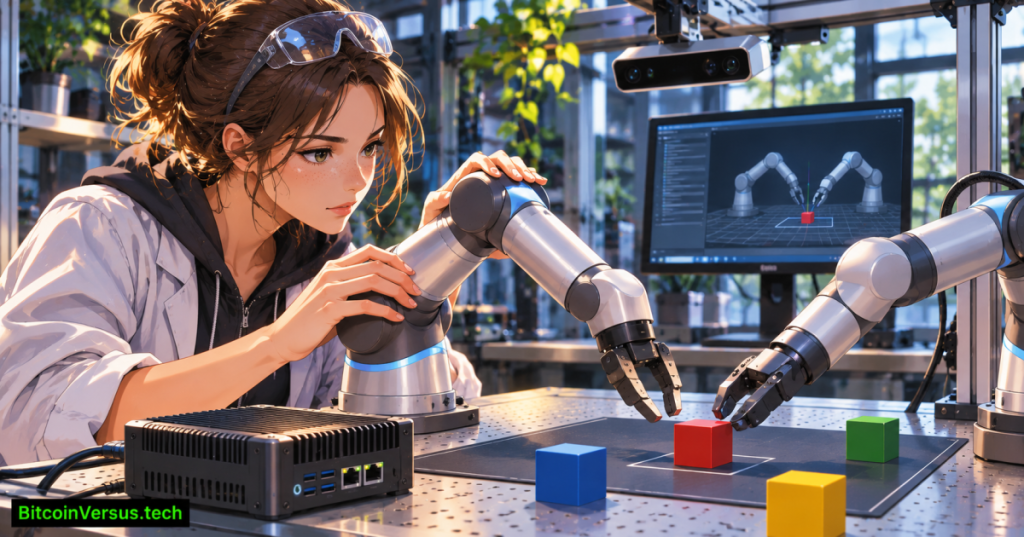
ASRock Industrial introduced a desktop robotics development kit on November 24, 2026, combining a compact Intel computer with paired robot arms and a depth camera. The RBK-100 announcement targets developers who want to record physical demonstrations, train machine-learning models and evaluate robotic manipulation without assembling an entire experimental platform from separate suppliers.
Teaching robots through demonstration
Conventional industrial robot programming often begins with explicit coordinates, motion sequences and conditions for interacting with equipment. Imitation learning takes another approach. A person demonstrates a desired task, and a model learns to predict actions from recorded observations. A developer can then evaluate the resulting behavior on physical hardware.
The RBK-100 incorporates two six-degree-of-freedom arms in a leader-follower arrangement. During recording, the operator guides one arm while the other reproduces the movement. A color-and-depth camera provides information about the objects and workspace. The computing platform captures the demonstration data for review and subsequent training. Success depends on the quality and diversity of the examples rather than merely the number of recorded attempts.
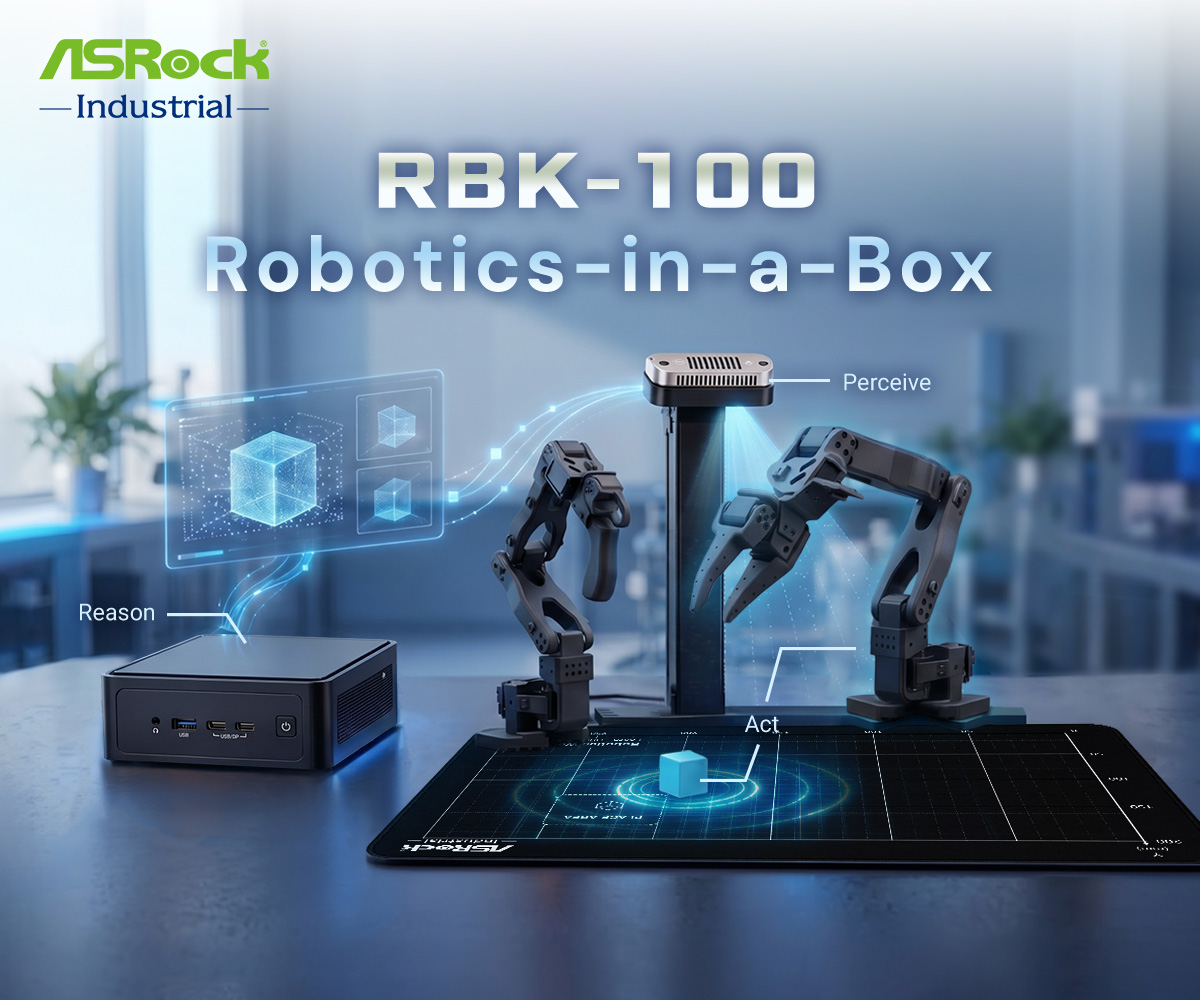
Computing at the workbench
According to the preliminary product specifications, the NUC BOX-358H incorporates an Intel Core Ultra X7 358H processor, a 512 GB PCIe 4.0 solid-state drive and either 32 GB or 64 GB of DDR5 memory. The kit includes mounting hardware, a USB hub and manipulation objects. The advanced configuration doubles the standard system’s advertised memory capacity, providing additional space for model parameters and execution buffers. It does not establish twice the training performance.
ASRock says its AiRoboStarter environment supports the ACT and Pi0.5 model workflows, with SmolVLA support planned. Training and inference can operate on the local computer, reducing dependence on external computing infrastructure. Optional advanced software connects language-model capabilities with robotic skills. Those capabilities should be evaluated separately from the accuracy of motor control.
From laboratory exercises to dependable automation
A robot that consistently transfers a cube between two known positions may still fail when lighting changes, an object moves or its gripper encounters unexpected resistance. Meaningful evaluation should therefore include previously unseen placements, repeatability, recovery behavior and safe operating limits. Independent testing would also need to identify the model, training duration, power consumption and task success rate.
Related engineering coverage includes OpenAMRobot’s dual-arm mobile platform, RISC-V motor control inside robot joints, integrated industrial 3D vision and UCLA’s wearable demonstration hand.
Independent reporting by Hackster also describes the integrated hardware and on-device learning approach. Pricing and delivery timing were not established in the reviewed announcement. The kit represents a packaged research environment rather than a demonstrated replacement for certified industrial automation equipment.
We volunteer daily to ensure the credibility of the information on this platform is Verifiably True. If you would like to support to help further secure the integrity of our research initiative, please scan the QR code below.



Leave a Reply