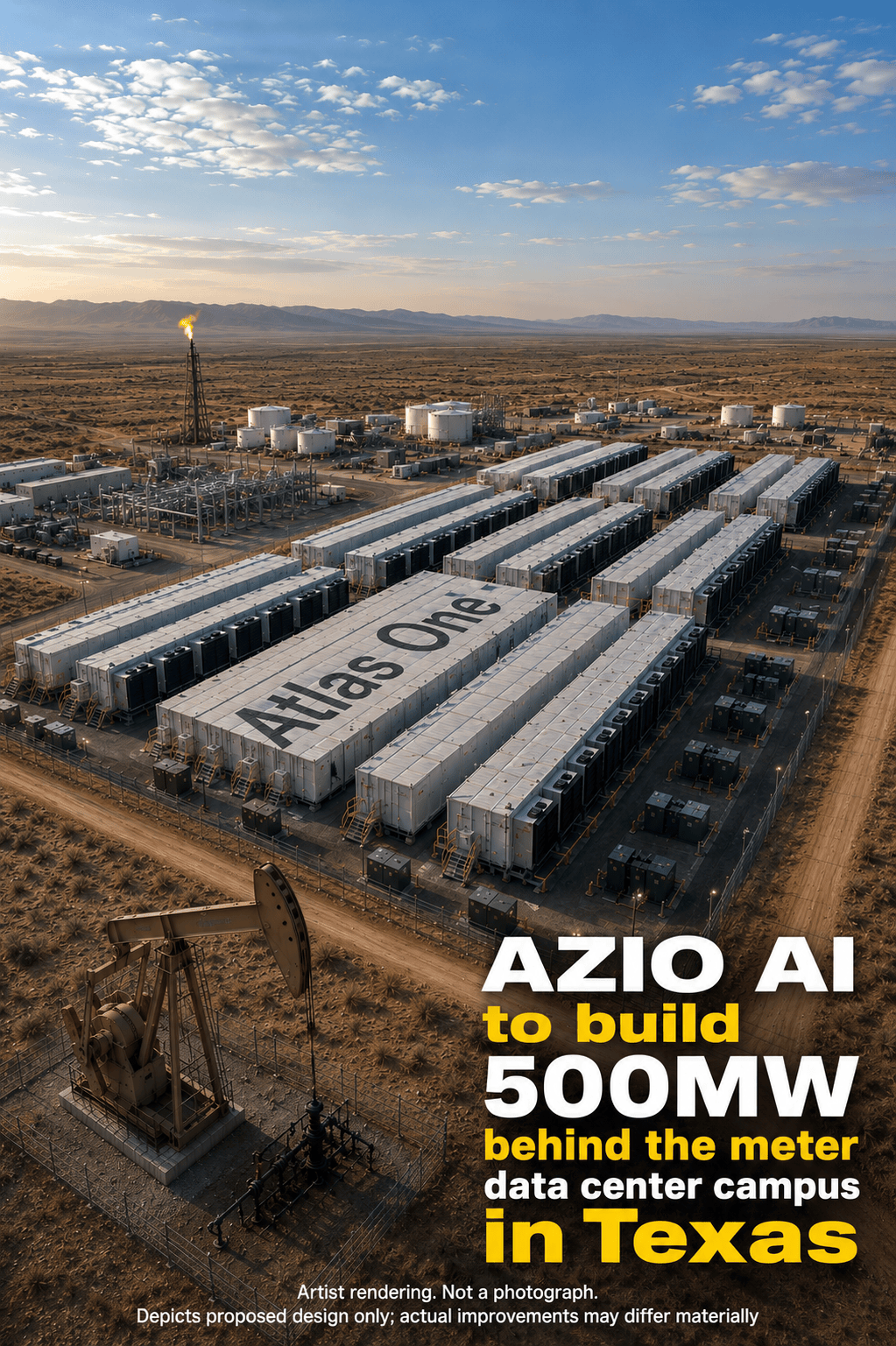
A South Texas computing campus that began with Bitcoin mining is preparing to host AI accelerators using electricity generated on its own property. On November 25, 2026, AZIO AI Holdings reported that infrastructure for its Power Champion customer at Atlas One had been built. GPU delivery remains pending, with no delivery date announced. The customer’s initial 10 MW allocation has not been energized, and its hosting agreement has not generated recognized revenue.
Bitcoin mining as an electrical test load
In its August 20 campus announcement, AZIO described more than 548 acres in Live Oak County, approximately 11 MW of secured generation capacity and an activated 6 MW Bitcoin mining deployment within that allocation. Management reported 97.8% uptime over several months for the mining operation. That historical result does not establish reliability for future GPU customers.
An ASIC mining facility provides sustained electrical demand while permitting individual machines to stop hashing without abandoning a coordinated training run. An AI cluster has different requirements: accelerator communication, checkpoint recovery, consistent cooling and electrical redundancy can affect the availability of an entire job. Testing a generator against mining demand therefore establishes useful operating experience, not complete AI qualification.
The economics of a 10 MW reservation
The customer agreement separates capacity charges from electricity consumption. At $150 per kW each month, a fully delivered 10,000 kW allocation would generate $1.5 million in monthly reservation charges, equivalent to $90 million over the initial five-year term. An optional expansion to 50 MW remains unexercised. The stated energy tariff is $0.13 per kWh, with additional applicable charges.
For illustration, continuous operation at 10 MW for a 30-day month would consume 7,200 MWh. At the stated energy rate, electricity alone would cost $936,000. Adding the full monthly reservation charge produces $2.436 million, before other charges. Actual bills depend on delivered capacity, measured consumption and contract terms; the calculation is neither recognized revenue nor profit.
Building a campus without grid dependence
AZIO describes Atlas One as designed to operate independently of the ERCOT electricity network using on-site gas generation. The approach can reduce exposure to utility interconnection delays, but transfers responsibility for dependable generation, fuel supply, electrical protection, maintenance and backup systems to the campus operator. Air permits and other approvals remain necessary.
The developer previously identified as much as 500 MW of potential additional generation capacity beyond the 11 MW secured in August. That expansion is a design ambition rather than installed power. Financing, equipment, permits, fuel infrastructure and customers would be necessary to realize it. Nor should a separate potential GPU sales pipeline be counted as contracted campus capacity.
What comes next
Related infrastructure strategies include Giga Energy’s Project Clay, the proposed Big Lake mining conversion, Soluna’s wind-adjacent Kati campus and Alberta’s Beacon gas generation project. Each approaches the challenge of powering high-density computing differently.
For Atlas One, the next meaningful milestones are GPU delivery, the necessary approvals, integrated equipment commissioning and customer capacity made available for billing. The November announcement represents progress in infrastructure preparation, but not an operating 10 MW AI deployment.
Cover credit: AZIO AI Holdings, August 20, 2026 concept artwork. The rendering does not depict a completed campus.
We volunteer daily to ensure the credibility of the information on this platform is Verifiably True. If you would like to support to help further secure the integrity of our research initiative, please scan the QR code below.



Leave a Reply