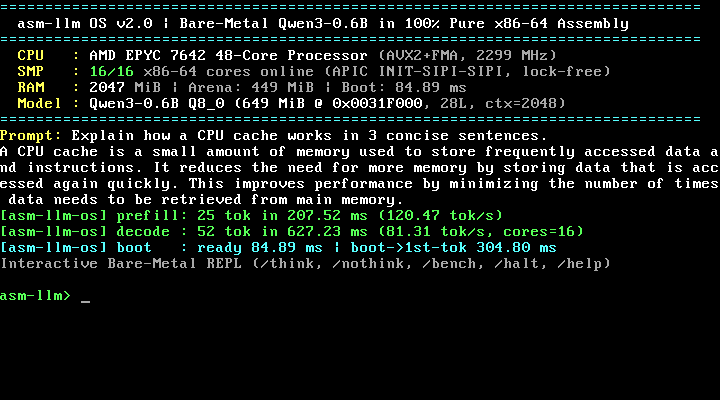
Software developer Alexey Fateev presented a specialized operating system on November 25, 2026, that starts directly into a Qwen3-0.6B language-model session without a Linux guest kernel. The project, llm.asm, implements its inference runtime and operating-system code in x86-64 assembly. Fateev reports up to 54% higher CPU decoding throughput than llama.cpp running under Linux on the same AMD EPYC 7642 machine.
What actually fits inside 24 KB?
According to the MIT-licensed project repository, the default stripped executable occupies 24,252 bytes, approximately 23.68 KiB. It contains the specialized kernel and inference code, not the complete model. Qwen3’s quantized weights and associated data occupy another 613.66 MiB in a separate file. The project also allocates memory for cached attention state and temporary computation.
The kernel initializes processor execution, creates memory mappings and starts additional cores through the local Advanced Programmable Interrupt Controller. It provides basic VGA console, PS/2 keyboard and serial interfaces for interactive chat. Reported kernel initialization takes 74–94 milliseconds; loading an ISO and starting a virtual machine can take considerably longer.
How the performance compares with Linux
The repository describes a CPU-only benchmark with a 34-token prompt and 64 generated tokens, using the Q8_0 model on AMD EPYC 7642. The published comparison uses three-run averages, with different model-file layouts for the two runtimes. The standalone kernel runs inside a QEMU/KVM guest for the EPYC comparison.
| Threads / vCPUs | Linux llama.cpp (tok/s) | Assembly OS (tok/s) | Increase |
|---|---|---|---|
| 1 | 16.63 | 23.67 | 42.3% |
| 4 | 51.08 | 78.89 | 54.4% |
| 8 | 80.79 | 118.08 | 46.2% |
| 16 | 103.03 | 134.94 | 31.0% |
Four threads produced the largest relative gain among the four configurations shown. At 16 threads, throughput reached 134.94 tokens per second, about 31% ahead of the corresponding llama.cpp result. The assembly inference program also runs under Linux and already outperforms the selected llama.cpp baseline by approximately 18–36% across the tested thread counts. Removing Linux therefore cannot account for the entire observed difference.
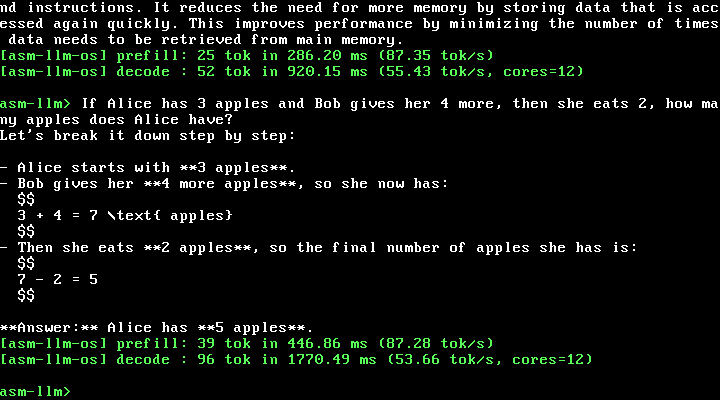
Why a specialized kernel can be faster
The optimized runtime combines integer vector operations, compact weight scales, predictable memory access and parallel attention. Its memory mappings use 2 MiB pages, reducing potential translation overhead relative to 4 KiB mappings. Fateev attributes an additional performance gain to the standalone configuration. Separating the effects would require matching numerical kernels, page sizes, processor affinity, memory layout and virtualization conditions.
The project reports matching 64 greedy output tokens against a PyTorch FP32 reference, with cosine similarity of 0.99965 for the optimized inference implementation. A short correctness test does not establish accuracy across all prompts or models.
A dedicated AI appliance, not a general-purpose Linux replacement
As PC Watch reports, the kernel lacks ordinary disk drivers and runs from memory. Its minimal design is useful for exploring inference appliances, but it does not supply the broad networking, application isolation, device support or service management expected from a general-purpose operating system. A diskless guest also still relies on its hypervisor host.
Related coverage includes AMD local AI acceleration, memory-integrated microcontrollers, alternative parallel processors and configurable RISC-V processors. The open-source experiment demonstrates how far a workload-specific software stack can be reduced, while leaving broader performance and security questions for independent testing.
We volunteer daily to ensure the credibility of the information on this platform is Verifiably True. If you would like to support to help further secure the integrity of our research initiative, please scan the QR code below.



Leave a Reply