
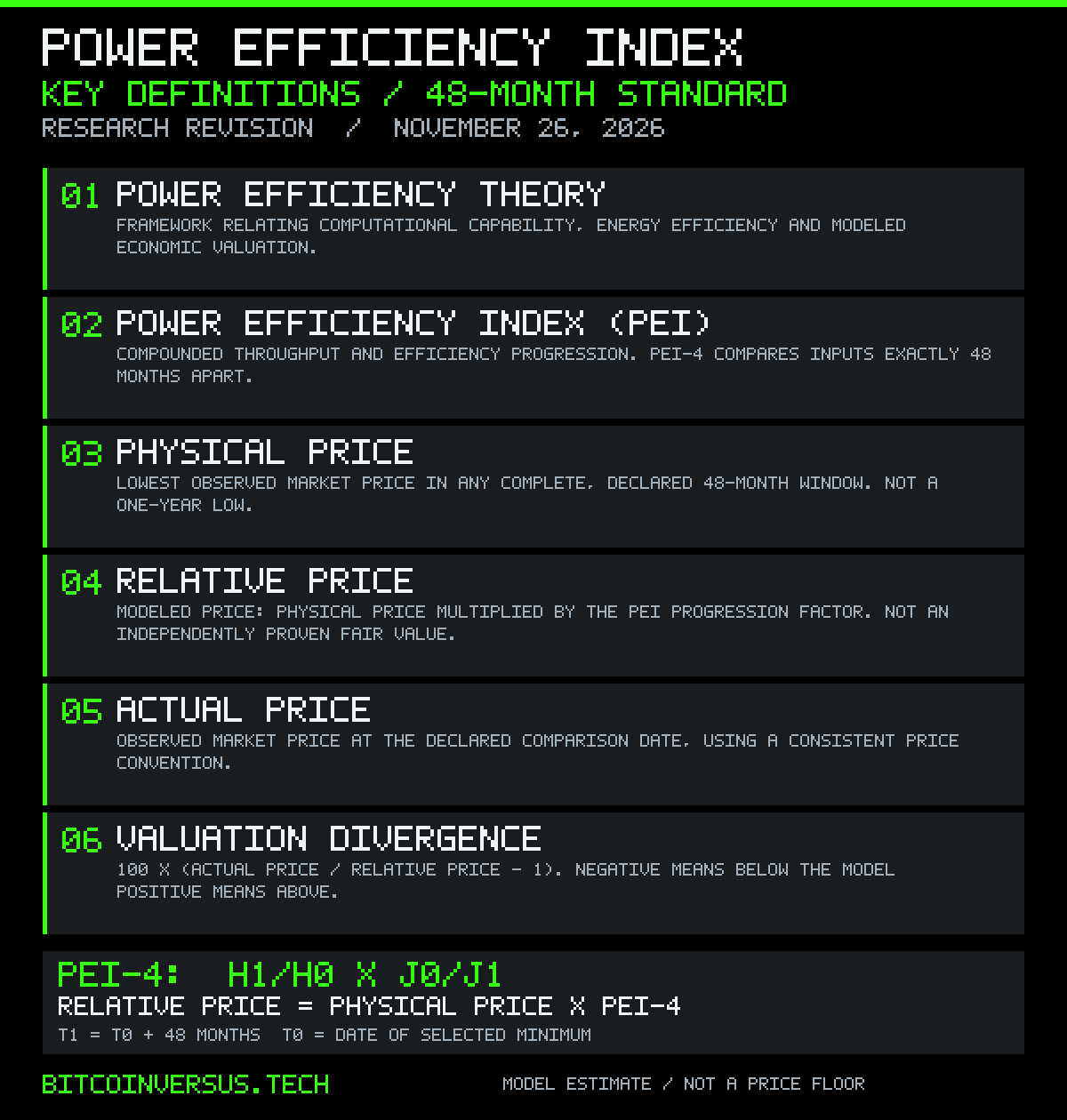
Power Efficiency Theory has refined the definition of physical price under the PEI Four-Year Interval Standard. For a proof-of-work asset such as Bitcoin, physical price is the lowest observed market price within a declared, complete four-year or 48-month measurement window. A low recorded over just 12 months does not independently qualify under the revised standard.
The original algebraic expression
The original January 17, 2026 Power Efficiency Theory equation expresses valuation as compounded performance growth divided by the remaining energy-cost factor. Under the Four-Year Interval Standard, the initial value is the physical price and the exponent is four.
V(t) = V₀ × [(1 + rₚ) / (1 − rⱼ)]t
V(4) = V₀ × [(1 + rₚ) / (1 − rⱼ)]4
V(4) = V₀ × [(1 + rₚ)4 / (1 − rⱼ)4]
V(t) = modeled relative price after t years; V₀ = physical price, the lowest observed market price in a declared complete 48-month window; rₚ = annual proportional growth in computational output (Bitcoin hashrate); rⱼ = annual proportional reduction in energy required per unit of output (Bitcoin J/TH); t = elapsed years from the date of the selected physical-price minimum, set to 4 (48 months) for PEI-4. Rates are expressed as decimals, with positive throughput and energy-cost factors.
Written directly using measured endpoint variables: V(4) = V₀ × (H₄ / H₀) × (J₀ / J₄), where H₀ and H₄ are baseline and four-year hashrates, and J₀ and J₄ are baseline and four-year energy-per-terahash values. The rate-based equation is equivalent when the rates are constant or calculated as compound annual rates from the matching endpoints. The physical-price selection window is distinct from the four-year progression interval.
Formal notation and measurement conditions
Defining the physical-price minimum
Physical Price (PEI-4): Pphysical,4 = mint ∈ W P(t), where W = [a, a + 48 months) and P(t) is a consistently defined market-price series. The window may start in any month or year; it need not coincide with a Bitcoin halving.
The earlier physical-price definition used yearly lows. The revised convention replaces that requirement with a complete 48-month minimum. Researchers must disclose their exchange, currency, observation frequency, and whether they measure daily closes or intraday lows. Select the earliest date in the event of equal minima.
Connecting physical and relative price
Let t₀ denote the date of the selected minimum. For a standardized four-year progression reading, t₁ = t₀ + 48 months. Relative price is calculated using the established relative-price framework:
R4 = Pphysical,4 × [H(t₁)/H(t₀)] × [J(t₀)/J(t₁)]
H represents comparable computational throughput, and J represents comparable energy required per unit of computation. Bitcoin uses hashrate and joules per terahash. Actual price remains the observed market price at the comparison date; valuation divergence compares that observation with the modeled relative price.
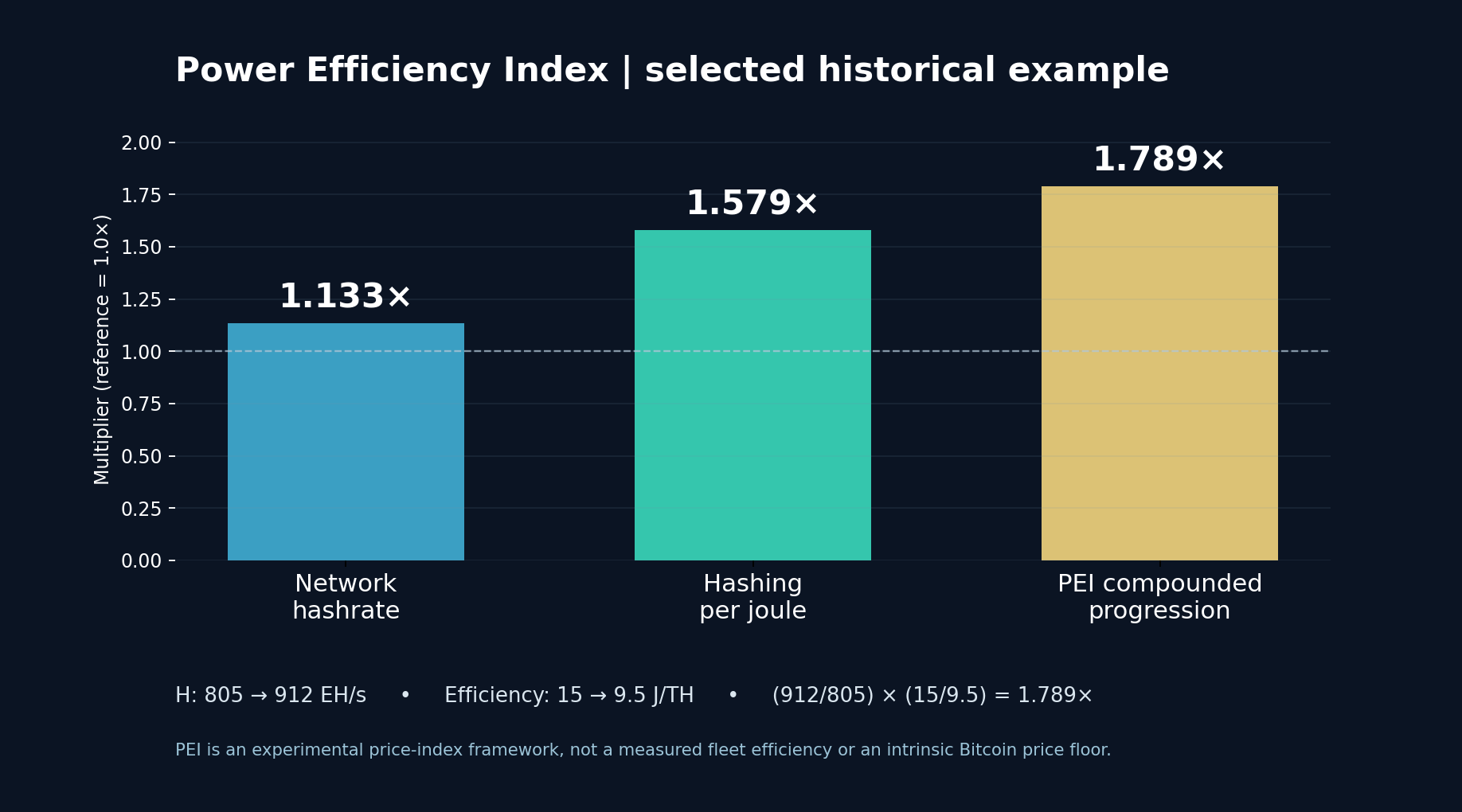
The minimum-selection window and the subsequent low-to-endpoint progression interval are distinct. A minimum occurring inside a declared window does not automatically make the window’s closing date a four-year progression endpoint. A later matched anniversary is required for the standardized calculation.
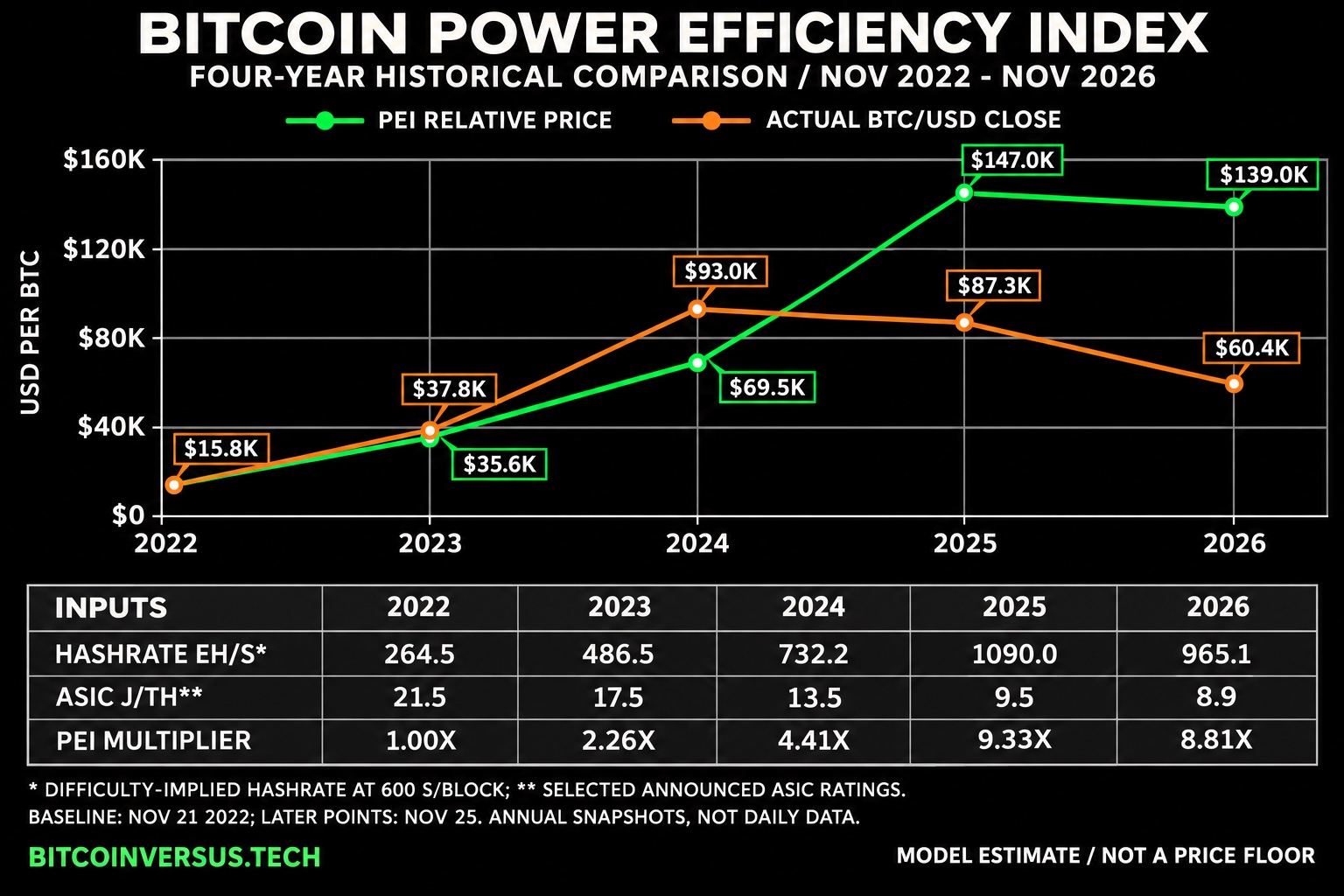
The Bitcoin Lexicon now records the revised definition. The standard preserves the original compounding principle while making baseline selection reproducible. Physical price is not an immutable market floor or independently established intrinsic value. The math is verifiable; the interpretation is experimental.
We volunteer daily to ensure the credibility of the information on this platform is Verifiably True. If you would like to support to help further secure the integrity of our research initiative, please scan the QR code below.



Leave a Reply