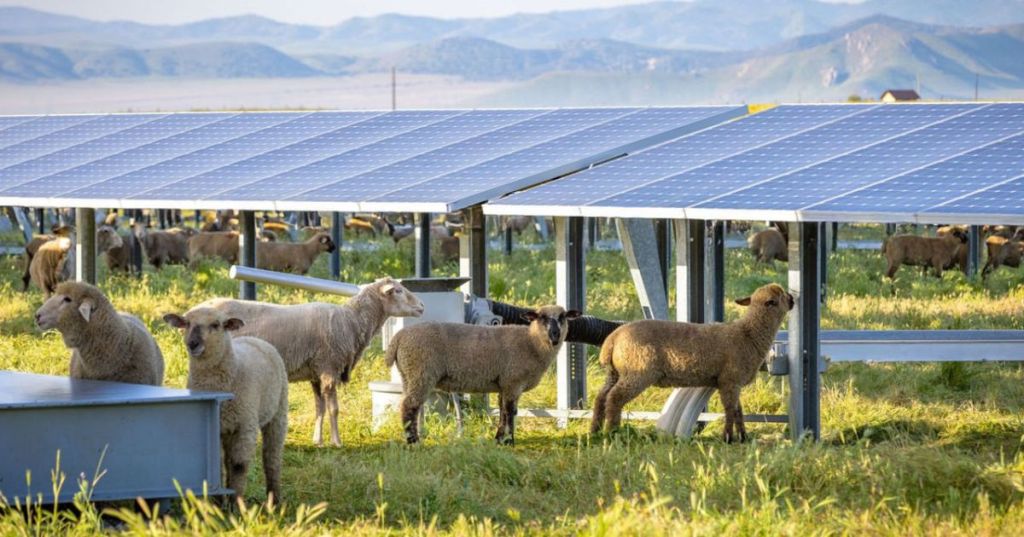
A 250 MW photovoltaic power station in California is gaining a second function that does not depend on sunlight. Clearway Energy announced on November 17, 2026, that its California Valley Solar Ranch has begun providing nighttime reactive power support under an agreement with Pacific Gas and Electric Company (PG&E). The service uses existing inverters to regulate transmission voltage after sunset, when the modules are no longer producing solar electricity.
SunPower’s February 2012 video documents the California Valley Solar Ranch during development. Historical project footage, not a demonstration of the new nighttime service. Watch directly on YouTube.
The facility in San Luis Obispo County entered full commercial operation in 2013. PG&E’s November 13 account traces the initiative to a need for voltage support in the Los Padres area. Unlike ordinary electricity procurement, such as Akamai’s Singapore rooftop solar agreement, the new arrangement concerns an electrical network service rather than the sale of additional solar energy.
Real power and reactive power are different
Alternating-current networks carry real power, measured in watts, and reactive power, measured in volt-amperes reactive (var). Real power represents net energy transfer capable of performing work. Reactive power describes the oscillating exchange of energy associated with electric and magnetic fields. Managing it locally can help maintain transmission voltages within acceptable limits.
A photovoltaic inverter normally converts direct current from solar modules into grid-compatible alternating current. Its semiconductor switches can also regulate the phase relationship between current and voltage. By controlling that relationship, suitably configured equipment can absorb or supply reactive power even when little or no real power is exported. Our discussion of solid-state equipment for hybrid AC and DC networks explores related power-electronic control principles.
CMTEQ’s January 2026 engineering tutorial compares reactive power control in synchronous generators and photovoltaic inverters. Watch directly on YouTube.
Why nighttime availability matters
Inverters have current and thermal limits. During daytime operation, real-power delivery and reactive-power capability must share the equipment’s available apparent-power capacity. At night, the absence of solar production can free some of that capacity for voltage regulation, provided the hardware, controls and grid connection support such operation. The inverter still requires auxiliary energy and incurs electrical losses. It does not generate solar electricity in darkness or replace battery storage.
Voltage regulation is geographically dependent. A utility needs a resource that can influence the relevant part of its network. Buying renewable electricity through a contract, as in Oracle’s Texas wind agreement, is not equivalent to obtaining reactive power at a particular transmission node.
An additional service from existing infrastructure
The parties have not published the contracted reactive-power rating, dispatch frequency, measured loss profile or financial terms in their announcements. The plant’s 250 MW generation rating must not be interpreted as a 250 MVAr nighttime capability. Those details would be necessary to quantify the economic value and compare performance with dedicated voltage-support equipment.
As power demand expands through developments such as the Homer City AI power campus, generation capacity is only one dimension of infrastructure planning. Clearway’s operating agreement illustrates how existing renewable assets can support network reliability through functions distinct from their original energy-production role.
Featured photograph: PG&E’s November 13, 2026 article, showing California Valley Solar Ranch. Cropped for editorial presentation.
We volunteer daily to ensure the credibility of the information on this platform is Verifiably True. If you would like to support to help further secure the integrity of our research initiative, please scan the QR code below.



Leave a Reply