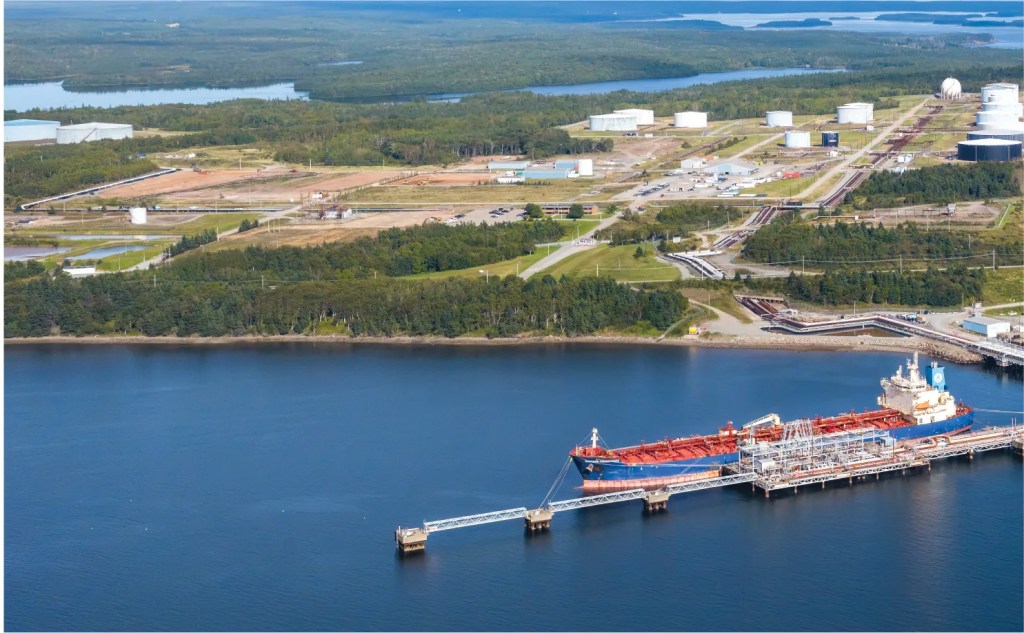
A former industrial terminal on the Strait of Canso could become a major Canadian artificial intelligence computing campus. On October 16, EverWind announced a planned investment exceeding $10 billion in the Point Tupper data center and Nova Scotia wind developments. Reuters confirmed that Anthropic had signed a lease for computing capacity at the site.
The proposal remains under development. On November 17, the Nova Scotia government announced public information sessions, providing an opportunity to examine the project’s electricity requirements, water use and community impacts. EverWind’s featured aerial photograph shows existing terminal infrastructure, not a commissioned AI campus.
A phased electricity supply
The developer targets an initial 95 MW phase in late 2027, with a subsequent 325 MW expansion scheduled to begin entering service in 2028, subject to approvals. Four wind developments, including Bear Lake, Windy Ridge, Kmtnuk and Upper Afton, would provide more than 650 MW of additional generation capacity. The wind portfolio is expected to come online across 2028 and 2029, after the first computing phase’s target date.
According to the project’s public engineering and community information, initial grid service would use the existing 138 kV connection under an interruptible arrangement. The company reports completed system-impact and facilities studies for the first phase, while implementation and commissioning remain outstanding.
Why 650 MW of wind does not equal 420 MW of continuous power
A constant 420 MW computing-facility load would consume about 3.68 TWh per year. Using a conservative illustrative wind capacity factor of 40%, 650 MW of installed wind turbines would produce about 2.28 TWh annually, equivalent to roughly 62% of that hypothetical demand. Neither number is a site production or consumption forecast. Hourly matching requires balancing even when annual energy production exceeds consumption.
Interruptible service creates a different design constraint from ordinary firm utility supply. Battery storage can support short-duration changes in demand, while emergency generators or controlled workload reduction can address longer interruptions. EverWind currently anticipates diesel emergency backup, not exclusive renewable operation at startup. Battery energy and power ratings have not been finalized publicly.
Cooling and accountability
The campus design contemplates recirculating coolant and rejecting much of the heat through air-cooled equipment. Lower outdoor temperatures can reduce cooling energy and water use, but annual performance must be measured after commissioning. Community concerns about electricity affordability and water availability cannot be settled solely by developer projections.
Key evidence to watch includes approved service tariffs, financing, wind construction, final water and emissions permits, transmission upgrades for the second phase, and measured operating performance. The project is noteworthy because new renewable generation is being developed alongside major computing demand rather than treating the regional grid as an unlimited resource.
Related coverage: AirTrunk wind and storage · Malaysia solar compute · Scottish floating wind · Renewable mining infrastructure


Leave a Reply