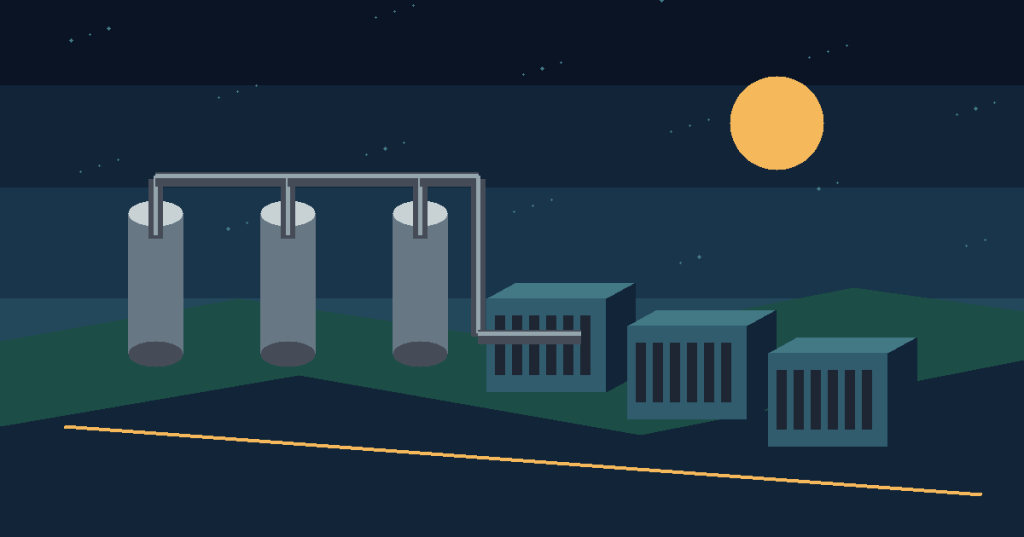
A natural gas processing plant in northwestern Saskatchewan could gain a second revenue stream through Bitcoin mining. Heartland Oil and Orion Power Solutions have proposed a 7 MW computing installation inside an existing industrial property in the Rural Municipality of Beaver River. The municipality published an open-house announcement on October 1, 2026, ahead of a consultation scheduled for October 15 in Pierceland.
The developers’ public project notice specifies locally sourced gas and dedicated electrical generation without a connection to SaskPower for mining electricity. The proposal concerns Bitcoin rather than artificial intelligence workloads. Data Center Dynamics reported the development on November 4. Neither a construction schedule nor commissioned computing capacity has been established in the reviewed evidence.
Converting gas into computing power
A gas engine converts fuel energy into mechanical work, turning an alternator to produce electricity. Switchgear, protection systems and distribution equipment then supply mining machines. On an isolated network, generator governors regulate frequency while voltage regulators respond to changing electrical demand. Operators must coordinate machine startup, staged load increases and generator maintenance without relying on a utility grid to balance the system.
If 7 MW represents the total facility draw, continuous operation would consume 61.32 GWh annually. Assuming 35% net electrical efficiency for illustrative gas generation, the corresponding fuel input would be 20 MW thermal at full output. Actual consumption depends on equipment efficiency, fuel composition, operating hours and the measurement boundary. The developers have not published generator ratings or measured fuel consumption.
What hashrate could the project support?
A hypothetical design allocating 90% of the electrical capacity to ASICs would provide 6.3 MW of mining power. At 20 joules per terahash, the machines could theoretically deliver 315 PH/s. At 15 J/TH, the same IT load could deliver 420 PH/s. Neither scenario represents an announced hardware purchase or observed hashrate. The remaining electrical capacity would support ventilation, networking and other facility requirements.
Existing infrastructure does not guarantee environmental savings
Heartland’s corporate operations profile describes an established gas production and pipeline network. Using existing industrial land may reduce additional land requirements. The project notice also says the mining computers would not require a water supply and promises noise assessments. Those are developer statements, not independently measured environmental outcomes.
Natural gas remains a fossil fuel. Whether onsite mining reduces emissions relative to another activity depends on what would otherwise happen to the gas, combustion efficiency and upstream methane leakage. The available project notice does not establish that the fuel would otherwise be flared or vented. Economic benefits and effects on nearby residents also require evidence beyond the proposed design.
The project adds a different energy pathway to recent coverage of hydropower-backed computing in Paraguay, MARA’s mining expansion, onsite fuel-cell generation and Indonesia’s geothermal computing proposal. The next milestones are permits, equipment procurement, construction and independently documented commissioning. Until then, seven megawatts remains proposed capacity.
We volunteer daily to ensure the credibility of the information on this platform is Verifiably True. If you would like to support to help further secure the integrity of our research initiative, please scan the QR code below.

BitcoinVersus.tech is not a financial advisor. This media platform reports on financial subjects purely for informational purposes.


Leave a Reply