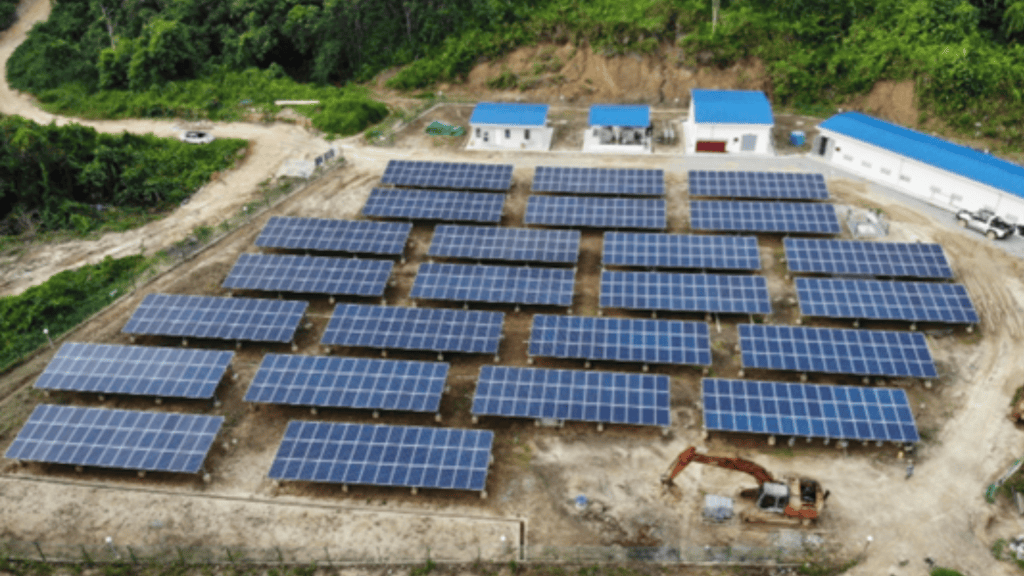
A proposed gigawatt-scale solar park in Malaysia has identified a data center developer as a potential electricity customer. On November 25, Helios Solar AG announced a non-binding memorandum of understanding with Galaxy Venus Data Center to assess renewable electricity supply for a planned computing facility in Perak.
The prospective supply would draw on Helios Solar Park in Gua Musang, Kelantan. The developer’s project profile specifies 1,000 MWp of photovoltaic capacity and 1,600 MWh of battery storage. Commercial operations are targeted around 2029, subject to development, financing and regulatory milestones. The memorandum establishes an evaluation process rather than a final power purchase agreement.
A gigawatt is not a constant gigawatt
Solar nameplate capacity describes peak DC module output under specified test conditions. It does not measure continuous generation or firm AC power delivered to a data center. Under an illustrative 18% annual capacity factor, 1,000 MW would produce approximately 1.58 TWh annually. Actual production would depend on weather, equipment configuration, losses and grid constraints.
A hypothetical 200 MW facility operating at full load throughout the year would consume 1.752 TWh. The comparison demonstrates why even a large solar project cannot be assumed to meet every hour of computing demand. The companies have not announced a binding allocation or confirmed data center load.
Battery storage and the night-time problem
A 1,600 MWh battery could theoretically deliver 200 MW for eight hours or 400 MW for four hours if its inverter rating and usable charge permit such discharge. The actual operating duration will be reduced by conversion losses, reserve requirements and state-of-charge limits. No battery power rating is established by the published energy capacity alone.
For high-density AI workloads, sustained availability matters alongside annual clean energy procurement. A workable design could involve grid imports, dedicated storage, dispatchable backup and workload scheduling. Those are engineering possibilities rather than confirmed commitments under the memorandum.
Land, transmission and regulatory constraints
According to Data Center Dynamics on November 27, the solar installation is planned across approximately 3,000 acres within a larger landholding. Helios also proposes conservation and tourism activities. The company plans to use Malaysia’s Corporate Renewable Energy Supply Scheme, although the eventual electricity contract and delivery arrangements remain under evaluation.
Galaxy Venus Data Center should not be confused with the US-based cryptocurrency and computing infrastructure company Galaxy Digital. The proposed Perak campus has not disclosed a confirmed accelerator count or commissioning date in the announcement.
The next milestones are a definitive electricity contract, grid connection arrangements, environmental approvals, battery power specifications and construction commencement. The proposal illustrates an important emerging relationship between renewable generation and computing demand without establishing that either facility is already operating.
Related coverage: Australian renewable compute · New Mexico solar storage · Solar Bitcoin mining · Power purchase agreements


Leave a Reply