
Keel Infrastructure, formerly Bitfarms, has expanded its contracted electricity supply at Baie-Comeau, Québec, from 22 to 30 megawatts (MW). The September 2026 amendment also permits the entire revised allocation to support general data-center applications, including artificial intelligence, according to the company’s November 5 quarterly SEC filing. The agreement adds 8 gross MW, a 36.4% increase in contracted capacity. It establishes a route toward AI and high-performance computing (HPC), rather than evidence of a commissioned GPU cluster.
A hydroelectric asset originally built for Bitcoin
The company’s predecessor began mining at Baie-Comeau in July 2023, initially drawing on a 3 MW deployment. The acquisition included a local utility agreement for 22 MW of hydroelectric power and an industrial property lease. Reusing equipment from another site reduced the need for new mining infrastructure, according to Bitfarms at the time.
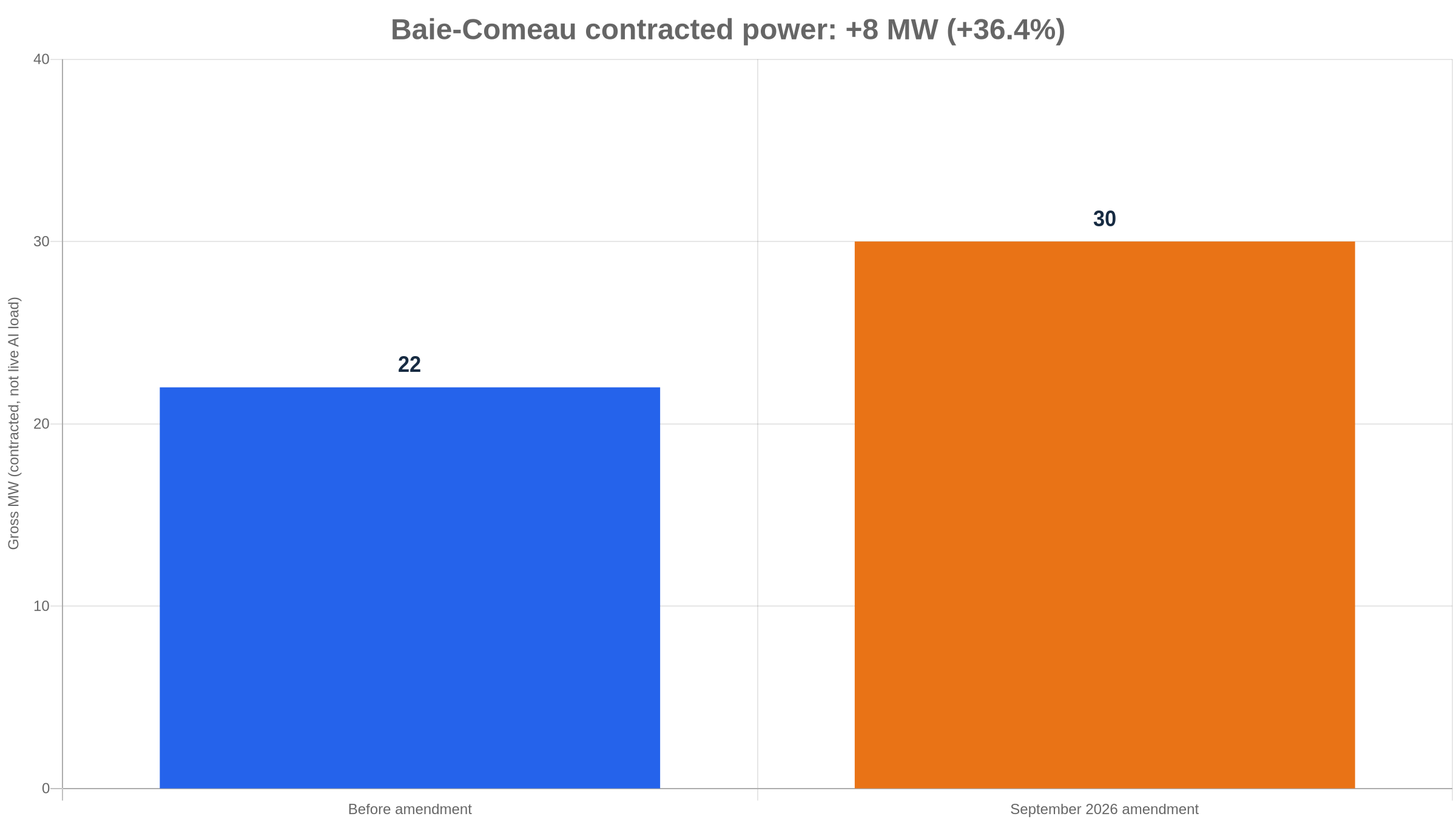
At continuous full contracted load, 30 MW corresponds to 720 MWh of daily electricity consumption, versus 528 MWh at 22 MW. The additional 8 MW could consume 192 MWh per day. These are theoretical energy quantities calculated by multiplying power by 24 hours, not meter readings. They exclude interruptions and do not establish electricity costs.
Converting power rights into advanced compute
A Bitcoin mine can distribute electrical power across independently operating SHA-256 ASICs. Large HPC installations instead require high-bandwidth networking, reliable power distribution and cooling designed for tightly coupled accelerator clusters. Backup systems and availability commitments can differ substantially. Contracted utility capacity is therefore only one input into the design of an AI data center.
For illustration, a 30 MW gross electrical budget at an assumed power usage effectiveness of 1.20 would support 25 MW of IT load, with the balance consumed by facility overhead. The assumed ratio is not a Keel specification. Actual accelerator count depends on server power, network equipment, rack architecture and cooling design.
Québec’s municipal electricity strategy
Independent reporting by Pivot on November 19 examines the role of municipal electricity distributors in Keel’s transition. The company plans to combine existing allocations at its 96 MW Sherbrooke project, separately from Baie-Comeau. Sherbrooke’s change of use remains subject to provincial review. Neither project should be represented as completed HPC capacity.
Keel’s transition is already affecting its mining business, as documented in our quarterly Bitcoin production and treasury report. Its Moses Lake conversion provides a separate example of physical construction progress. Hydroelectric infrastructure supporting both mining and advanced computing also appears in our Paraguay substation report.
The meaningful next milestones at Baie-Comeau are site-specific approvals, engineering plans, financing, construction and a documented customer agreement. Keel’s filing reports no revenue-producing HPC data center capacity in service at the reporting date. The amended power agreement strengthens the development opportunity without proving its commercial outcome.
We volunteer daily to ensure the credibility of the information on this platform is Verifiably True. If you would like to support to help further secure the integrity of our research initiative, please scan the QR code below.

For mobile scanning, open the article on another display and scan the QR code with a Bitcoin wallet. The voluntary donation amount is 5,000 sats. Verify the receiving address 3C9o19EH5HSiwEPyCTmEKzxhNCbo2X6TTb before sending.
BitcoinVersus.tech is not a financial advisor. This media platform reports on financial subjects purely for informational purposes.


Leave a Reply