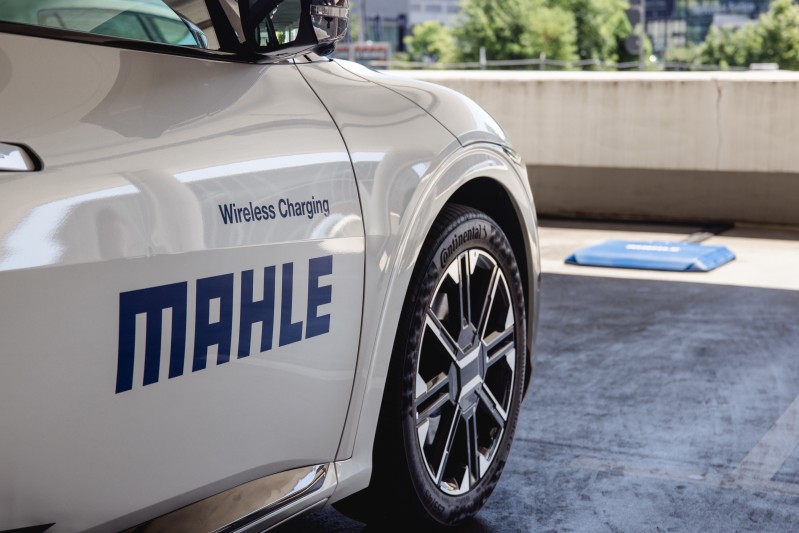
Automotive supplier MAHLE announced an automated parking and wireless electric-vehicle charging pilot on November 26, 2026. The German company is combining two engineering functions normally treated separately: positioning a vehicle in a parking space and transferring electrical energy into its battery. According to MAHLE’s announcement, engineers are evaluating the underlying charging technology with BMW using an iX3. Unlike the robotic connector deployed in BYD’s Abu Dhabi charging concept, the MAHLE approach eliminates physical insertion of a charging cable.
Why accurate parking matters
Inductive charging relies on magnetic coupling between a transmitting coil on the ground and a receiving coil on the vehicle. Alternating current in the transmitter creates a changing magnetic field, which induces voltage in the receiver. Power electronics then condition the received energy for the vehicle’s battery system. For background, our onboard charger explanation describes the distinction between power conversion and the battery itself.
Coil separation and lateral displacement affect coupling. A vehicle may fit inside a painted parking space without being positioned optimally for energy transfer. MAHLE combines camera-based parking-space recognition with inductive positioning feedback to guide the vehicle toward the ground pad. The parking algorithm and the energy-transfer controller therefore solve complementary problems.
Charging power and efficiency
MAHLE specifies charging power up to 11 kW and reports efficiency above 92% under vehicle test conditions. The announcement does not fully define the measurement boundary or provide independent test results across alignment, temperature and battery state. Consequently, the rating should not be interpreted as guaranteed utility-meter-to-battery efficiency.
Stationary charging differs from transferring electricity to moving vehicles, as explored in our reporting on Honda’s dynamic wireless charging road. A parked vehicle allows a more predictable geometry between coils. Dynamic systems must additionally manage changing coupling as vehicles travel between energized road sections.
From a prototype to fleet infrastructure
The Stuttgart test facility is designed to evaluate future charging systems at power levels up to 30 kW. That facility rating must remain separate from the pilot’s vehicle charging specification. Engineers can use the facility to investigate electromagnetic exposure, foreign-object detection, receiver integration and shielding.
For fleets, automated charging could reduce dependence on employees connecting and disconnecting cables. The practical benefits would depend on vehicle utilization, charger availability, parking accuracy, maintenance and electricity tariffs. The same operational questions arise in driverless taxi deployment, where vehicle uptime depends on infrastructure as well as driving software.
MAHLE also describes support for bidirectional energy transfer. Turning that capability into a grid service requires compatible vehicles, electrical protection, metering, communications and approval from the relevant electricity provider. Our analysis of Volkswagen’s vehicle-to-grid program illustrates the commercial distinction between a technically capable vehicle and an available grid participation program.
Electrive reported on November 27 that a production introduction timetable had not been provided. Future evidence should include independently documented efficiency, interoperability, operating reliability and a confirmed commercial launch. The development is an engineering validation milestone, not an established public charging network.
We volunteer daily to ensure the credibility of the information on this platform is Verifiably True. If you would like to support to help further secure the integrity of our research initiative, please scan the QR code below.


Leave a Reply