A small power plant with substantial civil engineering
Locus Energy announced on November 26, 2026, that its Trongstadlia hydropower facility in Åfjord, Norway, had been completed and commissioned in October. Located on the Amundalselva river, the project has an installed capacity of 5 MW and an expected annual output of about 13.4 GWh. Much of the roughly 1.2 km route connecting its water intake and generating equipment runs through a rock tunnel.
Featured cover: conceptual editorial illustration, not a photograph of the named project. Documentary and contextual images are identified in their captions.
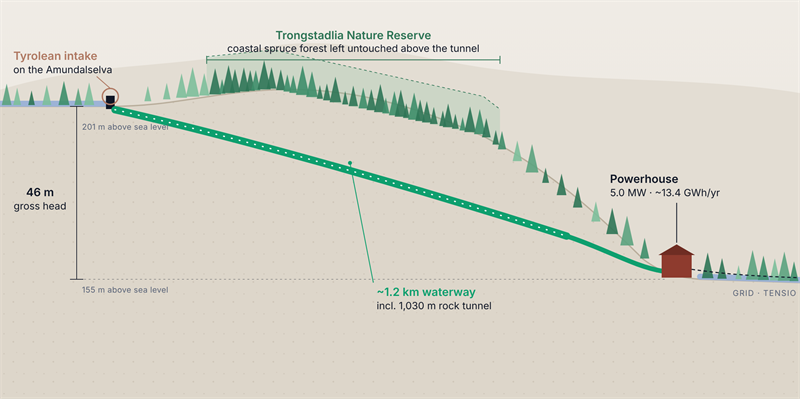
Operator-published AI-generated schematic of Trongstadlia; not to scale. Credit: Locus Energy.
Using elevation to generate power
The operator describes an intake elevation of 201 meters and a powerhouse elevation of 155 meters, giving a gross head of 46 meters. The maximum flow through the generating equipment is reported as 12.6 cubic meters per second. Hydroelectric power depends on water density, gravitational acceleration, flow and effective head. A turbine converts the water’s hydraulic energy into mechanical shaft power, and a generator converts that motion into electricity.
Checking the power figures
Using water density of approximately 1,000 kilograms per cubic meter and gravitational acceleration of 9.81 meters per second squared, the gross hydraulic power associated with 12.6 cubic meters per second and 46 meters of head is approximately 5.69 MW. Comparing the reported 5 MW installed electrical capacity with that theoretical figure gives a ratio near 88%. It is a simplified consistency check, not measured turbine efficiency: friction, net head, equipment ratings and operating conditions affect the real result.
Annual energy and water availability
The forecast 13.4 GWh annual generation corresponds to roughly 1.53 MW of average output over a 365-day year, or an implied capacity factor of 30.6%. Annual water availability determines how frequently a river-based hydroelectric system can operate near rated capacity. Seasonal precipitation, snowmelt and concession conditions may create considerable differences between peak output and average production. Underground waterways must also be designed for pressure changes, maintenance and safe operation.
River protection and operational evidence
The operator reports a required minimum bypass flow of 390 liters per second throughout the year under its concession. Maintaining water in the river is an environmental constraint as well as an input to the generation calculation. The plant’s projected annual electricity output should be compared with operating records after a complete hydrological cycle. Reliable evaluation would include measured water flow, electrical output, downtime and compliance with environmental conditions. The project demonstrates how even modest electrical capacity can require substantial underground civil works and precise hydraulic engineering.
Head losses are important when designing a waterway of substantial length. Friction along a tunnel or pipe reduces the pressure available at the turbine, with losses depending on flow, cross-sectional area and surface roughness. Intake restrictions and changes in direction add further losses. Measuring net head during operation would give a better basis for calculating equipment efficiency than subtracting the published elevations alone.
Sources and further reading
Fervo’s geothermal transmission rights | China’s 60 MW liquid-air battery | U.S. electricity generation mix | Utah’s 600 MWh battery
We volunteer daily to ensure the credibility of the information on this platform is Verifiably True. If you would like to support to help further secure the integrity of our research initiative, please scan the QR code below.

For mobile scanning, open the article on another display and scan the QR code with a Bitcoin wallet. The voluntary donation amount is 5,000 sats. Verify the receiving address 3C9o19EH5HSiwEPyCTmEKzxhNCbo2X6TTb before sending.
BitcoinVersus.tech is not a financial advisor. This media platform reports on financial subjects purely for informational purposes.


Leave a Reply