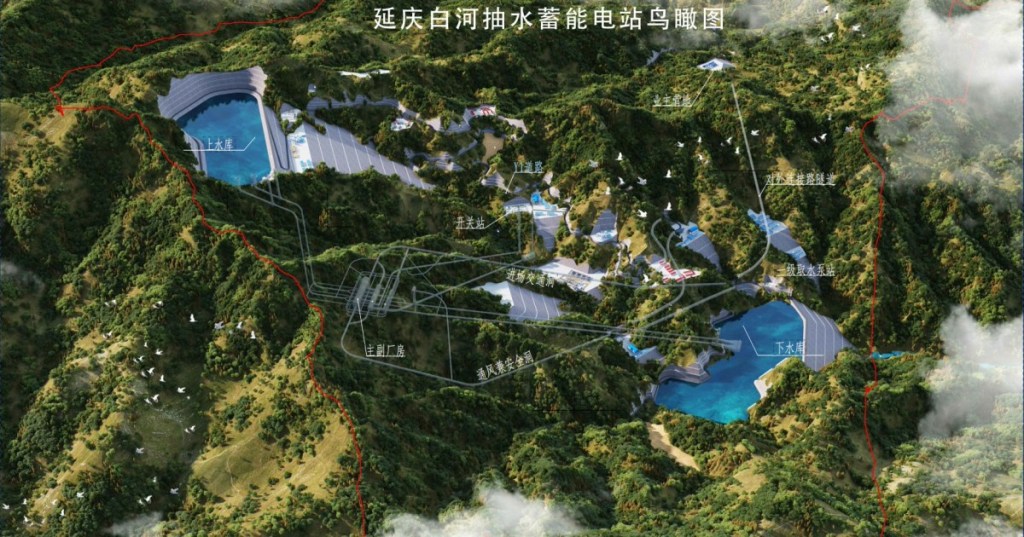
Beijing has approved a 1,000 MW pumped-storage hydroelectric development in the city’s mountainous Yanqing district. The municipal government announced the Baihe project on November 3, 2026, following an October approval by the city’s development and reform commission. Four reversible 250 MW generating units will support electricity storage and grid balancing. Unlike conventional hydroelectric developments such as the Solomon Islands’ Tina River project, pumped storage primarily shifts electricity between periods of differing demand.
A 5.5 GWh hydraulic energy store
The formal project approval specifies 5.5 hours of continuous full-power generation. Multiplying the 1 GW generating rating by the specified duration yields 5.5 GWh of indicative deliverable electrical energy per full discharge. The calculation describes design capability rather than a measured operating result. At a constant 1 GW output, the remaining deliverable energy decreases by 1 GWh per hour.
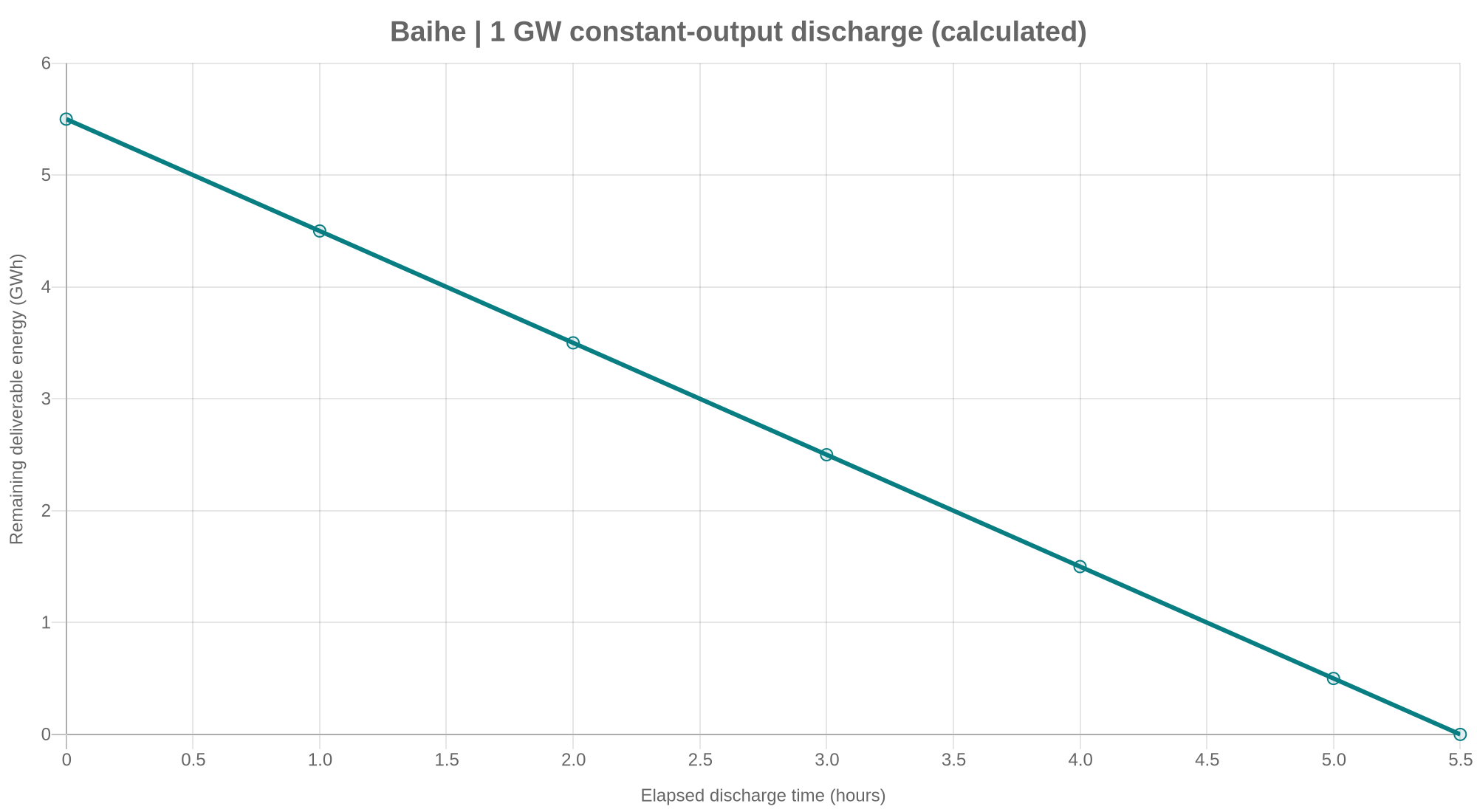
A line chart is appropriate because elapsed time and remaining energy are continuous quantities under the specified constant-output assumption. Its slope represents the rate of discharge. Actual operation can vary with reservoir levels, hydraulic conditions, auxiliary demand and dispatch instructions. The duration calculation follows the same power-versus-energy distinction explained in our coverage of China’s Golmud liquid-air storage facility.
Moving water to store electricity
The development comprises two reservoirs at different elevations, connecting water passages, an underground generating station and a surface switchyard. During charging, electrically driven pumps move water toward the upper reservoir. During generation, gravity drives water downward through the turbines. Reversible pump-turbines allow the same hydraulic machinery to perform both functions, subject to the equipment’s operating limits.
Pumping consumes more electrical energy than subsequent generation returns because hydraulic, electrical and mechanical losses occur during both stages. The published approval does not establish a project-specific round-trip efficiency, so charging energy and lifetime storage economics cannot yet be calculated precisely. The underlying storage principle differs from the electrochemical approach planned at Germany’s Gaggenau zinc-bromide installation.
Capital investment and construction schedule
The commission estimates total investment at 8.69 billion yuan, including 20 million yuan in working capital. The planned capital contribution is approximately 1.74 billion yuan. Relative to the announced 5.5 GWh discharge capability, total investment represents about 1,580 yuan per kWh of rated deliverable energy. The ratio is a design-stage capital metric, not an electricity price or levelized storage cost. Construction is scheduled to start in 2027, with a stated 66-month construction period and commissioning targeted for 2033.
Grid resilience and industrial demand
The project’s engineering designer identifies frequency regulation, reserve and black-start capability among the planned functions. Such services complement variable renewable procurement, including agreements like Sabey’s Texas solar contract. Baihe has no announced dedicated computing customer. Its importance lies in the planned ability to move large volumes of energy across several hours while strengthening the wider grid. Commercial operation remains a future milestone.
Featured rendering: Beijing Energy Group, supplied to Beijing Daily on November 1, 2026. Proposed facilities, not completed construction.
We volunteer daily to ensure the credibility of the information on this platform is Verifiably True. If you would like to support to help further secure the integrity of our research initiative, please scan the QR code below.

For mobile scanning, open the article on another display and scan the QR code with a Bitcoin wallet. The voluntary donation amount is 5,000 sats. Verify the receiving address 3C9o19EH5HSiwEPyCTmEKzxhNCbo2X6TTb before sending.
BitcoinVersus.tech is not a financial advisor. This media platform reports on financial subjects purely for informational purposes.


Leave a Reply