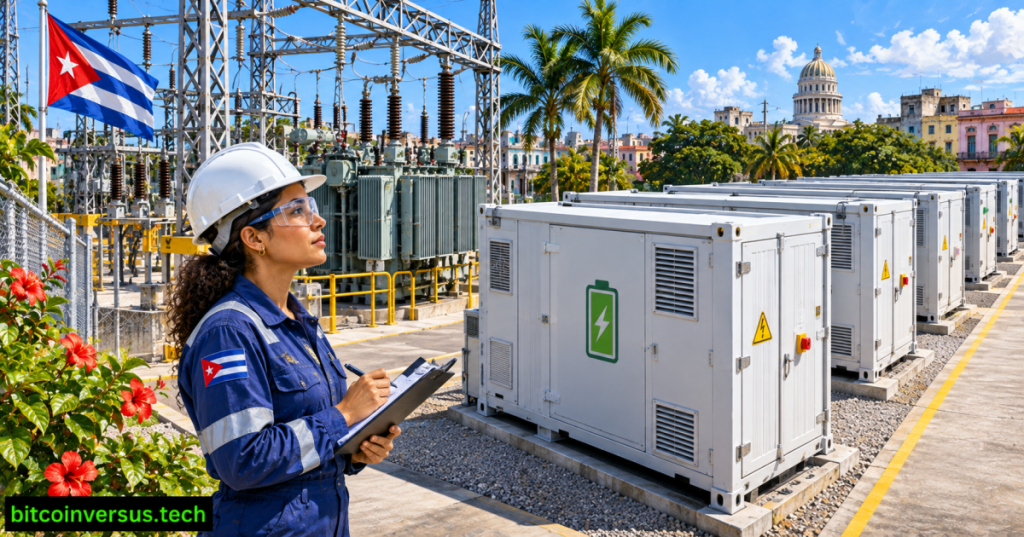
Cuba inaugurated the Habana 220 battery energy storage system on November 26, 2026, near the Technological University of Havana. The installation adds 50 MW of rated power to a national grid facing generation shortages and stability challenges. According to pv magazine’s November 27 report, the facility incorporates grid-forming technology and was developed with Chinese cooperation. Its deployment highlights a different engineering requirement from the solar resource assessment in the Republic of the Congo: balancing electricity generation against demand in real time.
Power capacity is not energy capacity
Habana 220 is the second installation in a four-site program. Each site has a reported nominal rating of 50 MW and 50 MWh. The first facility, at El Cotorro, entered operation in July. The remaining projects at Cueto and Bayamo are at different development stages. The four installations would provide a combined nominal 200 MW and 200 MWh if completed to the reported specifications.
A megawatt measures the rate of energy transfer; a megawatt-hour measures a quantity of energy. At rated discharge power, a fully charged 50 MWh battery could theoretically supply 50 MW for one hour. At 25 MW, the same nominal energy would last two hours. Actual duration depends on usable state of charge, conversion losses, thermal limits and operating reserves. A battery cannot compensate indefinitely for a persistent shortage of generation. Similar distinctions between rated energy and practical service appear in our analysis of distributed solar and storage economics in Colombia.
Grid-forming inverters and system stability
Conventional grid-following inverters synchronize their output with an existing alternating-current waveform. Grid-forming controls can establish a local voltage waveform and help regulate frequency in suitable operating conditions. They may support restoration after a widespread outage, provided the equipment, protection scheme, auxiliary power and network restoration plan are designed for that purpose. A grid-forming capability alone does not establish that a national black-start procedure has been successfully demonstrated.
Original research identifies longer-duration storage opportunities
A separate peer-reviewed August 2026 study by Leonardo Peña-Pupo and colleagues, including a researcher at the University of Oriente in Santiago de Cuba, applied the Australian National University Global Pumped Hydro Atlas to Cuba. Their geospatial screening identified 92 candidate closed-loop pumped-storage sites. These are prospective locations, not financed projects or confirmed economically recoverable storage capacity.
Pumped storage uses electricity to move water to an elevated reservoir. When generation is needed, water descends through turbines. Stored gravitational energy depends on water mass, gravitational acceleration and elevation difference. Hydraulic losses and equipment efficiency reduce the energy recovered. Terrain-based screening helps identify candidate locations, but detailed geological and hydrological investigation remains essential, as in Comoros geothermal exploration.
Fast battery response and longer-duration pumped storage could serve complementary roles. Neither technology creates net energy. Cuba would still need dependable generation, transmission maintenance, adequate financing and robust control systems. The country’s new battery installation is a tangible infrastructure milestone, whereas the pumped-storage research remains a planning resource. As with hydrological modeling in Côte d’Ivoire, site-level validation is the next step between numerical screening and construction.
Sources: pv magazine; Xinhua, November 28; Pumped Hydro Energy Storage Potential and Grid-Integration Feasibility for the Cuban Power System, Energies 19(16), 3857. Featured image: generated conceptual illustration, not documentary photography.


Leave a Reply