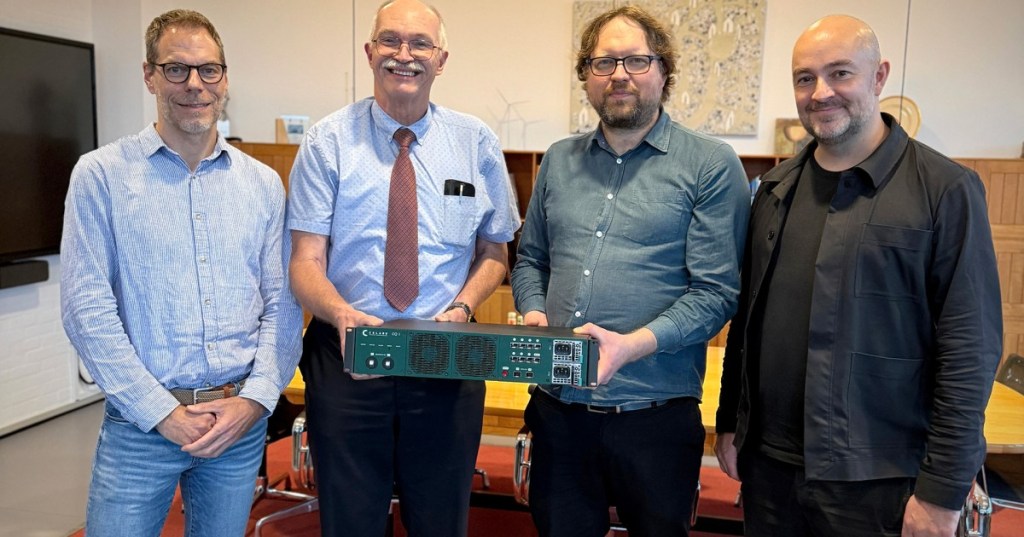
The Technical University of Denmark (DTU) announced on November 16, 2026, that quantum technology developed at the university has progressed into commercial products used in the country’s largest quantum-secured network to date. According to the university announcement, the network connects ten locations, including four government ministries, using equipment from Celare Quantum Communications. The deployment represents another approach to protecting critical network traffic alongside post-quantum key management.
Generating randomness and distributing keys
DTU spin-out Alea Quantum Technologies has acquired the patent for its quantum random number generator technology from the university. The device extracts randomness from measurements of light. Random numbers serve as inputs to cryptographic key generation, but an operational generator must also account for detector imperfections, electronic noise and entropy estimation. Celare, a separate DTU spin-out, develops quantum key distribution equipment.
Continuous-variable quantum key distribution (CV-QKD) encodes information in measurable properties of an optical field, such as its amplitude and phase quadratures. The sender and receiver compare selected information over an authenticated classical channel, estimate transmission noise and perform reconciliation and privacy amplification to derive shared secret keys under a defined security model. The quantum channel distributes key material rather than carrying all protected application data. Readers can review the underlying physics in our quantum computing guide.
Original research: quantum signals alongside 100 Gbps traffic
In their 2024 Optics Express field-trial paper, Nitin Jain and colleagues evaluated optical connections at DTU’s Lyngby campus and between Energinet electricity network nodes in Odense. They combined quantum signals near 1550 nm with commercial encrypted data traffic near 1300 nm on shared optical infrastructure. The classical encryption equipment supported 100 Gbps traffic. That line rate must not be confused with quantum secret-key throughput.
| Optical loss at 1550 nm | Estimated mean secret-key rate |
|---|---|
| 4.1 dB | 434.8 kbps |
| 5.5 dB | 148.6 kbps |
| 6.7 dB | 78.3 kbps |
Higher optical loss generally reduces the usable signal relative to noise, constraining the secret-key rate. The trials used existing underground fiber and optical ground-wire infrastructure. Similar integration challenges arise in Germany’s QuNET research.
Deployment is not a guarantee of absolute security
The NATO DIANA deployment announcement independently documents adoption at Denmark’s Ministry of Defence. The November university report does not disclose the installed network’s secret-key rates, exact link losses or independent security-audit results. Those parameters cannot be inferred directly from the earlier field experiment.
Quantum key distribution can complement post-quantum cryptography rather than replace every cryptographic function. Authentication, endpoint integrity, key management and implementation security remain necessary. Hybrid approaches are also explored in international quantum-safe network demonstrations. Celare co-founder Tobias Gehring discusses the transition from research prototypes to products in a Quantum Secure Networks Partnership interview. Denmark’s deployment offers a practical test of integrating quantum-derived keys into existing infrastructure without treating laboratory performance as a guarantee for production systems.
Featured photograph: actual DTU and Celare quantum key distribution equipment, photographed by Uffe Frandsen and published by DTU on November 16, 2026; cropped for publication.


Leave a Reply