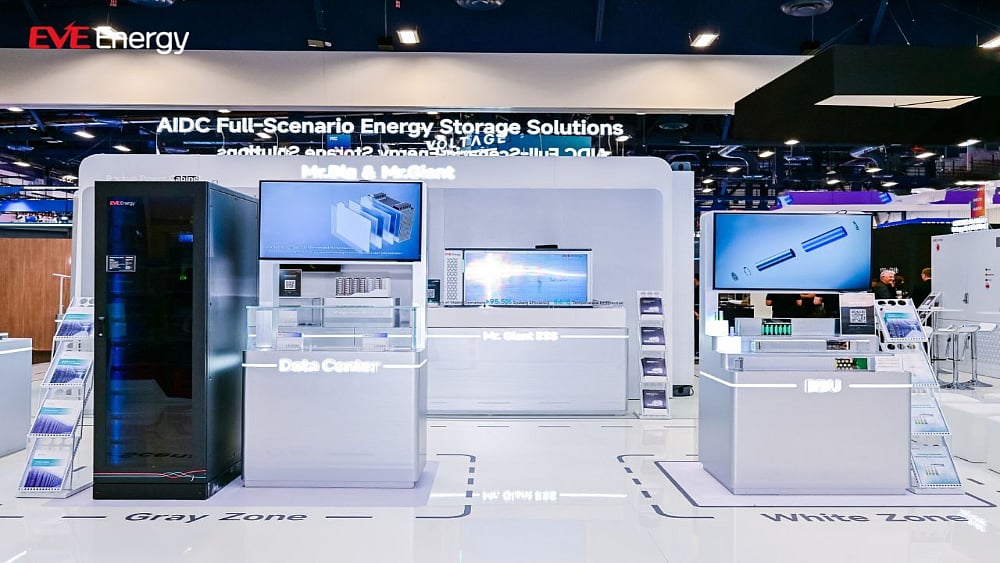
EVE Energy introduced an electricity-storage portfolio for artificial intelligence data centers at RE+ 2026 in Las Vegas, targeting the different power requirements of grid connections, electrical distribution equipment and server racks. Its November 26 announcement describes a 5 MWh container, a high-power backup cabinet and a rack-level battery-capacitor system. The portfolio extends the storage applications discussed in our coverage of Utah’s operating Faraday battery into the internal power architecture of computing facilities. EVE announced products, not a commissioned data center.
Grid-scale energy management
The containerized system is specified at 5 MWh and 1P, a power-to-energy ratio corresponding nominally to one hour of full-capacity discharge. A nominal 5 MW output follows from that ratio, although usable AC energy and sustained output depend on system limits. EVE reports system efficiency of 93.6% and a 20,000-equivalent-cycle figure for frequency-regulation applications. The announcement does not establish a universal round-trip efficiency or cycle-life guarantee across all operating profiles. Grid storage can manage peaks and provide frequency services, as can the hydraulic storage planned at Beijing’s Baihe development, although the two technologies have different operating characteristics.
Five-minute backup at the distribution layer
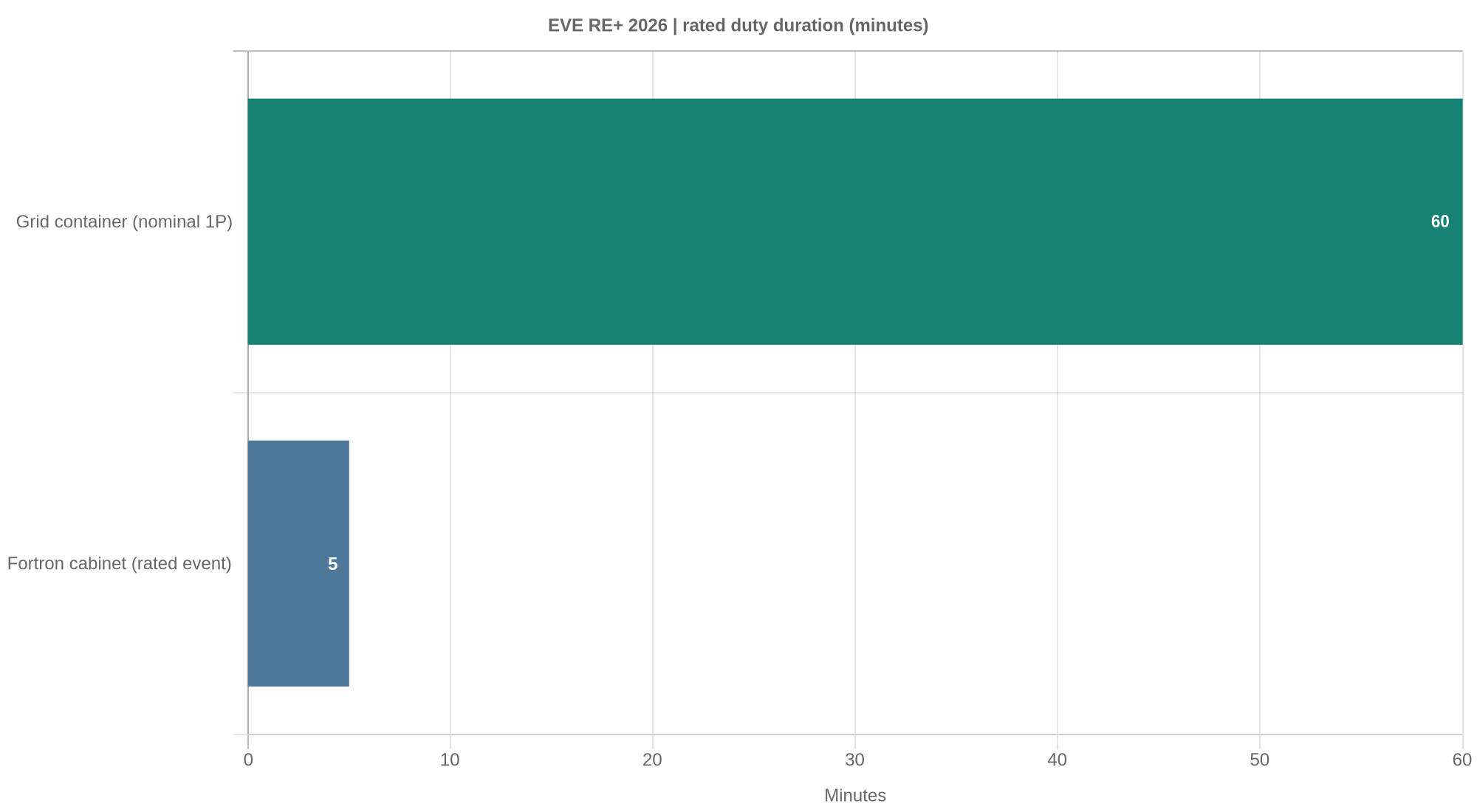
The Fortron cabinet is rated to deliver 660 kW for five minutes, according to EVE and TaiyangNews’ November 27 report. Multiplying the specified power by one-twelfth of an hour gives 55 kWh of energy delivered during the rated event. The result is not necessarily the cabinet’s total stored energy. The chart compares nominal duration at the container’s rated ratio with the cabinet’s specified event duration, rather than representing equivalent backup guarantees.
The cabinet is intended for UPS and high-voltage direct-current distribution. Its electrical protection, thermal isolation and fire-suppression systems must be evaluated with the complete facility architecture. The engineering questions differ from those facing the stationary zinc-bromide system proposed at Germany’s Gaggenau installation.
Rack-level response to fast load changes
EVE combines a lithium iron phosphate battery backup unit with a capacitor backup unit at rack level. The company specifies a 1-millisecond to 10-second load-smoothing window and backup transfer below 2 milliseconds. Those response and smoothing specifications do not describe full-power runtime. Capacitors can respond quickly to short demand changes, while batteries provide energy over longer intervals. Coordinating both devices requires control systems that avoid destabilizing the upstream power converters.
Storage does not replace sustained generation. A campus still needs adequate electricity supply, as the planned Homer City AI power development illustrates. EVE’s layered architecture is an attempt to address different time scales of electrical demand, from grid dispatch to rapid rack-level transients. Independent duty-cycle testing, integration validation and actual customer deployments remain necessary to establish performance under realistic computing workloads.
Featured photograph: EVE Energy, via TaiyangNews, November 27, 2026.
We volunteer daily to ensure the credibility of the information on this platform is Verifiably True. If you would like to support to help further secure the integrity of our research initiative, please scan the QR code below.

For mobile scanning, open the article on another display and scan the QR code with a Bitcoin wallet. The voluntary donation amount is 5,000 sats. Verify the receiving address 3C9o19EH5HSiwEPyCTmEKzxhNCbo2X6TTb before sending.
BitcoinVersus.tech is not a financial advisor. This media platform reports on financial subjects purely for informational purposes.


Leave a Reply