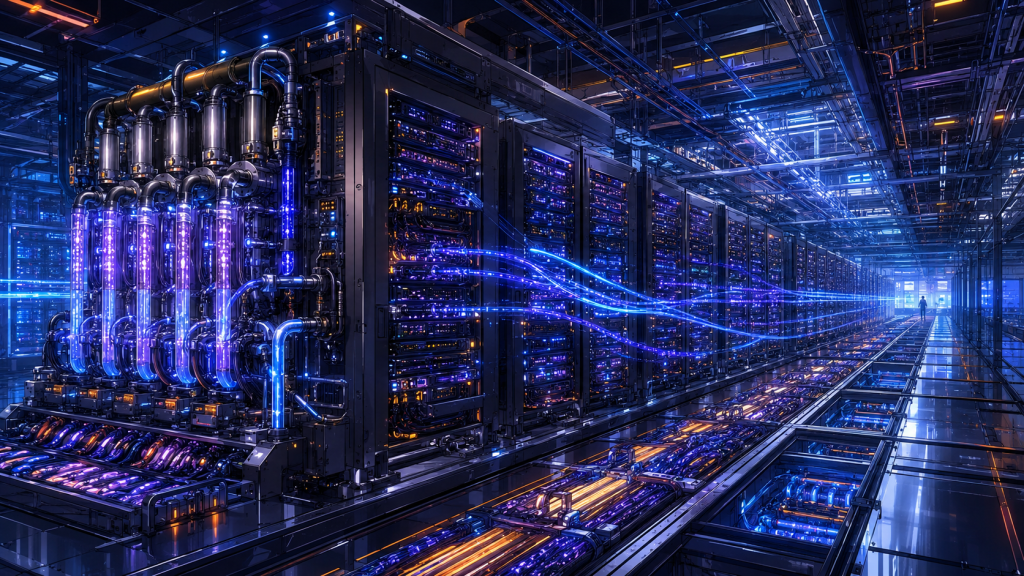
Getting an answer from ChatGPT after you ask it a question takes about 2 seconds, but the answer depends on a large physical infrastructure system operating behind the screen.
In Leo Cui’s video, The Entire AI Data Center Explained — From Electricity to ChatGPT, he follows a request through what he describes as an “AI token factory,” connecting the digital response to the power systems, processors, cooling equipment, memory, storage, networking hardware, and software required to produce it.
The process begins when a user’s request travels through internet and fiber-optic networks to the computing infrastructure running the AI model.
The text is divided into smaller units called tokens, which are converted into numerical inputs the model can process.
During inference, GPUs perform mathematical operations using the model’s trained parameters and generate the response one token at a time until the answer is complete.
This workload requires more than powerful processors. CPUs coordinate general system tasks, GPUs handle highly parallel AI calculations, high-bandwidth memory keeps model data close to the processors, and high-speed networking allows thousands of accelerators to operate together as a larger computing system.
Storage platforms hold datasets and model files, while software manages workload scheduling, communication, security, resource allocation, and model execution. NVIDIA describes modern AI factories as integrated systems combining energy, chips, infrastructure, models, and applications to optimize token production.
Electricity and heat removal are becoming two of the industry’s largest constraints.
The International Energy Agency reports that hyperscale AI facilities can require more than 100 megawatts of power, comparable to the electricity consumption associated with approximately 100,000 households. As processors become denser and more powerful, advanced rack-scale platforms increasingly use direct liquid cooling because traditional air cooling may not remove heat efficiently enough from high-density GPUs, CPUs, memory, and networking components.
Cui’s scaling-law analysis also closely aligns with the power-efficiency models we have developed around intelligence per watt, tokens per kilowatt-hour, and useful compute per unit of energy.
Traditional scaling laws suggest that larger models and greater compute can improve AI performance, but the infrastructure analysis shows that raw scale alone is no longer enough; the industry must produce more useful intelligence from each watt, GPU, and dollar invested.
In both models, the long-term winners will not simply operate the largest clusters, but will improve the ratio between energy consumed and valuable AI output produced.
Cui’s analysis also follows the money moving through the AI infrastructure supply chain. Semiconductor designers such as NVIDIA, AMD, Broadcom, and Marvell supply critical computing and networking technology.
Micron, SK hynix, and Samsung manufacture memory; Arista Networks, Astera Labs, Coherent, Lumentum, and Corning support data movement and optical connectivity; while Vertiv, Eaton, Schneider Electric, utilities, and power producers supply the electrical and cooling foundation. Hyperscalers, AI laboratories, and specialized neocloud providers then purchase or lease this infrastructure to train models and deliver inference services.
The central takeaway is that generative AI is not simply a software product operating somewhere in “the cloud.” Every answer is supported by a physical production chain involving power generation, substations, transformers, fiber optics, cooling plants, semiconductor manufacturing, server assembly, networking, storage, and software.
The investment opportunity may therefore extend beyond the companies building AI models, but the risks are also substantial: electricity shortages, construction delays, rapidly changing hardware, high capital costs, uncertain utilization, and falling token prices could determine which companies ultimately benefit from the infrastructure boom.
BitcoinVersus.Tech Editor’s Note:
We volunteer daily to ensure the credibility of the information on this platform is Verifiably True. If you would like to support to help further secure the integrity of our research initiatives, please donate here: 3C9o19EH5HSiwEPyCTmEKzxhNCbo2X6TTb
BitcoinVersus.tech is not a financial advisor. This media platform reports on financial subjects purely for informational purposes.


Leave a Reply