Apple’s newest Mac Studio is turning Thunderbolt 5 into something more ambitious than a peripheral connection: a fabric for distributed local AI.
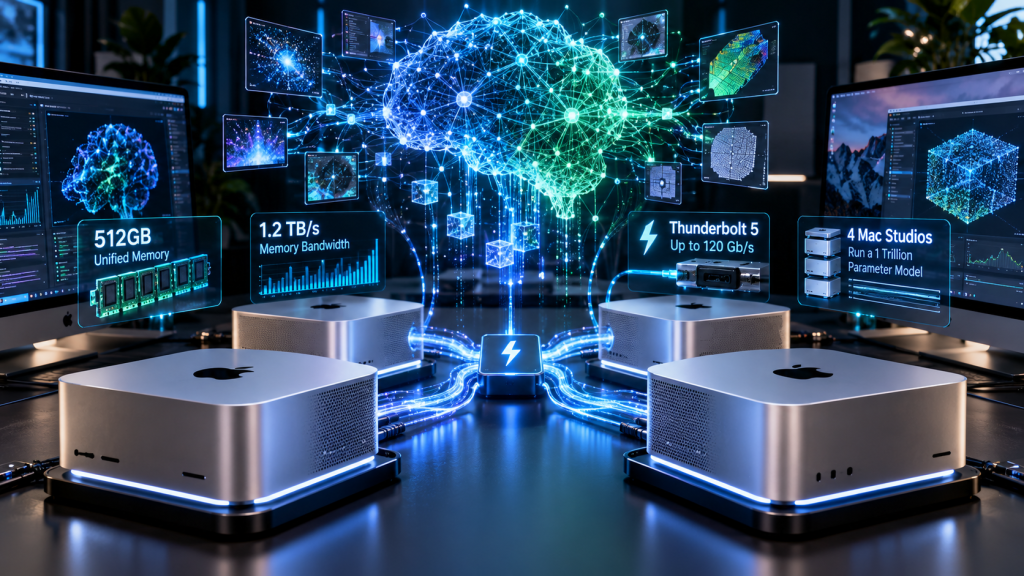
The M5 Ultra Mac Studio, now shipping after its August announcement, supports up to 512GB of unified memory, 1.2TB/s of memory bandwidth and Thunderbolt 5 connectivity up to 120Gb/s. Apple says Remote Direct Memory Access, or RDMA, allows multiple Mac Studio systems to be clustered for distributed AI inference. In its developer demonstrations, four Macs were linked to run a one-trillion-parameter model.
BitcoinVersus.Tech original illustration: four Mac Studio systems linked for distributed local AI, reflecting Apple’s demonstration of a trillion-parameter model across a four-Mac cluster.
Four Desktops Become One AI Cluster
The company says the M5 Ultra configuration reaches a 36-core CPU and up to an 80-core GPU, with Neural Accelerators in every GPU core. The important infrastructure detail is memory: a single system can be configured with half a terabyte of unified memory, letting large models stay close to the compute rather than repeatedly moving weights across conventional discrete GPU memory boundaries.
Developer Alex Ziskind demonstrated the idea directly by wiring four Mac Studios together and loading a trillion-parameter LLM. The video below is an English-language direct YouTube watch page from a verified channel with more than 500,000 followers.
Alex Ziskind demonstrates a four-Mac distributed MLX setup running a trillion-parameter model locally.
The development fits a wider shift BitcoinVersus.tech has been following. Positron is attacking inference through memory-first silicon, while Delos Data is targeting the interconnect bottleneck. Apple is taking a third route: use high-capacity unified memory and a short-reach RDMA fabric to turn compact desktops into a small distributed inference system.
Why 1.2 TB/s Memory Bandwidth Matters
Large-model inference is often limited by how rapidly model weights can be supplied to processors. That is why AI memory investment and CXL memory expansion have become as important to infrastructure planning as raw accelerator FLOPS.
Apple’s unified-memory architecture puts CPU, GPU and Neural Engine workloads in the same memory pool. Four high-memory Mac Studios do not magically become one giant monolithic chip—the model still has to be partitioned and communication overhead still exists—but MLX supports tensor and pipeline parallelism to divide inference across machines.
Apple demonstrated the software stack at WWDC26, including a one-trillion-parameter Kimi model distributed across four Macs. The engineering session also covers Python, Swift and C++ APIs, RDMA over Thunderbolt and distributed fine-tuning.
Yahoo Finance separately examined why the Mac mini and Mac Studio are increasingly being treated as personal AI workstations rather than conventional desktops.
Yahoo Finance examines the rise of Apple desktops as local AI workstations and the economics behind running agentic workloads outside the cloud.
Thunderbolt Becomes a Compute Interconnect
The architecture remains very different from hyperscale Ethernet or InfiniBand. Thunderbolt 5 is a short-reach copper interconnect here, not a replacement for the optical fabrics linking thousands of accelerators across a data center. BitcoinVersus.tech has separately covered 1.6T-to-6.4T optical networking and 136 Tbps distributed GPU fabrics.
Reuters reported September 22 that Apple is positioning the new Macs as a way for businesses and developers to lower recurring cloud-AI costs. That report also highlighted Apple’s four-Mac trillion-parameter demonstration and its emphasis on power efficiency.
The practical takeaway: this is not a data-center replacement. It is a new middle tier between a single workstation and a rack-scale accelerator cluster—compact, local, high-memory compute connected through a very short-reach high-speed fabric.
BitcoinVersus.Tech
Advertisement: Use promo code bitcoinversus at checkout to get 5% off participating Bitaxe mining products.
BitcoinVersus.Tech advertisement: participating Bitaxe mining products using promo code bitcoinversus.
BitcoinVersus.Tech Editor’s Note & Disclaimer:
We volunteer daily to ensure the credibility of the information on this platform is Verifiably True. BitcoinVersus.tech provides news, technical analysis and educational information and does not provide financial or investment advice. Manufacturer performance claims should be independently verified before purchasing or deploying hardware. If you would like to support to help further secure the integrity of our research initiatives, please donate here: 3C9o19EH5HSiwEPyCTmEKzxhNCbo2X6TTb


Leave a Reply