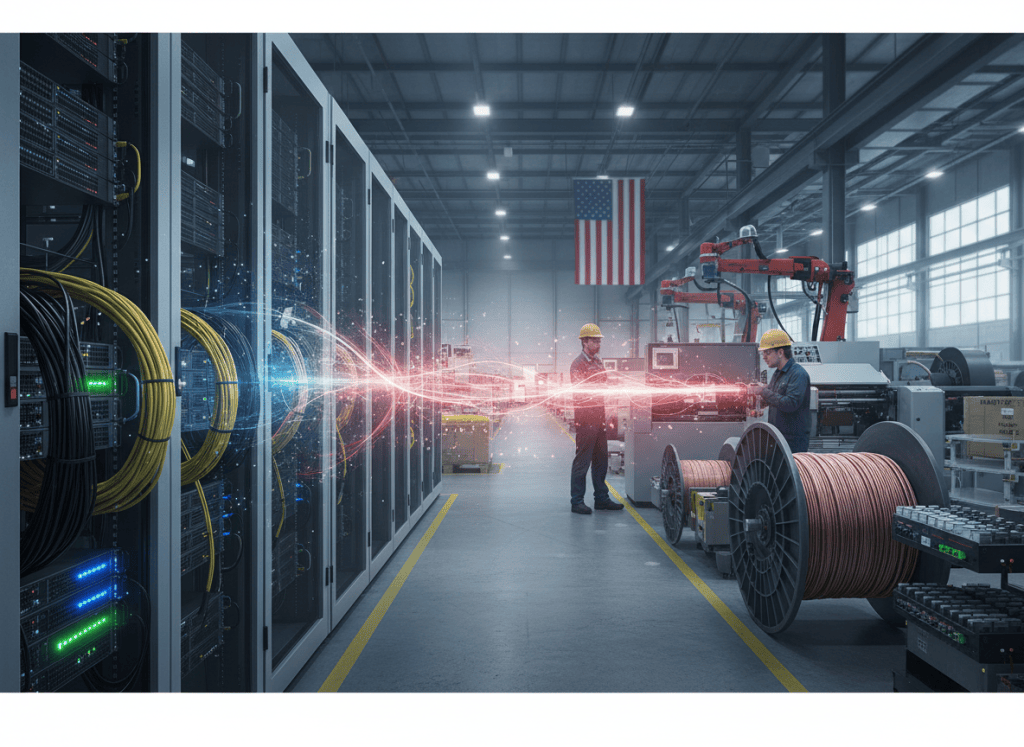
Leviton is committing $100 million over five years to expand manufacturing capacity for the physical networking systems that increasingly sit underneath AI clusters, data centers and smart buildings.
The company announced the program on September 24, saying the capital will go into its Network Solutions factories worldwide, with the largest investments at key U.S. factories. The plan expands production of Category 6A cabling, connectors, fiber-optic cabling and fiber connectivity. Independent coverage also tied the spending directly to rising data-center demand.
The AI Buildout Has a Layer-One Bottleneck
The headline number matters, but the stronger signal is where the money is going. AI infrastructure discussions often begin with accelerators, power and cooling. Those systems still depend on the physical network. As 1.6T Ethernet moves toward deployment, operators need denser fiber, reliable patching, structured cabling and manufacturing capacity capable of supplying projects on data-center construction schedules.
Leviton says the investment follows an earlier $80 million capital program completed in 2025. That program expanded global production and doubled the size of its Fuquay-Varina, North Carolina facility. The new program runs from 2026 through 2030 and covers both copper and fiber systems.
Fiber Density Is Rising With Compute Density
The change is visible elsewhere in the supply chain. BitcoinVersus.tech recently reported on 2,304-fiber systems packed into 2RU, 200G-per-lane optical connectivity and 3.2T-class AI networking technology. These developments point toward the same constraint: more compute per rack creates more pressure on the links connecting racks, switches and clusters.
Leviton’s Category 6A expansion addresses a different but still important part of that physical layer. Cat 6A supports 10 Gigabit Ethernet at frequencies up to 500 MHz and remains relevant across enterprise networks, smart buildings and portions of data-center infrastructure. Fiber becomes increasingly important as bandwidth, reach and port density rise.
Manufacturing Capacity Is Becoming Infrastructure
AI data centers cannot be deployed from semiconductor roadmaps alone. The construction stack includes switchgear, transformers, cooling equipment, racks, fiber assemblies, copper cabling, connectors and installation labor. Our recent look at rack-and-stack infrastructure shows why standardized physical deployment remains essential even as the hardware inside each rack changes rapidly.
The network is also becoming more optical. U.S. AI-networking chip capacity is expanding while vendors work on faster optical interfaces, and 1.6T optics are shipping as 6.4T links approach. Leviton’s spending is therefore notable not because cabling is new, but because a mature physical-infrastructure supplier is allocating another nine-figure sum to increase production while the AI network architecture is changing.
What the $100 Million Does Not Mean
The investment is a manufacturing-capacity commitment, not evidence that $100 million of AI-specific orders have already been booked. Leviton serves data centers, enterprise networks and smart buildings, and the company has not published a breakdown assigning the entire program to AI customers.
That distinction keeps the signal clear. The useful metric is the decision to expand both copper and fiber manufacturing across a five-year horizon while customers plan infrastructure for long-lived AI and high-performance networks.
The Physical Network Still Matters
AI accelerators can change every product cycle. Cabling plants, fiber assembly lines and data-center pathways operate on much longer timelines. Leviton’s investment suggests suppliers expect today’s bandwidth and deployment pressure to persist beyond a single generation of GPUs.
For additional context, this technical overview from Leviton explains the physical-network priorities it targets inside data centers.
The manufacturer also maintains this public channel for product and infrastructure updates.
BitcoinVersus.Tech Editor’s Note
Support independent technology reporting: BTC donations may be sent to 3C9o19EH5HSiwEPyCTmEKzxhNCbo2X6TTb.
Follow BitcoinVersus.tech on X/Twitter for new technology, Bitcoin mining, semiconductor and data-center coverage.
Disclaimer: BitcoinVersus.tech is not a financial advisor. This media platform reports on financial subjects purely for informational purposes.


Leave a Reply