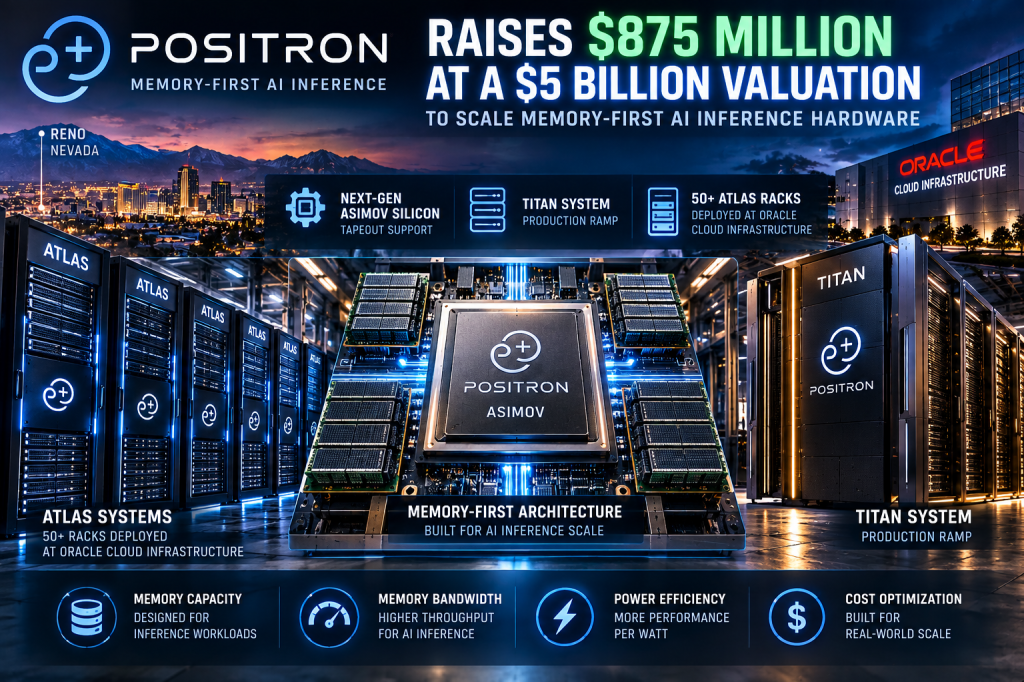
Positron AI has raised $875 million at a $5 billion post-money valuation to scale a memory-first approach to one of AI infrastructure’s fastest-growing workloads: inference.
The September 10 Series C will fund tapeout of Positron’s next-generation Asimov silicon, ramp production of its Titan system and expand manufacturing after a 50-plus-rack Atlas deployment at Oracle Cloud Infrastructure. The company is betting that memory capacity, bandwidth, power and cost—not raw arithmetic alone—will determine how efficiently increasingly large models can serve agents, assistants and copilots.
BitcoinVersus.Tech original illustration: Positron’s financing connects three generations of its inference roadmap—Atlas deployments today, Asimov silicon next and Titan systems built around memory-first inference.
$875 Million for the Inference Era
Reuters independently reported that the financing more than quadrupled Positron’s valuation in roughly seven months, from about $1.06 billion in February to $5 billion. In a striking jump, the Reno, Nevada startup has moved from an FPGA-based first generation toward custom silicon while competing in a market dominated by much larger semiconductor companies.
Positron’s own social feed tied the financing directly to the hardware roadmap. In its latest updates, the company says it is deploying more than 50 Atlas racks at Oracle Cloud while funding Asimov tapeout and Titan production.
Positron AI’s X feed connects the new financing to Atlas deployments, Asimov silicon and the Titan production ramp.
Why Memory Is Becoming the Battlefield
Qatar Investment Authority, which participated in the financing, describes Positron’s architecture as a way to reduce dependence on constrained HBM and CoWoS supply while supporting both air- and liquid-cooled data centers. The investor’s account says inference infrastructure is increasingly constrained by memory capacity, memory bandwidth and power.
That connects directly with BitcoinVersus.tech’s coverage of Delos Data’s interconnect bottleneck thesis, d-Matrix’s rack-scale inference architecture and SK hynix’s expansion across memory and AI infrastructure. Faster processors cannot deliver useful tokens if the memory system cannot continuously feed them.
Positron CEO Mitesh Agrawal recently discussed the $875 million round and the economics of inference on TBPN. The English-language interview below is a direct YouTube watch/live URL rather than a search-results page.
Positron CEO Mitesh Agrawal discusses the company’s $875 million Series C, inference demand and the infrastructure roadmap on TBPN. English audio; no translation required.
A second recent interview focuses more tightly on performance per dollar, performance per watt and matching hardware to inference workloads.
Positron’s Chasiu Cheung discusses inference economics and workload-specific hardware with theCUBE/NYSE Wired. English audio; no translation required.
From Atlas to Asimov and Titan
The funding follows a production-scale Atlas deployment rather than a purely paper roadmap. That distinction matters in a market where new AI accelerators often face years of software, packaging and system-integration work before meaningful deployment.
BitcoinVersus.tech has been tracking that systems race across custom AI silicon paired with 1.6T optics, 1.6T-to-6.4T optical networking and 136 Tbps distributed GPU fabrics. Positron’s bet is complementary: put more useful memory close to the inference engine so the system needs less expensive movement of model state across the network.
The important distinction is architectural: Positron is not claiming that networking disappears. It is trying to reduce how often inference workloads must pay the latency, energy and cost of moving enormous amounts of data between separate devices.
BitcoinVersus.Tech
Advertisement: Use promo code bitcoinversus at checkout to get 5% off participating Bitaxe mining products.
BitcoinVersus.Tech advertisement: participating Bitaxe mining products using promo code bitcoinversus.
BitcoinVersus.Tech Editor’s Note & Disclaimer:
We volunteer daily to ensure the credibility of the information on this platform is Verifiably True. BitcoinVersus.tech provides news, technical analysis and educational information and does not provide financial or investment advice. Manufacturer performance and efficiency claims should be independently verified before purchasing, deploying or investing in hardware. If you would like to support to help further secure the integrity of our research initiatives, please donate here: 3C9o19EH5HSiwEPyCTmEKzxhNCbo2X6TTb


Leave a Reply