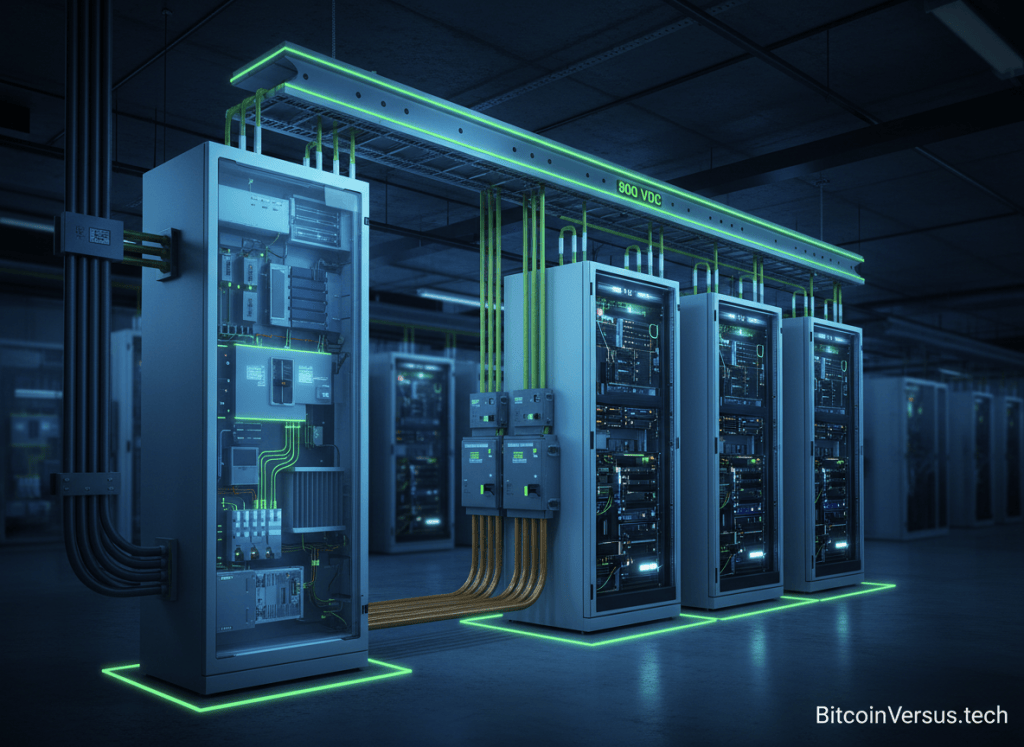
SolarEdge and Infineon are extending their collaboration into one of the least glamorous but most important pieces of 800 VDC AI infrastructure: fault protection. The companies are developing solid-state circuit breakers designed to isolate DC faults in a few microseconds, targeting the distribution layer between high-efficiency power conversion and the compute rack.
The companies say SolarEdge will lead the SSCB design while Infineon supplies CoolSiC JFET technology at the core of the protection devices. Infineon’s own announcement says the goal is to address a critical protection gap as AI data centers move toward 800 VDC distribution, while independent semiconductor coverage highlights the same shift from electromechanical interruption toward semiconductor-based protection.
800 VDC Needs a Different Kind of Breaker
Direct-current protection is harder than simply scaling up an AC breaker. AC current naturally crosses zero, which helps extinguish an arc. A high-voltage DC fault does not provide that same natural interruption point, making fast and selective protection more difficult as rack power rises.
BitcoinVersus.tech has already covered how 800 VDC is moving from concept toward deployable hardware. It has also tracked Enphase’s 800 VDC power modules and Delta’s 800 VDC power-and-cooling architecture. SolarEdge and Infineon are attacking the protection layer between those conversion systems and the load.
Microseconds Instead of Mechanical Contacts
The core technical promise is speed. The companies say their SSCB approach is designed to interrupt faults within a few microseconds rather than waiting for mechanical contacts to separate. Faster isolation can help limit fault energy before it reaches high-value AI compute equipment.
That difference is why power semiconductors are moving deeper into data-center distribution. BitcoinVersus.tech recently covered onsemi’s embedded power platform and Wise and Navitas targeting GaN and SiC for AI power conversion. In this case, silicon carbide is being used not only to convert power, but to protect the DC bus itself.
A semiconductor-industry account summarized the announcement in this September 14 post, emphasizing that power devices are becoming a more central part of facility design as 800 VDC architectures mature.
The Breaker Sits Between the SST and the Rack
SolarEdge’s larger architecture starts with a solid-state transformer platform designed to convert 13.8 to 34.5 kV medium-voltage input directly to roughly 800 to 1,500 VDC at greater than 99% claimed efficiency. The new protection work fills the distribution gap between that conversion stage and the compute rack.
The move complements other grid-to-rack developments. LITEON is pairing AI power delivery with liquid cooling through its DCX investment, while the broader industry is increasingly treating power conversion, protection and thermal management as one integrated system.
Still a Development Program, Not a Volume Product
The collaboration announcement does not provide a commercial shipping date, pricing or deployment count for the SSCB system. That matters. The technology should be treated as an active development program rather than a proven installed-base product.
What is clearer is the engineering direction: if 800 VDC becomes standard inside high-density AI facilities, protection can no longer be an afterthought. The same semiconductor advances that improve conversion efficiency are now being pulled into fault isolation, where microseconds can determine how much energy reaches an expensive rack.
BitcoinVersus.Tech Editor’s Note
Support independent technology reporting: BTC donations may be sent to 3C9o19EH5HSiwEPyCTmEKzxhNCbo2X6TTb.
Follow BitcoinVersus.tech on X/Twitter for AI infrastructure, semiconductor, Bitcoin mining and data-center reporting.
Disclaimer: BitcoinVersus.tech is not a financial advisor. This media platform reports on financial subjects purely for informational purposes.


Leave a Reply