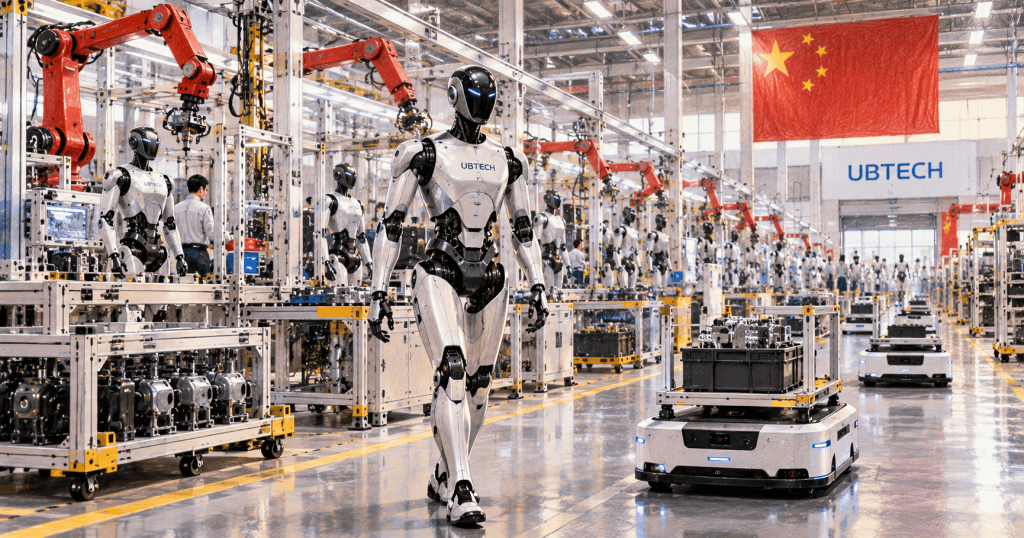
Humanoid robotics has spent years proving that machines can walk, carry parts, swap batteries, and perform increasingly complex industrial tasks. UBTECH is now attacking a different problem: how to manufacture the robots themselves at industrial scale.
On September 12, UBTECH’s new Liuzhou industrial humanoid robot factory entered production in Guangxi, China. An official Liuzhou report says the facility is built around a planned annual capacity above 10,000 robots and a designed production cadence of one robot every 10 minutes.
The important word is designed. A 10-minute takt is a production target, not proof that the plant has already maintained that output continuously. But even as a design goal, it shows how quickly the humanoid industry is moving from prototype workshops toward automotive-style manufacturing systems.
Pandaily summarized the shift in a September 14 X post, describing a roughly 14,000-square-meter plant that combines flexible assembly, robotic intralogistics, automated torque systems, digital tracking, and Siemens-supported factory simulation.
Robots Are Already Working Inside the Robot Factory
The phrase “robots building robots” is becoming literal in a practical manufacturing sense. The plant combines humanoid and wheeled robots with collaborative arms, autonomous logistics equipment, rotating assembly stations, automated storage, and digital manufacturing software.
Cruzr platforms are being used for material movement and handling, while other automation supports assembly, tracking, inspection, and internal logistics. The model resembles a highly automated automotive plant, with robots taking on selected production and intralogistics tasks.
That makes the comparison with XPENG’s new IRON production line especially useful. Both companies are signaling that the next phase of humanoid competition will be measured not only by what a robot can do in a demonstration, but by how consistently manufacturers can build, test, repair, and ship thousands of them.
A Ten-Minute Takt Changes the Engineering Problem
When production volumes are small, engineers can tolerate more manual adjustment. A technician can spend extra time aligning a joint, correcting a cable route, tuning a sensor, or fixing a fastener issue. At higher volumes, those exceptions become expensive.
A factory designed around a 10-minute cycle has to make repeatability part of the product. Torque values, connector seating, cable routing, firmware loading, battery systems, mechanical tolerances, calibration, traceability, and final testing all have to become structured processes instead of individual craftsmanship.
Independent reporting on the launch notes that the facility is intended to produce more than 10,000 humanoids annually and uses automation, digital twins, and robots inside the manufacturing flow. The larger significance is the shift from proving a humanoid can work to proving a factory can repeatedly manufacture one.
The Factory May Matter as Much as the Robot
Humanoid hardware is difficult to scale because every machine combines motors, gearboxes, bearings, sensors, cameras, compute, batteries, wiring, structural parts, hands, and safety systems. A robot that works beautifully as one prototype can still be a poor commercial product if it takes too long to assemble or requires frequent rework.
That is why manufacturing strategy is becoming part of robotics strategy. BitcoinVersus.Tech has already tracked Tesla adapting automotive manufacturing for humanoid production. UBTECH’s Liuzhou facility pushes the same broader idea: robot companies increasingly need production engineering, supply-chain discipline, quality systems, and factory automation alongside AI.
UBTECH’s Walker S2 is also designed around continuous industrial operation, including autonomous battery swapping. That feature only becomes commercially meaningful if the surrounding hardware can be manufactured consistently enough for fleets, not just individual demonstration units.
Physical AI Is Becoming a Manufacturing Race
The broader robotics market is already moving in that direction. BitcoinVersus.Tech recently covered Universal Robots bringing physical AI closer to established factory automation, where reliability, integration, safety, and repeatable deployment matter as much as model capability.
Humanoids now face the same test. Walking videos attract attention, but factories care about uptime, repair time, spare parts, calibration, serviceability, repeatability, and whether hundreds of units behave consistently across multiple shifts.
UBTECH’s Liuzhou plant is important because it treats the humanoid itself as a manufactured industrial product. The 10-minute design cadence may prove ambitious, and actual sustained output will depend on orders, supply chains, quality yield, and software reliability. But the direction is clear: the humanoid race is moving off the demo stage and onto the production floor.
Once robots start participating in the process of making more robots, the most interesting question is no longer whether the machines can walk. It is how quickly the factory can learn to build them well.
Editor’s Note
We volunteer daily to ensure the credibility of the information on this platform is Verifiably True. If you would like to support our research initiatives, please donate here: 3C9o19EH5HSiwEPyCTmEKzxhNCbo2X6TTb
BitcoinVersus.tech is not a financial advisor. This media platform reports on financial subjects purely for informational purposes.


Leave a Reply