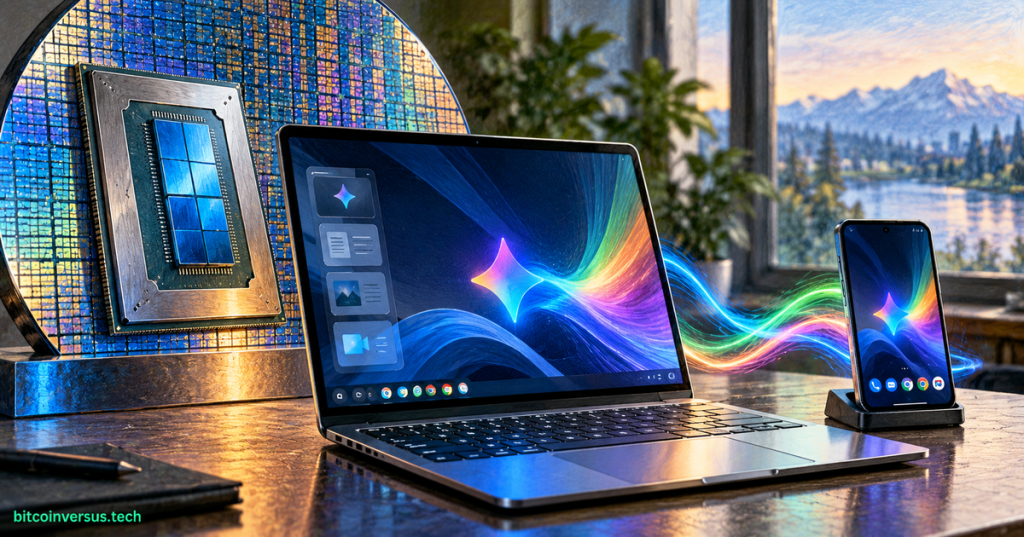
Intel just landed one of the more strategically interesting laptop design wins of 2026: Googlebook.
Google’s new premium laptop category launches with five flagship systems, and three of them—the Acer Googlebook 14, ASUS Googlebook 14 and Lenovo Googlebook 15—use Intel Core Ultra Series 3 processors, better known by the Panther Lake codename. The result gives Intel something more valuable than another conventional Windows laptop design: a front-row position inside Google’s attempt to build a new Android-connected, Gemini-centered PC platform.
According to Intel’s September 21 launch announcement, the Intel-powered Googlebooks pair Core Ultra Series 3 with Intel Wi-Fi 7, Bluetooth 6.0 and Thunderbolt connectivity. Intel also emphasizes that Panther Lake is built on Intel 18A and integrates CPU, GPU and NPU architectures in the same client platform.
Three of five launch Googlebooks run on Panther Lake
The split across the first Googlebook lineup is unusually revealing. 9to5Google’s launch breakdown lists the Acer, ASUS and Lenovo systems with Intel Core Ultra Series 3, while Dell and HP use Qualcomm Snapdragon X Elite.
That means Googlebook is not launching as an Intel-exclusive platform. It is launching as a real-time comparison between x86 and Arm under the same software strategy, with Googlebook OS optimized for both architectures.
For Intel, that is both an opportunity and a test. Panther Lake gets to compete on battery life, local AI, graphics, developer compatibility and cross-device workflows without the comparison being distorted by completely different operating systems.
Google’s launch post makes the platform pitch clear
Google’s own launch messaging focuses less on raw benchmark numbers and more on the idea of continuity between the laptop and an Android phone. In its September 21 launch status, Google introduced Googlebook as a new laptop category built around high-resolution touch displays, long battery life, Android synchronization and Gemini Intelligence.
That matters for Intel because the CPU is no longer the only thing defining the laptop experience. The platform now has to support on-device AI, phone continuity, a desktop-class browser, Android applications, Linux tools and the broader Gemini software layer without making any one of those pieces feel bolted on.
This is also an 18A showcase
Panther Lake is Intel’s first major client platform built on 18A, so every high-profile design win also doubles as a manufacturing proof point. BitcoinVersus.Tech has been following that fabrication story from several angles, including ASML’s move of High-NA EUV toward production, a technology path that matters directly to the leading-edge process race.
Intel’s foundry roadmap is also extending beyond the node inside Panther Lake. Our report on major chipmakers evaluating Intel 14A showed how the company is trying to turn advanced process technology into an external foundry business rather than only an internal manufacturing advantage.
At the data-center end of the roadmap, Intel is making the same modularity bet at much larger scale. BitcoinVersus.Tech recently covered Diamond Rapids rebuilding Xeon around 16 chiplets and UCIe-S. Googlebook is the client-side version of the same larger question: can Intel turn process technology, packaging and architecture into products that win inside increasingly heterogeneous computing platforms?
The x86-versus-Arm comparison just got cleaner
Googlebook may become one of the most useful consumer tests of the modern processor market because Intel and Qualcomm are entering the same new category at the same time.
If the software experience is genuinely consistent across the lineup, buyers will be comparing platform behavior rather than simply choosing between Windows and ChromeOS ecosystems. That makes battery life, application compatibility, local AI performance, graphics, thermals and developer tooling more visible as processor-level differentiators.
Intel does not control the whole Googlebook launch, but that may make the design win more important. Panther Lake is not being protected by exclusivity. It has to prove itself next to Snapdragon X Elite in Google’s newest premium computing experiment.
For Intel 18A, that is exactly the kind of public test that matters.
BitcoinVersus.Tech
Advertisement
Editor’s Note
We volunteer daily to ensure the credibility of the information on this platform is Verifiably True. If you would like to support to help further secure the integrity of our research initiatives, please donate here: 3C9o19EH5HSiwEPyCTmEKzxhNCbo2X6TTb
BitcoinVersus.tech is not a financial advisor. This media platform reports on financial subjects purely for informational purposes.


Leave a Reply