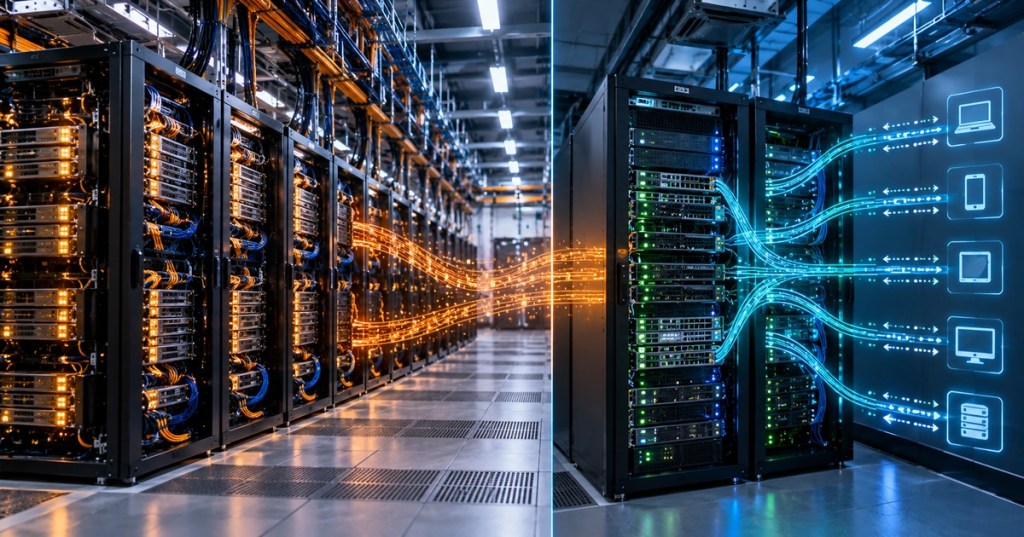
AI training and AI inference are two different jobs. Training is where a model learns patterns by adjusting its internal parameters. Inference is where the trained model uses those learned parameters to produce an answer, prediction, image, recommendation, or other result from new input.
The easiest way to remember the difference is simple: training changes the model; inference uses the model.
Training Is The Learning Phase
During training, a machine-learning model processes examples, measures how wrong its predictions are, and updates its weights so future predictions improve. That cycle can repeat many times across large datasets.
Large-model training often uses clusters of GPUs or other accelerators connected by high-speed networking. Our coverage of Reflection AI’s 501B-parameter Beam model shows how model scale can shape the compute problem.
Inference Is The Working Phase
Inference begins after a model has been trained and deployed. The model receives new input, applies patterns stored in its learned weights, and generates an output without running the full training loop.
Google Cloud describes inference as the execution phase in which a trained model makes predictions on new data. A chatbot response, image classification result, recommendation, speech transcription, or generated image can all be inference.
Training Changes Weights
Model weights are numerical values that determine how learned patterns influence an output. Training repeatedly adjusts those values in response to error signals or rewards.
Inference usually keeps the learned weights fixed while processing a new request. That is why using a model is different from teaching it.
Inference Prioritizes Speed And Scale
IBM explains that inference applies what a trained model learned to new data, while training includes the additional parameter-updating steps needed to improve the model. That changes how hardware, memory, networking, batching, and software are optimized.
Latency Matters During Inference
A training job can run for a long time without a person waiting for each individual calculation. Inference is often connected directly to an application that expects a result quickly, so latency becomes a core production metric.
That is one reason AI infrastructure is increasingly judged by useful output per watt and per dollar. BitcoinVersus.Tech examined the same efficiency problem in our story on Qualcomm’s tokens-per-watt approach to AI data centers.
Inference Can Run In The Cloud Or At The Edge
Not every inference request has to travel to a giant central data center. Smaller or optimized models can run on local servers, PCs, phones, cameras, vehicles, and industrial computers.
Edge inference can reduce network delay and keep some processing closer to where data is generated. Our coverage of Spectrum’s 1,000-site distributed AI infrastructure shows why inference is spreading beyond a few hyperscale campuses.
Fine-Tuning Sits Between Training And Use
Fine-tuning starts with an already trained model and adjusts it for a narrower task, domain, or behavior. It is still a learning process because parameters are being changed, but it usually requires less work than building a model from scratch.
After fine-tuning, the updated model can be deployed again for inference. A typical lifecycle therefore includes training, fine-tuning, deployment, inference, monitoring, and later retraining when needed.
Serving Is The Infrastructure Around Inference
Model serving is the system that makes inference available to applications. It can include API endpoints, load balancing, accelerator pools, caches, monitoring, and autoscaling.
A model can be trained correctly and still deliver a poor experience if the serving system is slow, overloaded, expensive, or unreliable.
The Easy Way To Remember It
Training is the learning stage. Inference is the doing stage. Training changes the model so it learns patterns. Inference uses those learned patterns to produce useful results from new input.
Once that difference is clear, AI infrastructure makes more sense: training explains giant accelerator clusters, while inference explains the focus on latency, throughput, serving efficiency, edge deployment, and the cost of each result.
BitcoinVersus.Tech
Advertisement
Editor’s Note
We volunteer daily to help keep the information on this platform verifiably accurate. If you would like to support our independent research, please donate here: 3C9o19EH5HSiwEPyCTmEKzxhNCbo2X6TTb
BitcoinVersus.tech is not a financial advisor. Content is provided for informational purposes.


Leave a comment