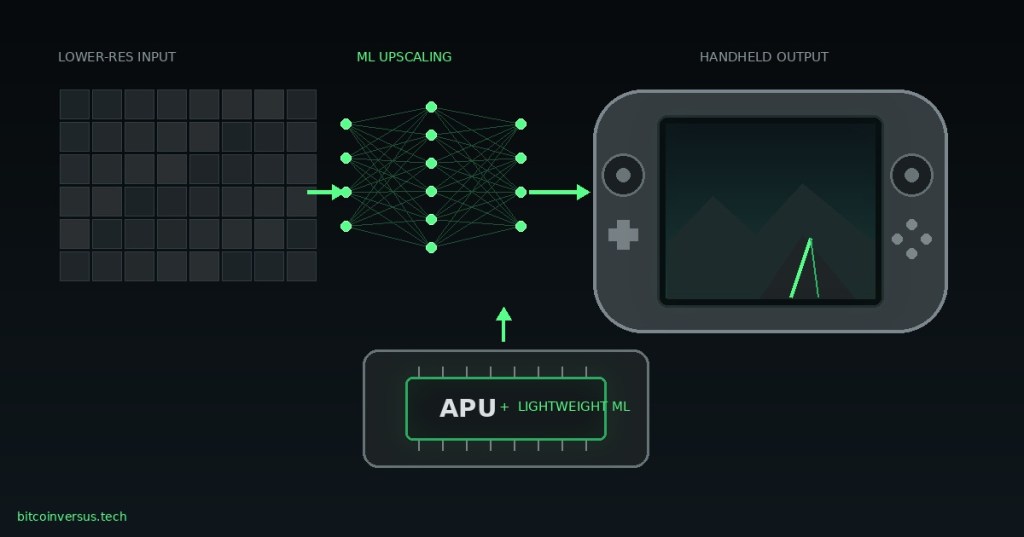
AMD plans to push its machine-learning graphics upscaling beyond desktop Radeon cards and into APUs, gaming laptops and handheld gaming PCs before the end of 2026, according to comments from Computing and Graphics chief Jack Huynh reported by The Elec. The plan has two tracks: a lighter FSR 4 model for existing APUs and new processor products designed to support the technology more directly.
That matters because handheld PCs live under a much tighter power, thermal and memory-bandwidth budget than desktop graphics cards. AMD’s latest FidelityFX Super Resolution stack uses machine learning to reconstruct a higher-resolution image from a lower-resolution render, shifting part of the image-quality problem from brute-force native rendering toward inference. If AMD can make that workload light enough for integrated graphics, portable systems could gain sharper images without simply asking their GPUs to render every pixel natively.
AMD is widening FSR 4 beyond desktop GPUs
Huynh, who oversees AMD’s Computing and Graphics Group, said the company intends to expand its ML-based FSR technology across the product stack by year-end. AMD’s own FSR technology page describes its current ML-powered upscaling as part of a broader stack that also includes frame-generation and ray-regeneration features.
The desktop path has already broadened. AMD first tied FSR 4 closely to RDNA 4 hardware, then expanded newer FSR upscaling support to Radeon RX 7000-series products. Huynh’s June update also said AMD was developing lightweight machine-learning models for APU-class hardware—a direction that now has a year-end target.
Why handheld gaming is the harder target
A desktop GPU can devote far more silicon, memory bandwidth and electrical power to an upscaling model than a compact handheld APU. In a portable machine, the CPU cores, integrated GPU and memory controller compete inside one tight power envelope. That makes every millisecond of inference latency and every additional memory transfer matter.
This is where AMD’s lighter model becomes interesting. The Elec reports that AMD developed a version specifically optimized for APU environments, with image quality and low latency as core goals. The distinction is important: AMD has not said that every existing handheld will receive identical FSR 4 capabilities, and it has not published a complete supported-device list.
The memory side is especially relevant. BitcoinVersus recently broke down why GPUs depend so heavily on fast graphics memory. Handheld APUs generally share system memory instead of carrying a large pool of dedicated VRAM, so bandwidth efficiency matters as much as raw compute when a machine-learning upscaler has to reconstruct frames quickly.
What this could mean for handheld PCs
The immediate takeaway is not that every Steam Deck, ROG Ally or Legion Go suddenly has official FSR 4 support. AMD has not named the final compatibility matrix. The confirmed part is the broader strategy: support existing APUs with a lighter model while launching new APU products intended for stronger FSR 4 support.
That strategy fits a larger shift in portable PC gaming. Valve has been expanding the software side of that ecosystem as well; BitcoinVersus recently covered SteamOS moving toward ARM hardware and Valve bringing SteamOS gaming to ARM64. Hardware vendors are simultaneously trying to stretch battery life and graphics quality through smarter rendering rather than simply scaling power consumption upward.
A new APU is also coming
The other half of AMD’s plan is new silicon. Huynh said AMD will launch new products alongside expanded support for existing APUs. The Elec interprets that as a next-generation APU with graphics hardware better suited to FSR 4, but AMD has not publicly named the chip architecture, retail products or handheld systems that will use it. Reports connecting the announcement to rumored future Ryzen Z-series parts therefore remain speculation until AMD formally identifies them.
The distinction between desktop and mobile graphics is becoming increasingly software-defined. A traditional high-end gaming PC can still buy image quality with a bigger GPU, cooling system and power supply. Handhelds cannot. Technologies such as FSR increasingly determine how much useful image quality manufacturers can extract from a fixed thermal envelope.
What comes next
The next milestones are straightforward: AMD needs to name the supported existing APUs, ship the lightweight model, identify the new FSR 4-capable APU family and show how image quality and latency compare with the desktop implementation. Until those details arrive, the most important part of this week’s announcement is the direction of travel: machine-learning upscaling is moving from premium discrete GPUs toward the lower-power integrated graphics that define handheld gaming PCs.
Editor’s Note
We volunteer daily to ensure the credibility of the information on this platform is Verifiably True.
BitcoinVersus.tech is not a financial advisor. This media platform reports on financial and technology subjects purely for informational purposes.


Leave a comment