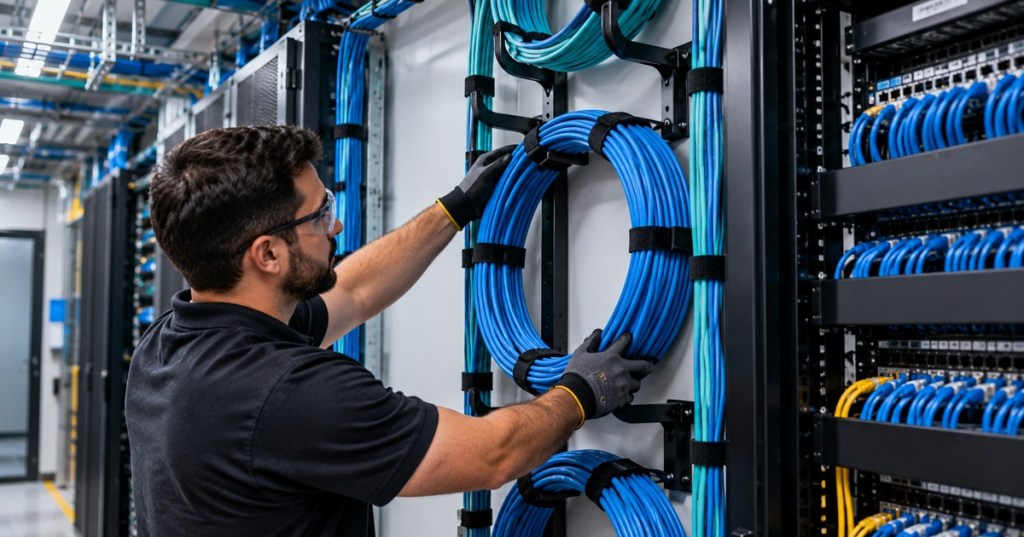
A service loop is extra cable left on purpose so future work does not require replacing the entire run. It gives a technician enough slack to move equipment, reterminate a connector, relocate a patch panel, repair damage, pull a device forward for service, or resplice fiber without immediately running out of cable.
That sounds simple, but service loops sit at the intersection of almost every physical-layer rule we have covered recently: bend radius, pulling tension, pathway fill, strain relief, labeling, airflow, and accessibility. Extra cable is useful only when it is stored correctly.
The biggest mistake is thinking there is one universal “leave 10 feet” rule. There is not. The correct amount of slack depends on the cable type, enclosure, equipment service envelope, splice plan, rack design, future moves and adds, and the project or manufacturer specification.
Why Leave Slack at All?
Imagine a copper run terminated exactly to the back of a patch panel with zero extra length. If the panel moves one rack unit, the connector is damaged, or the cable has to be punched down again, the technician has nowhere to go. The same problem is worse with fiber optic cable, where a future splice or damaged connector may consume part of the original cable length.
A good service loop creates maintenance margin. It lets equipment be repositioned, connectors be reworked, damaged ends be cut back, and panels be serviced without turning a small repair into a full cable replacement. This is especially useful in data centers, telecom rooms, outside-plant fiber systems, industrial controls, and dense rack-and-stack environments.
Fiber Service Loops Are Really Bend-Radius Problems
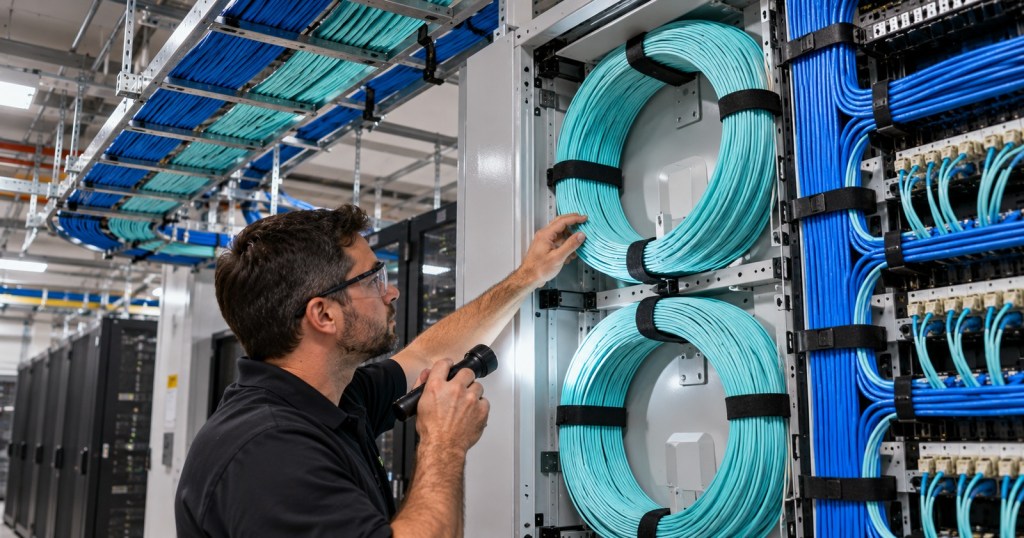
Fiber can be stored in a loop only if the loop itself respects the cable’s long-term bend limit. The Fiber Optic Association gives the familiar general guideline of 20 times cable diameter while under pulling tension and 10 times cable diameter after installation, while emphasizing that the exact cable specification always wins.
That means the service loop is not an excuse to make a tight coil. If a cable requires a 60 mm minimum long-term bend radius, the loop diameter must be at least 120 mm—and in practice, giving the cable more room is usually easier to maintain. Higher-count, armored, ribbon, bend-insensitive, and specialty fiber may use different limits.
This is why outside-plant crews use snowshoes, storage brackets, handholes, splice enclosures, and purpose-built slack-management hardware. Corning’s FlexNAP installation procedure explicitly tells installers not to exceed recommended bend radii in slack loops and to choose storage hardware large enough for the cable being installed.
Slack Is Not the Same as a Coil Stuffed Into a Box
A service loop should be accessible, supported, labeled, and large enough to preserve the cable’s geometry. Stuffing fifty meters of fiber into a tiny enclosure may technically preserve the cable length while making the next technician’s job worse.
That distinction showed up in a 2026 r/FiberOptics discussion where a preconnectorized drop had so much slack packed into a network interface enclosure that commenters immediately questioned the cable length selection. Extra slack can be valuable, but once it blocks access, crowds connectors, or forces tight bends, it stops being good maintenance margin and becomes clutter.
Where Should the Service Loop Go?
The best location is usually where the slack helps future work without blocking normal operations. That may be a wall-mounted slack-storage bracket, cable tray, overhead basket, fiber enclosure, rear rack manager, handhole, splice location, or approved outside-plant storage point.
In a rack, avoid dropping a giant coil directly behind active switches or servers. That can obstruct airflow, hide labels, interfere with server slide rails, make patching difficult, and turn one cable move into a bundle-wide disturbance. Store slack where a technician can reach it without moving unrelated live connections.
For fiber, remember that the storage hardware itself becomes part of the bend-radius system. For copper, remember that large bundles still consume pathway area and can complicate structured cabling pathways.
Server and Equipment Service Loops Are Different
Some service loops exist because the equipment itself moves. A rack server on sliding rails may need enough network or management cable to move into its service position without unplugging every connection. The same idea appears around KVMs, storage trays, movable industrial panels, robotics cells, cameras, and equipment drawers.
That slack should follow the equipment’s actual movement path. Too little cable pulls on the RJ45 connector or fiber transceiver. Too much cable can snag, cross a fan path, catch on rail hardware, or block airflow. A service loop is therefore part of the mechanical design, not just leftover cable.
Do Not Treat Power Cords Like Fiber or Ethernet
One important boundary: the “leave a neat coil” habit from telecommunications should not automatically be copied onto loaded power cords. Power conductors have current, thermal, overcurrent-protection, routing, and listing requirements that differ from communications cabling. Excess power cable should be handled according to the equipment manufacturer, electrical design, and applicable installation rules rather than copied from a fiber slack loop.
The same warning applies to mixed pathways. Keeping Ethernet, fiber, control wiring, and power physically organized makes troubleshooting easier and reduces the chance that future work damages an unrelated system.
Service Loops Need Labels Too
A beautiful coil of mystery cable is still a maintenance problem. If slack is stored away from the termination point, label it so the next technician knows the source, destination, cable ID, and—where the site standard requires it—fiber count, strand assignment, circuit, or equipment relationship.
This becomes especially important around LC, SC, MPO, and MTP fiber systems, where polarity, cassette assignments, trunk identification, and connector type can matter as much as the physical cable route.
How Much Slack Is Enough?
There is no useful universal answer in feet or meters. Instead, work backward from the maintenance task:
- What might move? A rack, patch panel, server, enclosure, splice tray, or termination point may need repositioning.
- What might be reterminated? Leave enough usable length to remake the connector or move to another port without immediately replacing the run.
- Where can the slack live safely? The storage location must preserve bend radius, airflow, access, and pathway capacity.
- What does the manufacturer or project require? Outside-plant fiber, preterminated trunks, copper horizontal cable, and equipment patch cords can have completely different expectations.
- Can the next technician identify it? Accessible, labeled slack is useful. Hidden, tangled slack is not.
Seven Bad Service-Loop Habits
- Making the loop smaller than the cable’s long-term bend limit.
- Using tight zip ties that crush the jacket or fiber bundle.
- Stuffing excess cable behind fans, power supplies, or sliding equipment.
- Leaving so much slack that the enclosure becomes unserviceable.
- Mixing unlabeled service loops from unrelated circuits into one bundle.
- Using pathway capacity as permanent slack storage until the tray is full.
- Cutting all slack out because the installation looks cleaner without it.
The Best Service Loop Is Almost Boring
A good service loop should not be the first thing you notice in a rack or enclosure. It should sit quietly in the correct place, stay inside the cable’s mechanical limits, remain labeled and accessible, and be ready when someone actually needs it.
That is the larger lesson behind good cable management: the cleanest installation is not the one with the least cable. It is the one that leaves exactly enough operating margin for the next repair, upgrade, move, or mistake.


Leave a comment