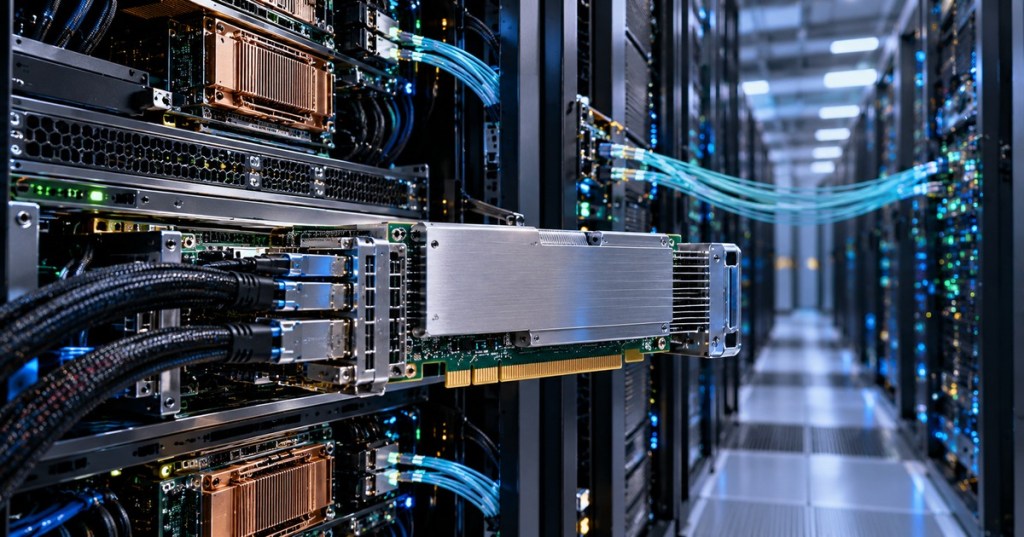
Astera Labs is trying to make PCIe 7 work not just across a circuit board, but across an entire AI rack—and, with optics, between racks. The company announced its Aries 7 signal-conditioning family on October 8, combining smart retimers, redrivers, cable modules, optical drivers and optical transimpedance amplifiers into one portfolio for next-generation AI systems.
The headline number is reach. In its Aries 7 announcement, Astera says the family is designed to cover links ranging from centimeters of board trace to more than 50 meters over optical cable. That matters because PCIe is increasingly being asked to connect accelerators, memory and switches across larger physical systems rather than stay confined to one motherboard.
PCIe 7 Doubles The Link Rate Again
PCIe 7 runs at 128 GT/s per lane, double PCIe 6.0. The PCI-SIG PCIe 7 FAQ says a full x16 link can provide up to 512 GB/s of bidirectional bandwidth while retaining PAM4 signaling and backward compatibility with earlier PCIe generations.
Doubling the data rate also makes the physical channel harder to engineer. Faster electrical signals have less margin for loss, reflections, connector discontinuities and board-trace imperfections. A link that is easy to route at a slower generation can become unreliable when the signaling rate doubles.
That is why the PCIe story is no longer just about the endpoint device. The motherboard, connectors, cables, switches and signal-conditioning devices all become part of the performance budget.
Why Retimers And Redrivers Exist
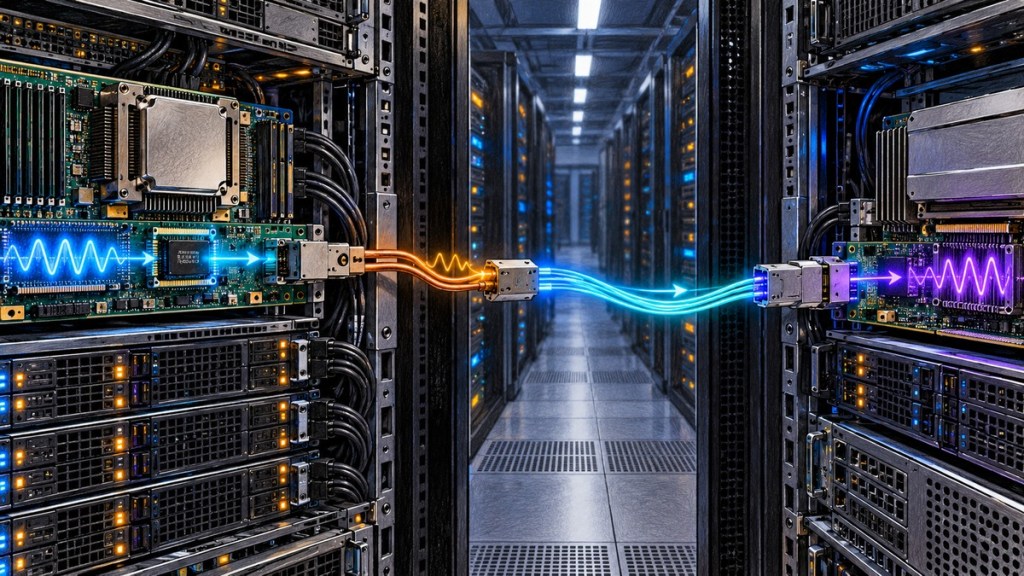
A retimer receives a degraded high-speed signal, recovers its timing and data, then retransmits a cleaned-up version farther down the link. A redriver is generally a lighter-weight signal-conditioning device that boosts and equalizes the electrical signal without fully rebuilding it.
The tradeoff is familiar in high-speed hardware design: stronger signal recovery can extend reach and improve robustness, while simpler conditioning can reduce power and latency where the channel does not need as much help.
Astera Labs’ Aries retimer overview explains the core problem the product family is built around: extending PCIe reach while preserving signal integrity across demanding server topologies.
That same problem becomes more severe as AI servers add more accelerators and more internal links. BitcoinVersus.Tech recently covered HPE’s PCIe 6 AI servers; PCIe 7 raises the channel rate again before that generation has even become ordinary server hardware.
Optics Moves PCIe Beyond The Board
The most interesting part of Aries 7 is not another retimer generation. It is Astera’s attempt to treat optical PCIe as part of the same signal-conditioning family.
Copper remains attractive for short links because it is familiar, comparatively simple and can avoid optical conversion overhead. But as reach increases, electrical loss becomes harder to manage. Optical fiber can carry high-speed data much farther while avoiding many of the channel-loss problems of long copper runs.
Astera says its optical products support architectures including near-package optics and linear pluggable optics, with the portfolio extending PCIe links beyond a single chassis. That makes PCIe relevant to the same rack-scale design problem that Ethernet and other high-speed fabrics already face.
CScale’s launch post frames the broader rack-scale optical problem: as AI systems spread across more accelerators and more racks, optical interconnect reliability becomes part of useful compute—not just a cabling detail.
AI Racks Need More Than Fast GPUs
AI performance increasingly depends on keeping expensive accelerators fed with data. A GPU that waits on a broken, retraining or bandwidth-constrained link is still an idle GPU.
That is why seemingly obscure components such as retimers, switches, cable modules and optical drivers matter. They sit between the headline processors and determine whether the surrounding system can actually move data at the rate those processors expect.
The same system view appears in other parts of the stack. Direct Memory Access lets devices move data without forcing the CPU to copy every byte, while a high-speed network interface card moves traffic outside the server. PCIe is one of the internal highways connecting those components.
At larger scale, rack architecture is becoming a product in its own right. BitcoinVersus.Tech has also covered Cisco and Supermicro rack-scale AI systems, where compute, networking and physical integration are designed together rather than treated as separate boxes.
COSMOS Adds A Software Layer To The Link
Astera is also tying Aries 7 into its COSMOS software suite for link monitoring, diagnostics and tuning. That reflects another shift in hardware infrastructure: high-speed links are increasingly managed like observable systems rather than passive traces.
If a link begins accumulating errors or losing margin as temperature, cable conditions or system configuration change, software-visible telemetry can help operators identify the problem before it becomes a full outage. For fleets of AI servers, that can matter as much as peak benchmark bandwidth.
What Comes Next
Astera says Aries 7 is expected to begin sampling in the fourth quarter of 2026 and plans to demonstrate both copper and optical PCIe 7 implementations at the OCP Global Summit in San Jose on October 12–15.
The bigger question is how quickly PCIe 7 moves from demonstrations and early samples into production AI platforms. PCIe 6 hardware is only beginning to appear in new server designs, so PCIe 7 will not replace it overnight.
But the direction is clear: as accelerators become faster and AI systems spread across larger physical footprints, the interconnect problem is moving from the edge of the motherboard to the architecture of the rack itself. Astera’s Aries 7 launch is an early sign of what that transition looks like in hardware.


Leave a Reply