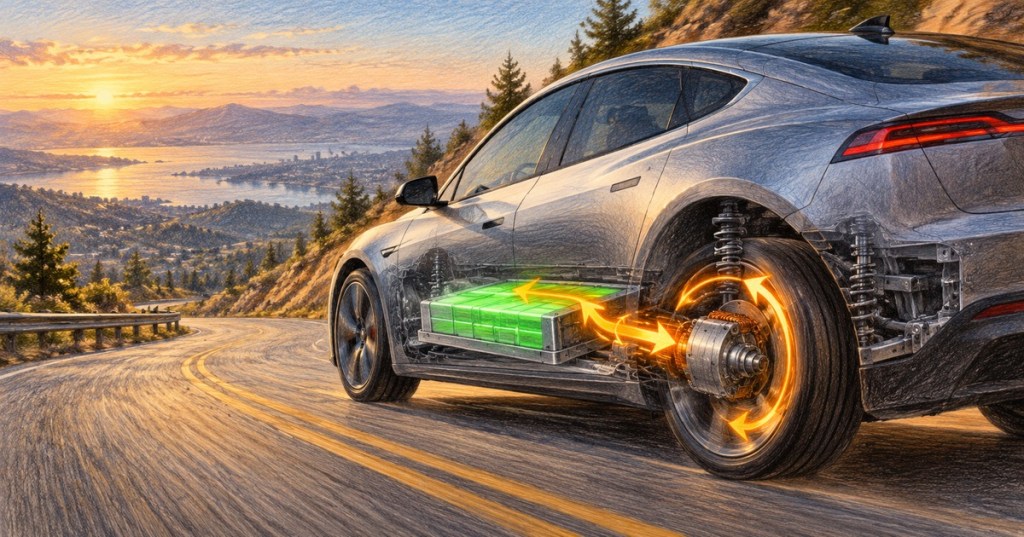
Regenerative braking is a way for an electric or hybrid vehicle to slow down while recovering some of the energy that would otherwise be wasted as heat. Instead of relying only on friction brakes to squeeze brake pads against rotors, the vehicle can use its electric traction motor in reverse: the moving wheels turn the motor, the motor acts as a generator, and electrical energy flows back toward the battery.
That is why an electric car can feel different when you lift off the accelerator. In many EVs, simply reducing accelerator pressure produces noticeable deceleration. The car is not “coasting badly.” It is deliberately converting part of its motion back into electricity.
Normal brakes mostly turn motion into heat
A moving car has kinetic energy. In a conventional friction-brake system, slowing the car means converting much of that kinetic energy into heat at the brake pads and rotors. The hotter brakes become, the more obvious the energy conversion is.
That approach is simple, powerful and reliable, but the energy is largely gone once it becomes heat. Regenerative braking asks a different question: if the vehicle already has an electric motor connected to the wheels, can some of that motion be turned back into useful electrical energy before the friction brakes finish the stop?
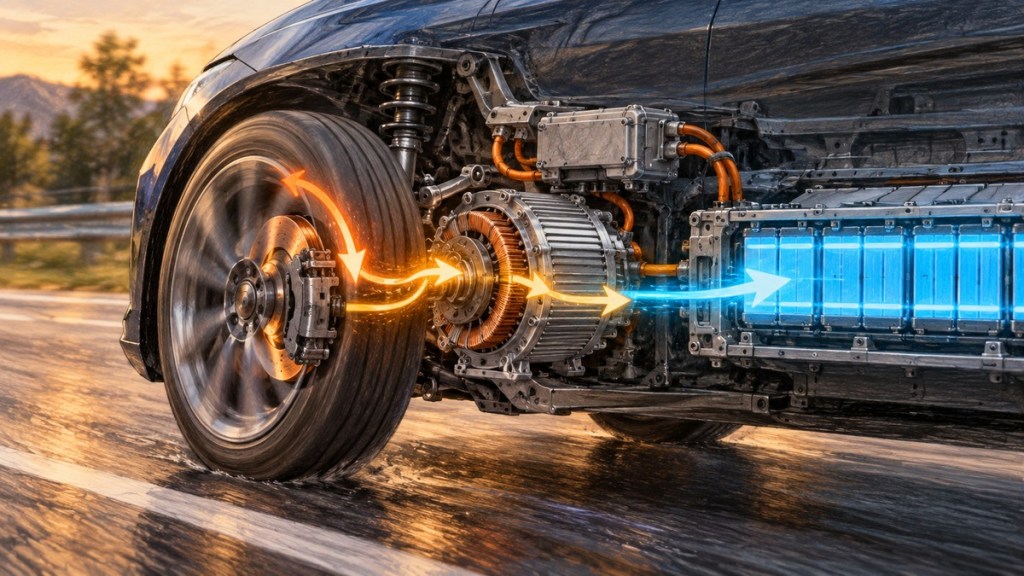
The same motor can push the car or resist it
During acceleration, electrical energy leaves the battery and flows through power electronics to the motor. The motor produces torque that turns the wheels. During regenerative braking, that energy path is partly reversed: the wheels keep the motor spinning, and the motor generates electrical power while producing a torque that resists the vehicle’s motion.
The U.S. Department of Energy’s Alternative Fuels Data Center describes the same process in hybrids: the electric motor works as a generator during braking and stores captured energy in the battery instead of losing all of it through friction.
This is also one of the reasons the electric motor is such a flexible machine. It can convert electrical energy into mechanical motion while driving, then convert mechanical motion back into electrical energy while slowing. That two-way behavior is central to both battery EVs and the hybrid cars that combine an engine with an electric drive system.
Chevrolet demonstrates One-Pedal Driving and Regen on Demand in the Equinox EV, showing how regenerative braking changes everyday driving.
Regenerative braking does not recover all the energy
Regeneration is useful, but it is not a perpetual-motion trick. Every conversion has losses. Tires flex, bearings create friction, the motor and inverter generate heat, the battery has charging losses, and some braking situations require the friction brakes to contribute heavily or take over completely.
The Department of Energy has estimated that net regenerative braking can recover roughly 22% of vehicle energy on the EPA combined city/highway driving cycle for a typical EV. The exact number varies with vehicle design, route, speed, temperature, battery state of charge and driving style. The important point is not that braking becomes free; it is that some energy that used to be wasted can now be reused.
Why regeneration is especially useful in city driving
Regenerative braking is most valuable when a vehicle repeatedly speeds up and slows down. Stoplights, traffic, hills and urban driving create many opportunities to recover energy. Long, steady highway cruising creates fewer braking events, so there is less motion to recapture.
That does not mean regeneration is irrelevant at highway speed. Automakers can tune vehicles to recover meaningful energy during higher-speed deceleration as well. Tesla highlighted this in a 2024 software update that increased regenerative braking at highway speeds on certain Model S and Model X vehicles.
Tesla’s Spring Release notes included increased regenerative braking at high speeds so more energy could return to the battery during highway deceleration.
What is one-pedal driving?
One-pedal driving is a control strategy that makes regenerative braking stronger when the driver lifts off the accelerator. Pressing the accelerator adds torque. Easing off reduces torque and begins regeneration. Lifting off farther can create strong deceleration, and some vehicles can bring themselves nearly or completely to a stop without the driver touching the brake pedal in ordinary conditions.
This does not mean the car literally has only one pedal or that the brake pedal is unnecessary. Emergency stops, low-traction conditions, very low speeds and situations where regeneration is limited still require conventional braking. Chevrolet’s current EV guidance explicitly tells drivers to remain ready to use the brake pedal even when One-Pedal Driving is active.
The friction brakes never disappear
Modern EVs usually combine regenerative and friction braking. This is sometimes called blended braking. The driver asks the vehicle to slow down, and software decides how much deceleration can safely come from the motor-generator and how much must come from hydraulic brakes.
Friction brakes remain essential because regeneration has limits. A motor can only generate so much braking torque. A nearly full battery may have little room to accept additional charge. A very cold battery may temporarily accept power more slowly. Emergency braking can demand far more stopping force than the electrical system can recover. At the final few miles per hour, conventional brakes may also be used to complete and hold the stop.
Why regenerative braking can become weaker
Drivers sometimes notice that regenerative braking changes from one trip to another. That can be normal. Battery state and temperature matter because the regenerated electricity has to go somewhere.
- Battery nearly full: there may be limited room to accept more energy.
- Battery very cold or very hot: charging power may be restricted to protect the cells.
- Low vehicle speed: the motor may produce less useful regenerative braking as rotational speed approaches zero.
- Traction limits: slippery roads can require the vehicle to reduce regenerative torque to preserve stability.
This is one reason electric cars use sophisticated brake-control software instead of treating regeneration as a simple on/off feature.
Regeneration can reduce brake wear
Every time the motor handles part of the slowing job, the friction brakes do less work. The Department of Energy notes that brake systems on hybrids and EVs can last longer because regenerative braking reduces friction-brake use.
There is an interesting maintenance tradeoff, though: because the physical brakes may be used less often, automakers still have to manage corrosion, moisture and uneven rotor use. A vehicle that relies heavily on regeneration still needs healthy mechanical brakes because those brakes remain the final safety system when maximum stopping force is required.
Why hybrids benefit so much from regeneration
Regenerative braking helped make hybrid cars practical long before battery EVs became mainstream. A conventional hybrid such as a Prius does not need to plug into a wall because it can recover energy while slowing and use that energy later to assist the engine.
That recovered electricity is not the hybrid’s only energy source—the gasoline engine still supplies most of the total energy—but regeneration lets the vehicle reuse energy that a conventional car would throw away as brake heat. That is why the feature connects directly to our earlier explainer on how hybrid cars work.
Regeneration is part of a larger energy system
Electric vehicles move energy through several stages: grid electricity charges the battery, the battery powers the inverter and motor, the motor turns the wheels, and regenerative braking can send a portion of the vehicle’s kinetic energy back the other way. External charging still supplies the overwhelming majority of the vehicle’s energy, whether through a home charger, fast charger or emerging systems such as Honda’s experimental wireless charging road.
The same energy-density limits that shape electric cars also become even more demanding in aviation, where battery mass is much harder to hide. BitcoinVersus explored that larger constraint in Why Electric Planes Are Still Almost Impossible After 50 Years.
A practical driving takeaway
Regenerative braking rewards smooth driving. Looking farther ahead, easing off the accelerator earlier and allowing the motor to slow the vehicle gradually can recover more energy than accelerating hard and then demanding a last-second stop.
But the best approach is not to obsess over maximizing every watt. Follow the vehicle’s controls and safety guidance, use the brake pedal whenever needed, and remember that road conditions matter more than energy recovery. Regeneration is an efficiency feature first; safe stopping remains the priority.
The takeaway
Regenerative braking turns the electric motor into a generator while the vehicle slows. That generator action resists the wheels, produces braking force and sends part of the recovered energy back into the battery.
It cannot recover everything, and it cannot replace friction brakes. What it does accomplish is unusually elegant: the same machine that makes the car move can help slow it down, recharge the battery and reduce brake wear—all from energy that conventional vehicles largely throw away as heat.


Leave a Reply