
REDWOOD CITY, Calif. — Reach Power reported October 28 that a quadcopter completed a 10-hour autonomous flight using wireless energy beamed from the ground. The September 22 demonstration at Virginia Tech’s Institute for Advanced Computing was streamed to defense officials at the Pentagon and tested whether a drone could manage its own charging without landing, GPS or manual controls.
According to Reach’s announcement, the aircraft flew with a deliberately small battery capable of about 90 seconds of flight on its own. The company reports that radio-frequency power extended the same configuration’s endurance approximately 400-fold. Aviation Week independently reported the announcement, but public flight telemetry has not been released.
Reach Power’s linked recording of the September 22 wireless-powered drone endurance test, supplied with its October 28 announcement.
How a Drone Charges While Flying
The quadcopter used onboard visual navigation to maintain position and monitored its battery state. When charged, it left the beam; when power ran low, it returned and requested energy. The ground transmitter electronically redirected radio waves toward the receiving antenna, without physically rotating its array.
The system differs from a tethered drone, which draws electricity through a cable but cannot freely leave the tether’s reach. It also differs from ordinary wireless vehicle charging, where a receiver passes over nearby charging infrastructure.
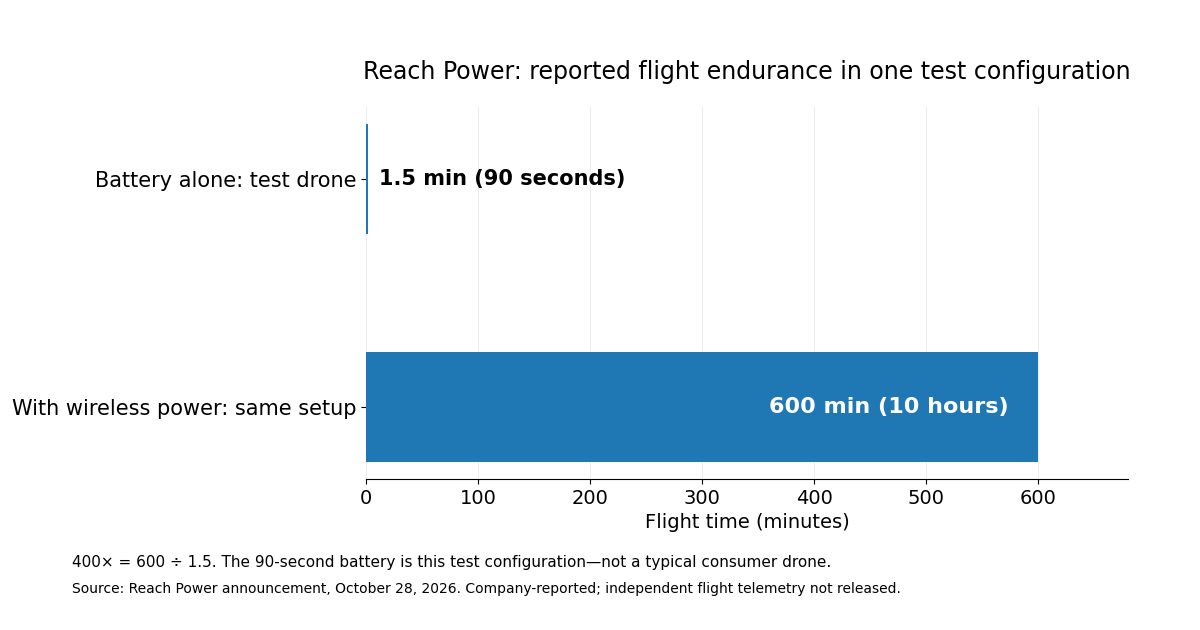
Company-reported results for this experimental drone: 1.5 minutes battery-only versus 600 minutes with wireless power. The 90-second baseline is not a typical consumer-drone battery.
From Prototype to Useful Infrastructure
Reach previously demonstrated 50 watts delivered to a drone across roughly six meters in a separate 2024 test using four transmitters. The new experiment adds autonomous departure and reacquisition over a much longer flight period, not a published longer-range power specification.
BitcoinVersus.Tech has covered first-responder drone operations, robot-assisted drone deployment and open drone hardware. Keeping aircraft airborne without battery swaps could change the logistics of inspection and communications missions.
What Still Needs Proof
Reach has not publicly disclosed the September test’s transmitter distance, delivered RF power, conversion efficiency or independent safety measurements. Those will matter more than flight duration alone when evaluating outdoor operations, multiple moving aircraft and energy cost.
The next meaningful milestone is a repeatable field trial with transparent power, distance and reliability data—not a claim that drones can already remain airborne indefinitely.
Support BitcoinVersus.Tech
We volunteer daily to ensure the credibility of the information on this platform is Verifiably True. Please scan the original QR code below to donate 5,000 sats if you would like to support our independent reporting. For best results, open this page on a laptop or larger screen.

On mobile, display the QR code on another screen to scan it with a Bitcoin wallet; alternatively, use a wallet’s saved-image QR-scanning feature if available. Bitcoin donation address: 3C9o19EH5HSiwEPyCTmEKzxhNCbo2X6TTb.
BitcoinVersus.tech is not a financial advisor. This media platform reports on financial subjects purely for informational purposes.


Leave a Reply