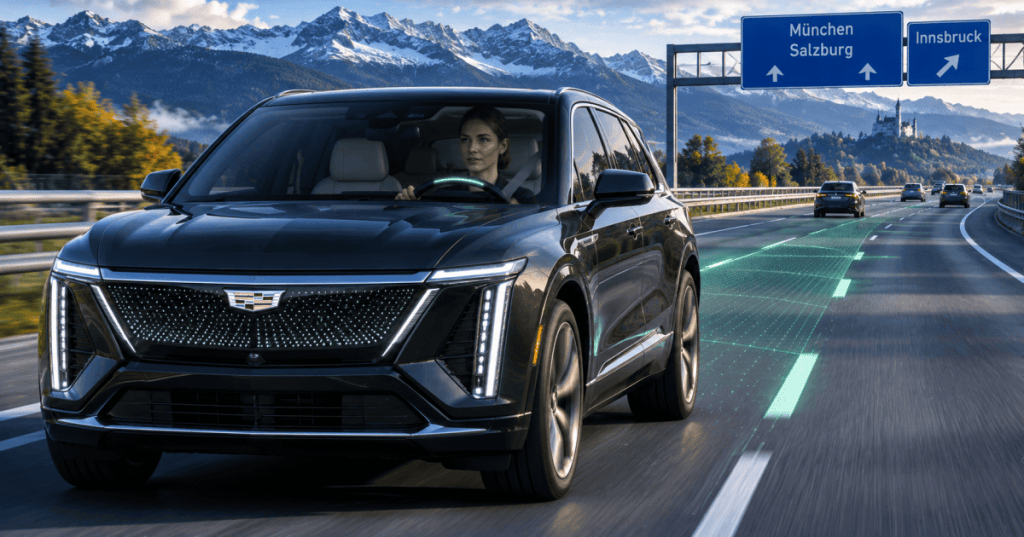
Cadillac is preparing Super Cruise for Europe from mid-December 2026, bringing its hands-free driver-assistance technology to more than 180,000 kilometers of compatible highways and expressways across 16 countries. The November 4 announcement, presented ahead of Auto Zürich, covers selected electric SUVs including OPTIQ, LYRIQ and VISTIQ. Availability on a mapped road does not make the vehicle self-driving: the system remains Level 2, requiring an attentive driver.
Cadillac launched Super Cruise in North America in 2017. Its European expansion relies on mapped routes, cameras, radar, positioning systems and a camera monitoring the driver. A November 4 Automobil Revue report describes operating speeds up to 130 km/h, with Germany, France and Switzerland among the initial markets. Country coverage describes a road network, not permission to operate on every street.
Cadillac, “How to Use Super Cruise” (April 2024). An official introduction to driver monitoring, compatible roads and hands-free assistance. The video predates the European launch.
How the hands-free system works
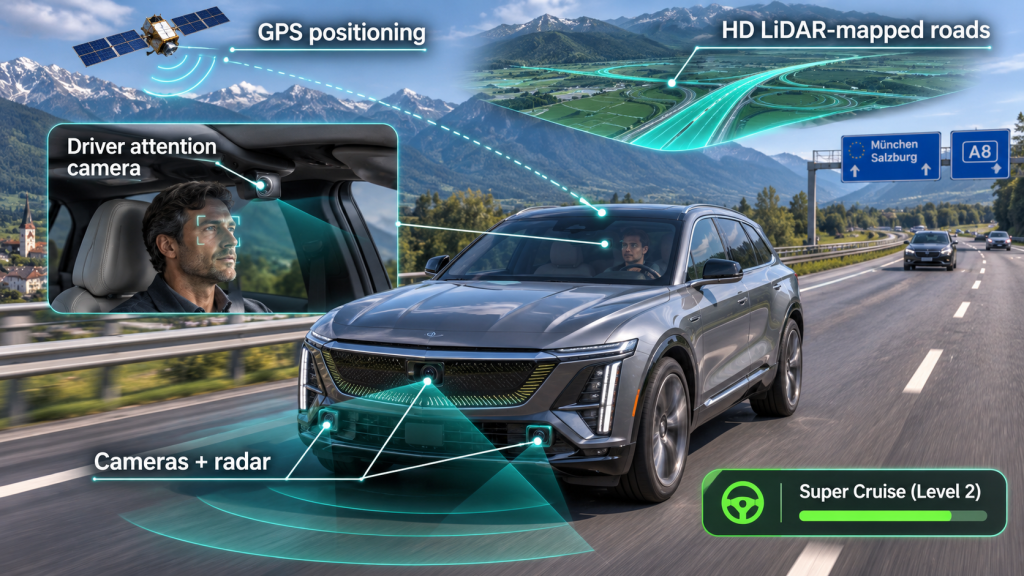
The vehicle combines GPS positioning, high-definition road maps prepared using LiDAR measurements, onboard cameras and radar. Adaptive cruise control manages speed and following distance while assisted steering helps maintain the lane. Compatible Cadillac models can perform a lane change after the driver activates the turn signal. Road information displayed through Google built-in helps identify eligible stretches before a trip.
A LiDAR-mapped road is not evidence that every participating vehicle carries a live LiDAR scanner. The distinction matters when comparing Super Cruise with the hardware strategies described in BitcoinVersus.Tech’s coverage of Rivian’s falling LiDAR component costs and Toyota and Waymo’s planned robotaxi program. Those technologies have different operational designs and driver-responsibility requirements.
Eligible vehicles, updates and subscription terms
Cadillac identifies the 2025-and-newer OPTIQ and 2026-and-newer LYRIQ and VISTIQ as compatible European models. The company says previously delivered eligible vehicles can receive activation through a software update at an authorized Cadillac service partner, with no new hardware required. European motorists should check their model, market and service partner before assuming the feature is active.
A three-year Super Cruise trial is included with selected Cadillac electric SUVs. Continued use requires a paid plan afterward, and Cadillac has not disclosed a uniform European subscription price. The rollout adds a software-based capability to an EV market already experiencing heavier competition, reflected in earlier reporting on Chinese vehicle brands expanding in Europe and BMW’s electric-vehicle strategy.
Cadillac, “Super Cruise | 2026 OPTIQ” (May 2025). Official demonstration of activation, lane changes and takeover alerts; not footage of the 2026 European launch.
Driver attention remains mandatory
Super Cruise can assist with steering, braking and acceleration, but it cannot replace the driver or guarantee collision avoidance. A steering-wheel camera monitors head and eye position. Cadillac says warnings escalate when attention drops, potentially leading the vehicle to slow and stop if the driver remains unresponsive. Poor lane markings, obstructed sensors, severe weather or leaving a mapped road may also interrupt availability.
The launch is therefore separate from the driverless operations discussed in BitcoinVersus.Tech’s robotaxi business analysis. Level 2 drivers must watch the road continuously and remain ready to intervene, even when their hands are off the wheel. The engineering milestone is regional deployment of a supervised assistance system, not removal of human responsibility.
The December rollout will test how well the mapped-road network, software activation and driver experience transfer from North America to European traffic conditions. Actual uptake, regional subscription pricing and measured safety outcomes remain to be established.
Editor’s Note: Cadillac’s European Super Cruise documentation is the primary technical reference. The November 4 launch details are cross-checked against Automobil Revue and Golem reporting. Both videos predate the European rollout. The featured cover and in-body diagram are original conceptual artwork, not real driving-test photographs.

For mobile scanning, open the article on another display and scan the original QR code with a compatible Bitcoin wallet. Verify the destination before donating 5,000 sats: 3C9o19EH5HSiwEPyCTmEKzxhNCbo2X6TTb.
We volunteer daily to ensure the credibility of the information on this platform is Verifiably True. If you would like to support our work and help further secure the integrity of our research initiatives, please scan the QR code below to donate 5,000 sats.
BitcoinVersus.tech is not a financial advisor. This media platform reports on financial subjects purely for informational purposes.


Leave a Reply