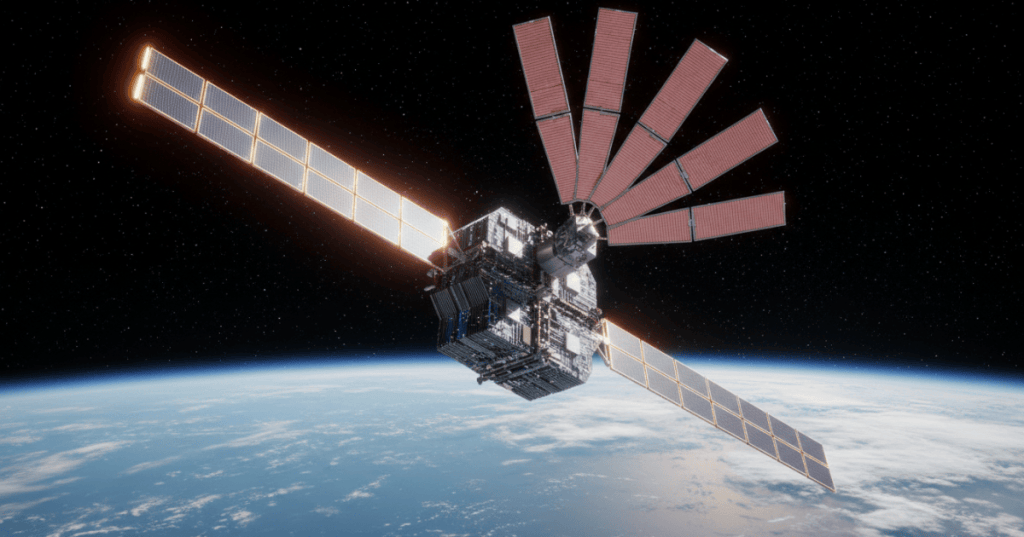
Starcloud has opened its Redmond-area spacecraft factory to cameras, showing how the startup is building orbital computing systems around NVIDIA graphics processors, deployable radiators and solar power. In an October 31, 2026 video tour hosted by Molly O’Shea of Sourcery, CEO Philip Johnston and engineers described the hardware already flying, a second spacecraft under assembly and ambitions for industrial-scale orbital data centers.
Starcloud-1 launched in November 2025 with an NVIDIA H100 data-center GPU. The company says the spacecraft has performed AI workloads in orbit, a technical milestone distinct from operating a profitable commercial data center. The new factory tour offers a closer look at engineering constraints than earlier coverage of chips flown in space.
Inside Starcloud’s $2B Space Factory, published October 31, 2026 by Sourcery with Molly O’Shea. Original reporting and factory tour featuring Starcloud’s executives and engineering team. Credit: Sourcery.
The Discussion Deepens Around 15 Minutes
The factory interview at 15:00 moves into a discussion of ambitious spaceflight and launch economics. Sourcery’s published chapter guide places a proposed $15 million mission to the nearest star at 13:12, equipment for an Alpha Centauri spacecraft at 17:49, and Johnston’s highly speculative SpaceX valuation discussion at 19:10. Those segments are broader aerospace projections rather than demonstrated orbital GPU economics.
The interview returns to Starcloud’s near-term hardware at 24:22, when engineers discuss Starcloud-3 dimensions, and at 33:49, when the discussion turns to GPU survival under space radiation. The published chapter markers provide useful navigation; a complete word-for-word transcript of the 15-minute passage was not independently obtained.
An H100 in Orbit, a Larger Satellite on the Ground
The 2025 satellite demonstrated that a terrestrial-class accelerator could survive launch and execute workloads above Earth. In the interview, Johnston said Starcloud built its first spacecraft for approximately $2.5 million, compared with much higher quotations from aerospace contractors. The figure is a company-reported spacecraft cost, not the complete cost of a scaled orbital data-center service.
The company says it has raised about $450 million, including an August $250 million financing round, and was valued at approximately $2.3 billion in that transaction. Investors include NVIDIA and Cisco Investments. The capital will fund manufacturing, launches and engineering, not proof of future profitability.
Starcloud-2, shown undergoing integration and testing, is targeted for January 2027 according to the October 31 interview. Earlier schedules placed its launch in 2026; the new timing should be treated as a revised target, not a completed mission. Engineers demonstrated deployment hardware and vibration testing. Starcloud says the next satellite will have roughly 100 times Starcloud-1’s power capability.
Cooling Is an Engineering Problem, Not Free Refrigeration
Computing chips convert most consumed electrical energy into heat. In vacuum, air convection cannot remove it. Starcloud therefore uses internal cooling systems to transport waste heat toward radiators, which reject energy as infrared radiation. Large radiator area adds mass and structural complexity, and radiation exposure can increase hardware failure rates.
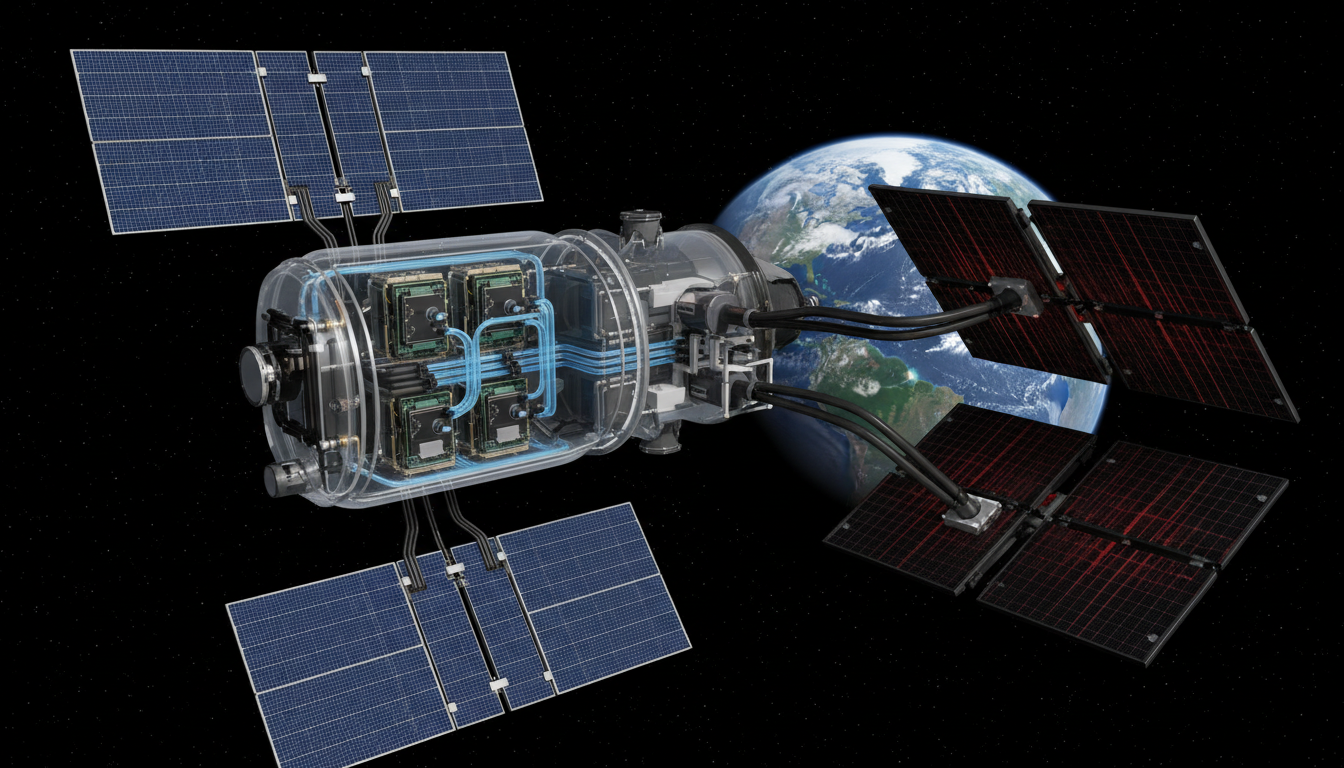
Starcloud engineers described extended chip burn-in and radiation testing intended to identify failures before launch. Hardware cannot be serviced as readily as in a terrestrial facility. A failure-rate increase of even 10%–20% could undermine the business model, Johnston said. Prior reporting on Google’s orbital TPU work shows competitors face similar thermal and radiation questions.
An 88,000-Satellite Proposal Is Not a Deployed Network
Starcloud has applied to the Federal Communications Commission for authority to operate up to 88,000 satellites between 600 and 850 kilometers altitude. The filing is a request, not an authorization or deployment count. Johnston described a future Starcloud-3 design weighing about two metric tons and drawing roughly 235 kilowatts, with as many as 50 units envisioned per Starship launch. Neither Starship delivery capacity nor sustained operations at that scale have been demonstrated.
Johnston also argues orbital data centers could become competitive if launch costs fall toward $500 per kilogram. Such economics depend on launch prices, radiator mass, replacement rates, communications, insurance and usable solar exposure. The argument remains a projection, not an observed industry cost advantage.
Starcloud’s earlier lunar-computing partnership and Bitcoin-mining hardware plans show the breadth of potential workloads. The near-term test is whether Starcloud-2 launches, maintains stable GPU performance and serves paying customers at predictable cost.
Editor’s Note. Reporting is based on the October 31 Sourcery factory interview, NVIDIA’s October 2025 Starcloud profile and public FCC filing. Funding, performance and cost figures are attributed to Starcloud where independent verification is unavailable. The video is original interview footage; playback is separately checked after publication.

Scan the original QR code using another device to support independent research.
We volunteer daily to ensure the information on this platform is Verifiably True. If you would like to support the research, please scan QR code.


Leave a Reply