November 15, 2026 — Energy / Battery Technology.
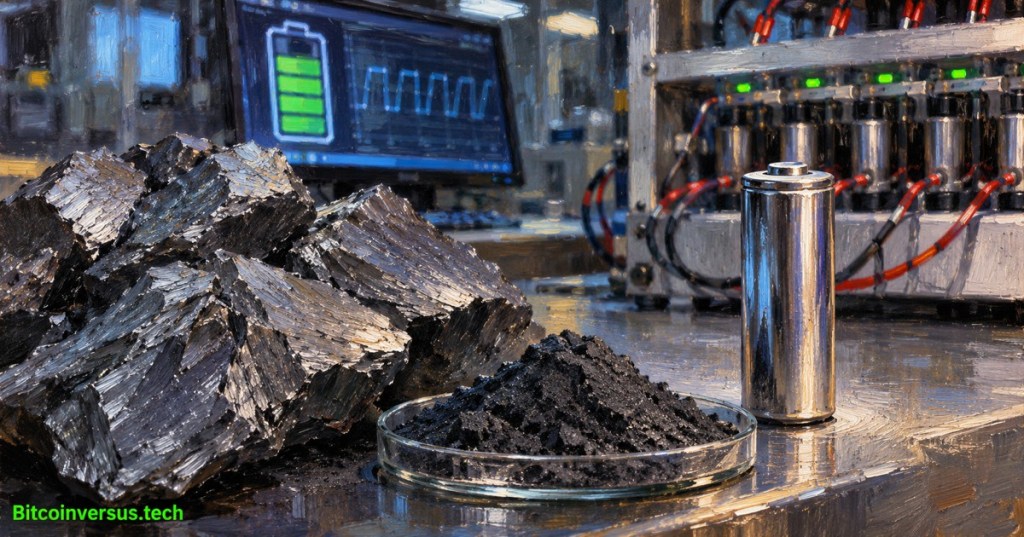
Australian battery-materials producer Talga Group says natural graphite from its Talnode-C anode has been used in lithium-ion cells that completed more than 8,000 charge-discharge cycles during testing by KRI, a research subsidiary of Osaka Gas. Announced November 12, 2026, the result suggests longer service life for applications that charge and discharge batteries frequently, but it remains a laboratory result rather than evidence of commercial deployment.
An anode stores lithium during charging and releases it during discharge. Graphite remains a major commercial anode material because its layered crystal structure can reversibly accommodate lithium ions. Repeated cycling nevertheless gradually changes electrode interfaces, consumes active lithium and can reduce usable capacity. Electrode composition, electrolyte formulation, temperature, charge rate and discharge depth all influence measured longevity.
Primary source: Talga Group ASX technical announcement (PDF), November 12, 2026.
What the 8,000-cycle result means
Talga’s ASX announcement describes the 8,000-cycle result as approximately five times the lifespan of conventional cells. The comparison is a company characterization: cycle counts cannot be compared rigorously without matching the test conditions, capacity-retention cutoff and cell design. The disclosure does not by itself establish identical performance in a vehicle pack or grid installation.
KRI, which Talga identifies as an Osaka Gas subsidiary with three decades of battery research, developed the long-life cells. Talga supplied the graphite anode material. The achievement therefore reflects an integrated cell design rather than proof that the anode alone produced every improvement. Independent replication, detailed electrochemical data and third-party performance benchmarks would strengthen the claim.
High-cycle batteries have an especially direct economic use in stationary energy storage. A system operating daily accumulates thousands of equivalent full cycles over its lifetime. Longer-lived cells could defer replacement costs and reduce material consumption, provided initial cost, round-trip efficiency, safety and calendar aging remain competitive. For high-mileage fleets and robotaxis, charging speed and operation under varying temperatures would also matter.
Official company disclosure: Talga Group ASX release (PDF). No verified official video was identified for the battery test; no unrelated player has been substituted.
Commercialization remains years away
An illustrative calculation helps explain the scale: 8,000 complete cycles at one cycle per day corresponds to about 21.9 years of cycling. That is not a 22-year warranty or predicted field life. Calendar aging, partial cycles, operational downtime and actual depth of discharge make the practical result different. Even a battery capable of extensive cycling can fail other lifetime requirements.
Talga says pilot samples are already in KRI’s customer evaluation program, with scale-up toward mass production targeted for 2030. Customer evaluation is not a purchase commitment, and the production date is a target. Manufacturing yield, supply contracts, electrode consistency and qualification testing still separate the laboratory result from high-volume availability.
The news adds another development path to battery innovation alongside zinc–iodine research, advanced battery-related fabrication, power-intensive AI networking expansion and automation of laboratory experimentation. Those reports address different technologies, but together show why improved materials and reliable validation are important across energy-intensive industries.
The next decisive evidence will be a complete cell-test protocol, retained-capacity measurements, safety results and repeatable performance across production-representative samples. Until then, 8,000 cycles is a promising reported test milestone—not a confirmed industry-wide fivefold improvement.
Source and disclosure
Talga Group, ASX announcement, November 12, 2026. Company-reported laboratory performance has not been independently reproduced for this article.
Editor’s Note: BitcoinVersus.Tech reports technical developments with attention to primary evidence, commercial readiness and the limits of available data. Coverage does not constitute investment advice. Reader contributions are voluntary and do not influence editorial conclusions.


Leave a Reply