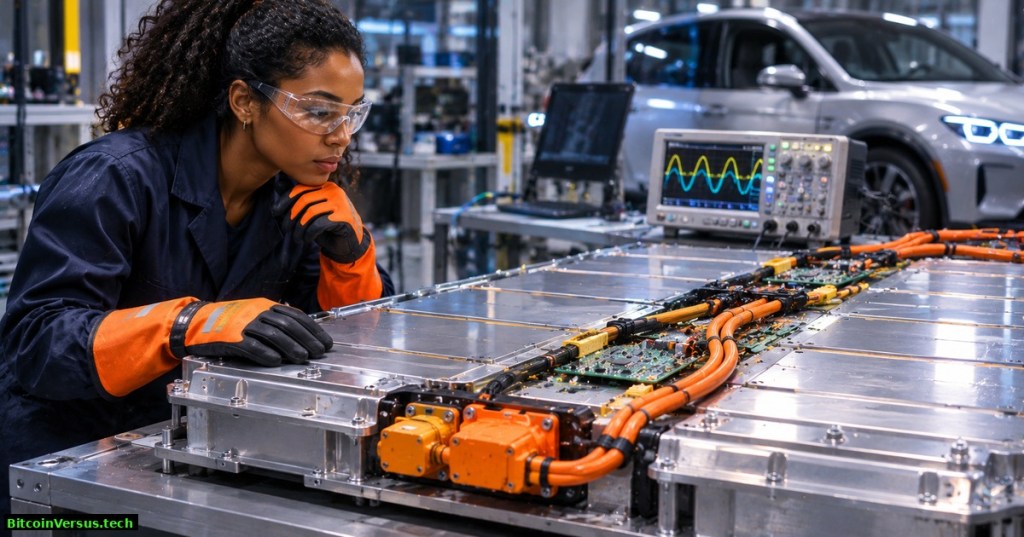
BMW Group and semiconductor supplier Lumissil Microsystems have demonstrated a way for an electric-car battery to send monitoring information across the electrical connections already carrying power. Their November 10, 2026 announcement describes two-way power-line communication, or PLC, across a complete 800-volt Gen6 battery system. The potential reward is fewer dedicated communication wires and connectors inside future battery packs.
The experiment used BMW’s sixth-generation hardware, already associated with the new iX3, to connect a central battery-management controller with multiple cell-supervisory circuits. Lumissil says the system transmitted cell measurements and control commands under varying electrical conditions. The company does not provide quantitative packet-error rates, data throughput, saved wiring mass or production cost figures.
BMW Group official video, December 8, 2025, showing Gen6 high-voltage battery assembly at Debrecen. Archival manufacturing context, not footage of the November 2026 PLC test.
How can electricity and data share the same conductors?
In conventional packs, monitoring circuits sample cell voltages and temperatures and pass those readings through dedicated data connections to the battery management system. Power-line communication instead superimposes a modulated signal on existing conductive paths. Receiver electronics recover the signal while the conductors continue serving their primary electrical function.
BMW and Lumissil call the approach “No New Wire.” The phrase describes the communication network. The high-voltage conductors, battery sensors, protective devices and the electrical insulation needed for vehicle safety do not disappear. PLC is also not the same as wireless communication; the information still travels through a physical electrical connection.
The test connected a central controller and several cell-monitoring nodes. According to Lumissil’s November 10 release, bidirectional exchanges worked at individual-cell and complete-pack levels over representative voltage and current conditions. The results establish feasibility on the tested architecture, not certification for all driving, crash or aging environments.
Why a simpler battery harness matters
Each dedicated connector adds an assembly step and another interface to inspect. A communication scheme requiring fewer parts could make battery construction simpler and potentially reduce mass, cost and service complexity. The companies present those as expected benefits, rather than measured reductions.
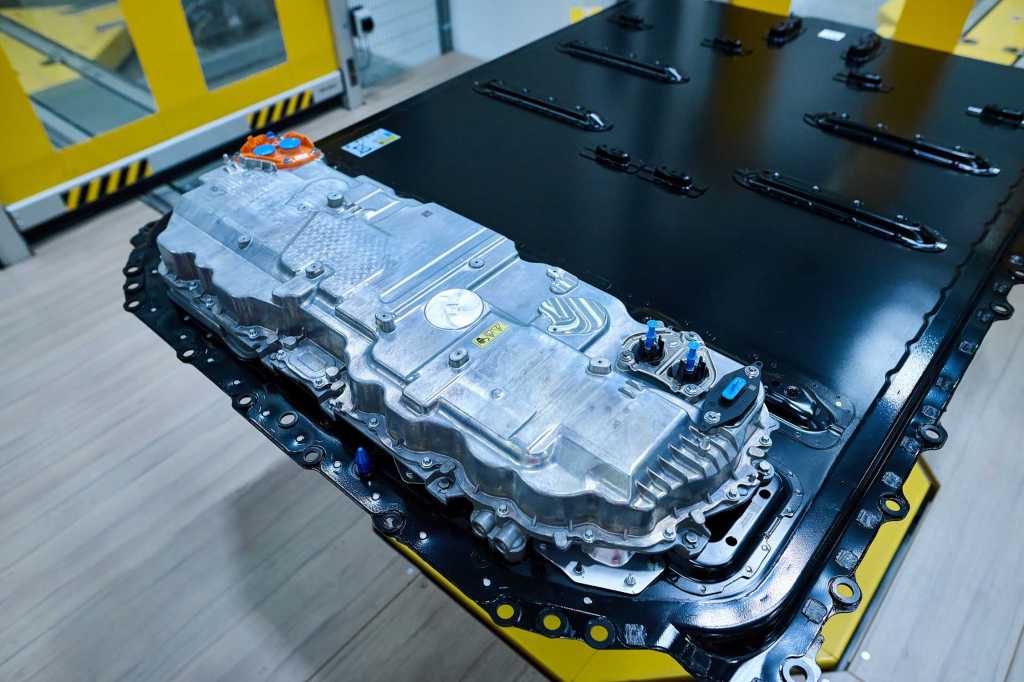
BMW’s Gen6 pack uses a cell-to-pack arrangement that places cylindrical cells directly into the high-voltage battery housing. BMW’s central Energy Master consolidates essential control functions. The company has separately expanded battery manufacturing, including the new Woodruff plant in South Carolina. The experimental PLC architecture should not be confused with a confirmed wiring change in every BMW vehicle already leaving those factories.
Official BMW Group video, February 7, 2026, explaining how the iX3 Gen6 high-voltage battery contributes to the vehicle body structure. Not a PLC measurement or demonstration.
The harder problem is electrical noise and safety
An 800-volt traction system is not a quiet communication channel. Switching inverters, charging hardware and changing battery impedances can interfere with a modulated signal. A peer-reviewed study of automotive high-voltage PLC channels describes noise and coexistence problems that any real implementation must manage.
Production approval would also require robust isolation, diagnostics, fault handling, electromagnetic compatibility and dependable communication when components age or fail. A successful laboratory exchange does not automatically establish automotive functional-safety compliance. The November announcement gives no commercial integration schedule, production pricing or independent endurance data.
BMW’s broader EV strategy has already been covered in our reporting on its electric-vehicle sales mix. Parallel innovations include 800-volt DC power equipment for AI facilities and a graphene sensor powered by nearby electrical fields. Neither uses the same battery PLC system, but both illustrate efforts to get more functionality from existing electrical infrastructure.
The next test is a production-ready battery
The practical questions are measurable: how many connectors could be removed, what weight would be saved, how often do messages fail under electromagnetic stress and how safely does the system handle missing data? BMW and Lumissil plan to continue development. For now, the confirmed milestone is a complete-pack communication demonstration, not a wire-free vehicle or a production launch.
Sources and technical reading
- Lumissil Microsystems, November 10, 2026, BMW joint test announcement
- EV Engineering & Infrastructure, November 12, 2026, independent industry reporting
- BMW Group, October 15, 2026, Gen6 manufacturing and Energy Master background
- BMW Group official July 2025 production photograph
- Energies, 2021, power-line communication for automotive high-voltage batteries, channel modeling and coexistence
Editor’s Note: We volunteer daily to ensure the credibility of the information on our platform is Verifiably True. If you would like to support our work and the integrity of our research initiatives, scan the QR code below to donate 5,000 sats.

For mobile scanning, open the article on another display and scan the QR code with a Bitcoin wallet. Verify the receiving address 3C9o19EH5HSiwEPyCTmEKzxhNCbo2X6TTb before sending.
BitcoinVersus.Tech provides technology, engineering and financial journalism for informational purposes and does not provide financial, investment, legal or professional electrical engineering advice.


Leave a Reply