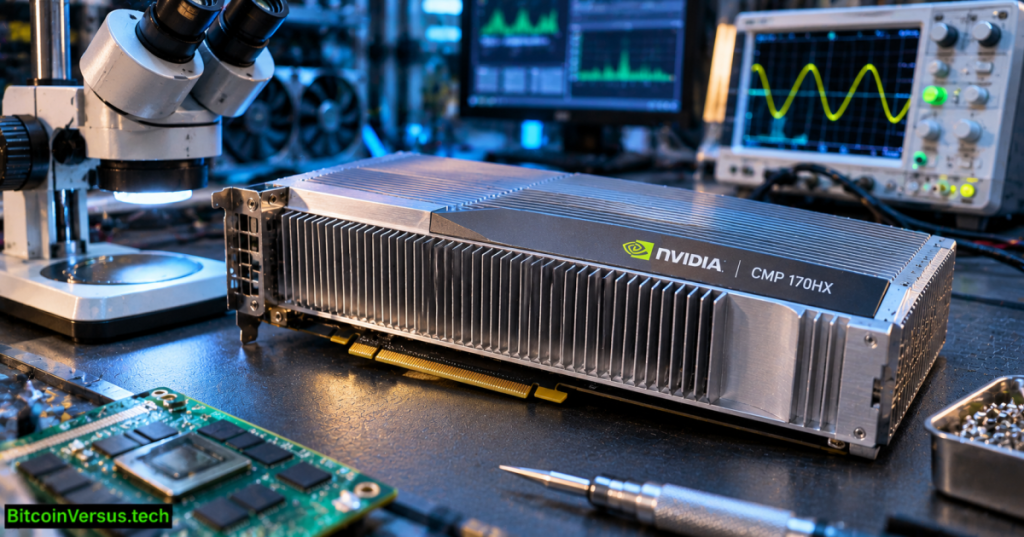
A cryptocurrency mining GPU once restricted to 8 GB of accessible memory has been experimentally unlocked to expose 80 GB. Hardware researcher Kate published the original November 10, 2026 findings after investigating NVIDIA’s CMP 170HX, a 2021 Ethereum-mining accelerator built with the GA100 silicon also used in A100 AI processors. Nine of ten 8 GB specimens she examined reportedly had a functional 80 GB framebuffer. Her research shows what some mining-era silicon can do after modification, not a universal upgrade, approved NVIDIA feature or new Bitcoin mining breakthrough.
Linus Tech Tips’ September 2026 investigation of earlier CMP 170HX memory unlocks. Archival footage predates Kate’s November hardware-fuse research.
Why a mining card had hidden AI hardware
NVIDIA created Crypto Mining Processor cards during the 2021 Ethereum GPU-mining boom, separating mining buyers from its gaming GPU market. The CMP 170HX shipped without video outputs and with major compute features disabled. It nevertheless contained a GA100 processor related to NVIDIA’s professional A100, including high-bandwidth memory physically installed on the package. NVIDIA’s original CMP strategy aimed to serve coin miners with specialized products.
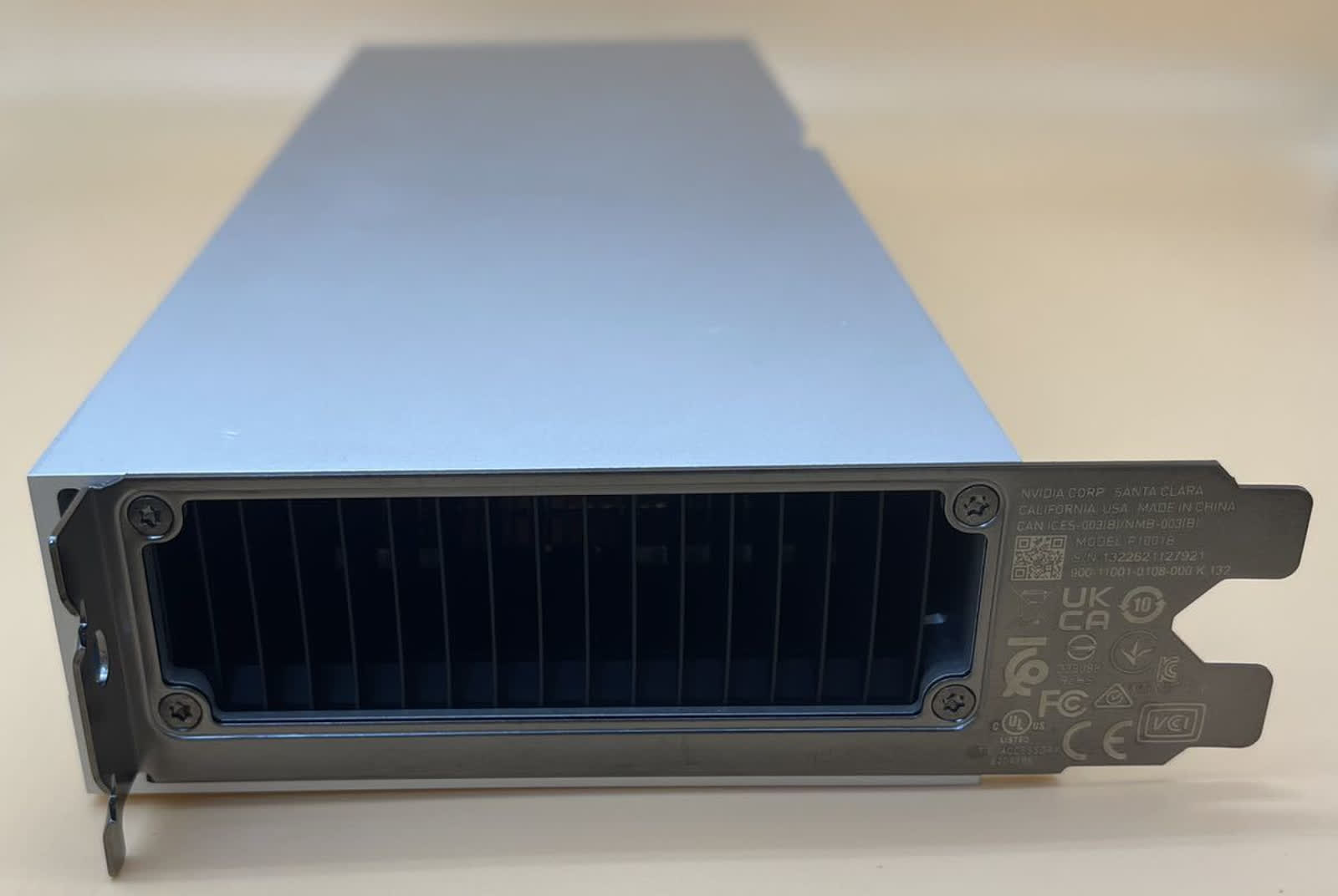
Earlier community software modifications recovered up to 64 GB on some 8 GB boards. Kate’s work goes further: she reports a hardware security fault that temporarily affects how the chip interprets configuration restrictions, allowing additional permanent feature changes. The process involves invasive work and carries a real risk of rendering the card unusable. It is not a routine driver download or a safe upgrade guide.
The card topped an A100 in one specific test
Kate reports approximately 120 to 126 working streaming multiprocessors on suitable modified dies, versus the 70 enabled on a stock CMP 170HX. Her tested card produced 85.861 TFLOP/s in one OpenCL FP16 fused-multiply-add test, compared with 72.488 TFLOP/s for the listed retail A100. The difference is about 18.4%. Researcher-provided results do not establish faster AI model inference, better Tensor Core performance or higher efficiency at equal electrical power.
| GPU configuration | FP16 FMA throughput |
|---|---|
| Software-unlocked CMP 170HX | 50.129 TFLOP/s |
| Retail NVIDIA A100 reference | 72.488 TFLOP/s |
| Hardware-unlocked CMP 170HX | 85.861 TFLOP/s |
Community member’s November 15 report of a CMP 170HX showing 80 GB memory and 126 SMs, published in r/LocalLLaMA. An individual account, not a manufacturer validation.
Eight-gigabyte and ten-gigabyte versions differ
Memory unlock results depend on the card. The 8 GB variant was the main subject of Kate’s research; her sample included one card with only 64 GB of healthy memory. The nominal 10 GB version typically has different physical memory constraints and often exposes only 40 GB after earlier modifications. An operating-system readout claiming 80 GB does not prove that every address range stores unique usable data. Independent full-range tests and sustained workloads are essential.
July 2026 creator testing ten CMP 170HX cards for local AI workloads. Older community testing, not a demonstration of Kate’s November voltage-fault method.
Why the story matters to GPU miners
The CMP 170HX targeted Ethereum’s former Ethash proof-of-work algorithm, not Bitcoin’s SHA-256 mining. Ethereum switched to proof of stake in 2022. Restoring general-purpose computation may therefore create alternative uses for stranded mining accelerators, including experimentation with local AI workloads. Related BitcoinVersus.tech reporting explains how mining and cloud computing differ and follows GPU rental markets. Neither article establishes a business case for modifying old cards.
Owners also face unmeasured power consumption, uncertain reliability, secondhand-price inflation and incomplete support for features such as ECC or multi-instance partitioning. Community updates through November 18 describe further successful cards alongside reports of failures. Mining software developments such as GPU voltage tuning and miner recovery fixes are unrelated to the security research and should not be conflated with it.
What would prove practical value?
Useful independent evidence would compare identical model workloads, long-run error rates, external wall-power measurements, host-interface throughput and real acquisition costs. Kate also reports PCIe and limited two-card interconnect functionality, but not a complete replacement for a data-center A100. The enduring finding is that hardware segmentation can hide substantial resources. Whether recovering them yields reliable, economical AI computing remains an open engineering question.
Sources: Kate’s November 10 original research; CMP Wiki technical verification; TechRadar’s November 18 reporting; NVIDIA’s 2021 CMP introduction.
Editor’s Note: We volunteer daily to ensure the credibility of the information on this platform is Verifiably True. If you would like to support our work and help further secure the integrity of our research initiatives, please scan the QR code below to donate 5,000 sats.

Disclaimer: BitcoinVersus.tech provides independent educational journalism, not investment, purchasing, electrical or hardware-modification advice. Voltage-fault research and permanent hardware modifications can damage equipment or compromise security. Reported performance is not independently verified across devices.


Leave a Reply