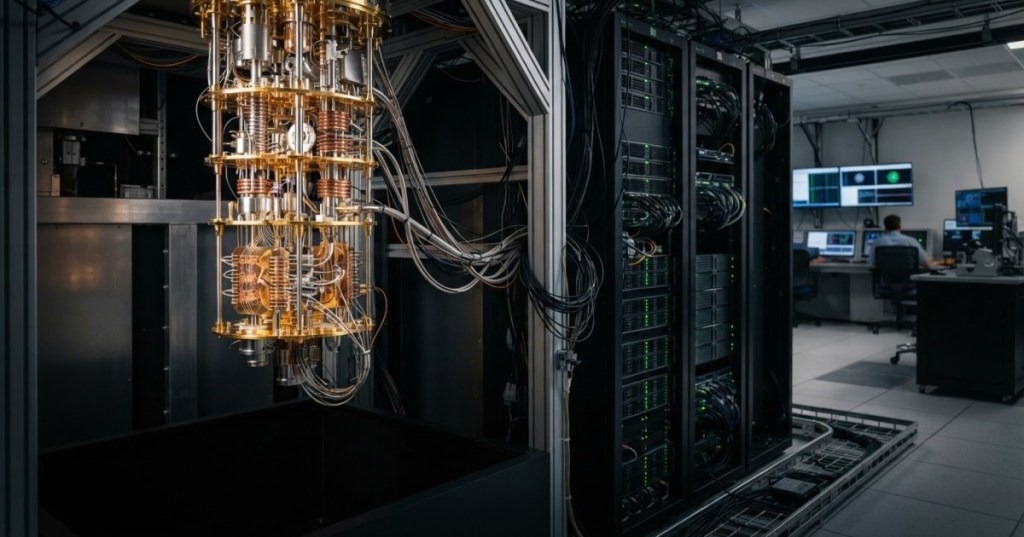
NVIDIA, IBM and the U.S. Department of Energy’s Fermilab announced a quantum computing collaboration on November 16, 2026, aimed at bringing superconducting quantum processors into the same research environment as powerful GPU supercomputers. The partners plan to investigate error correction, modular quantum systems and scientific applications. The announcement describes a developing research platform, not a completed fault-tolerant quantum computer.
IBM Research, August 2026: operational cryogenic modules for future modular quantum systems. Earlier IBM research footage, not a demonstration of the newly proposed Fermilab platform.
Why quantum machines need powerful classical computers
Quantum processors can manipulate delicate states of qubits, but noise causes errors before many useful calculations are complete. Error correction distributes logical information across physical qubits, repeatedly measures error signatures and feeds the results to a conventional decoder. GPUs and CPUs handle the classical computation and control systems surrounding the quantum device.
The partnership intends to co-locate NVIDIA DGX B200 systems with IBM quantum computers, including IBM Quantum Nighthawk, to help researchers test decoder software and physics workloads. IBM’s Nighthawk roadmap concerns future chip scaling; an announced qubit target is not evidence that a fully corrected machine already exists.
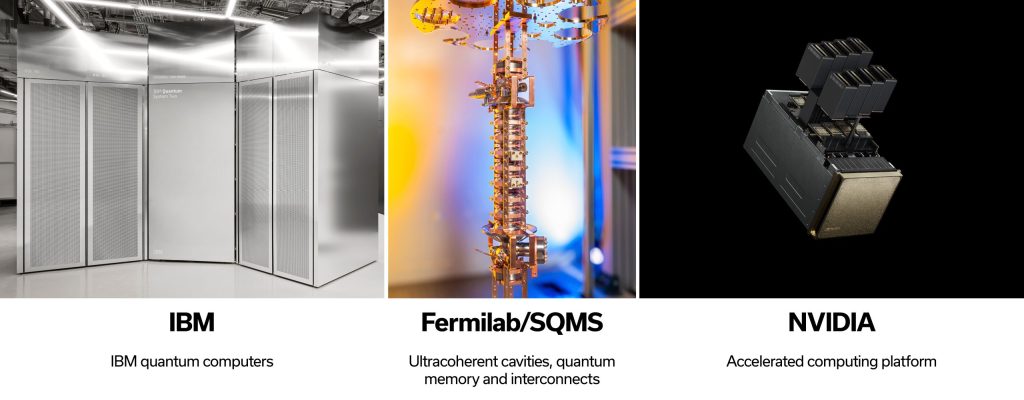
Fermilab will study how modular systems connect
Fermilab says initial work will model and emulate communications between quantum modules, measuring the effects of link errors, latency and feedback. Later research may incorporate the laboratory’s ultracoherent superconducting cavities as quantum memories or interconnect resources. Researchers are targeting high-energy and nuclear physics problems, including particle interactions and lattice gauge theories. Physical links between several error-corrected quantum processors remain a research objective.
NVIDIA Newsroom’s November 16 announcement post concerning IBM, Fermilab, DGX B200 and the separate decoding result. Original post: NVIDIA Newsroom on X.
A 13,000× decoder claim requires context
In a separate November 16 release, NVIDIA introduced TCBP-JOBS, a GPU-accelerated quantum error-correction decoder available in CUDA-Q QEC 0.9.0. The research summary reports speedups from 10× to 7,400× against selected sparsified Tesseract decoder configurations, and up to 13,000× against an unsparsified long-beam baseline on certain bivariate-bicycle codes. Results differ by code, decoder configuration and accuracy target.
NVIDIA also says a quantum-design research task could shrink from 12 weeks to 45 minutes. Converting 12 weeks into 120,960 minutes gives a roughly 2,688× wall-clock ratio, not 13,000×. The figures refer to different comparisons and must not be presented as interchangeable. Neither speedup measures a real quantum computer running every application 13,000 times faster.
Related work illustrates the wider engineering race. BitcoinVersus.Tech previously examined an IBM, AMD and Oak Ridge error-correction platform and an AMD and PsiQuantum decoder latency result. Different decoders, hardware and workloads cannot be compared directly without matched tests.
NVIDIA Developer’s May 2026 CUDA-Q academic demonstration. Earlier educational material explaining the software ecosystem, not a benchmark of the November decoder.
Scheduling a quantum processor like an HPC resource
IBM and NVIDIA also describe Quantum Resource Management Interface integration with Slurm, a scheduler used by large supercomputing centers. The goal is to reserve and account for shared quantum processing units alongside CPUs and GPUs under familiar workload policies. Operators would still need to manage cryogenics, calibration, queue latency and fragile qubit lifetimes. Unified scheduling does not eliminate those physical limits.
The important milestone is integration: testing how accelerator hardware, control software, error correction and scientific workloads interact. The partners have outlined a credible experimental direction, but have not disclosed a finished multi-module quantum computer, a production deployment date or independently verified end-user speedups.
Sources and reporting notes
Primary documentation: NVIDIA, November 16; IBM, November 16; Fermilab, November 16; and NVIDIA’s TCBP-JOBS research record. The featured cover is conceptual artwork, not a photograph of the proposed system. Relevant videos are archival and labeled. External embed playback requires live-page verification.


Leave a Reply