
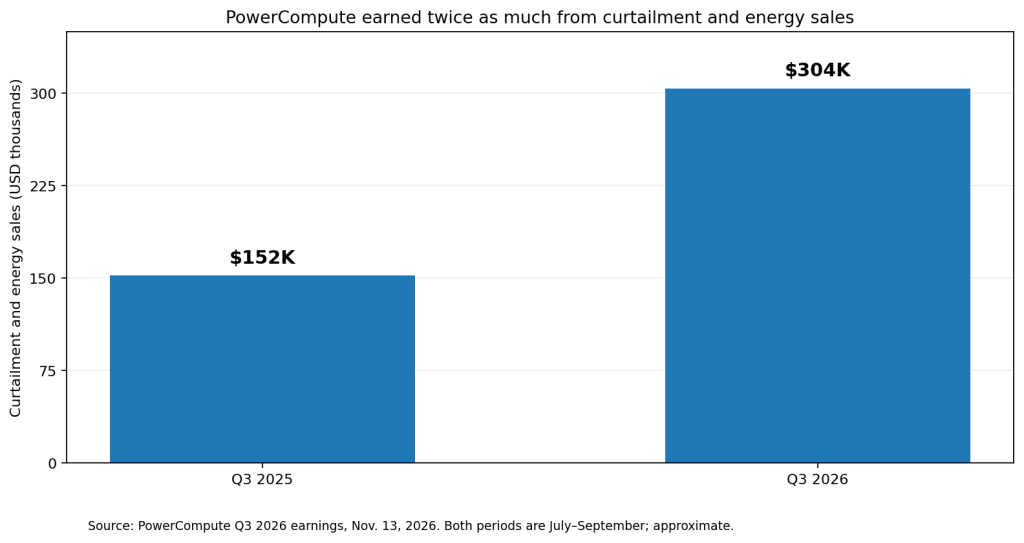
PowerCompute has turned its Oklahoma Bitcoin mining site into a small experiment in GPU rentals, but its latest quarterly filing reveals a striking economic contrast. The company earned approximately $1,000 from GPU computing during the third quarter of 2026, while curtailment and energy sales across its mining operations contributed approximately $304,000. The figures, disclosed in a Form 10-Q filed in November and the November 13 results, show how mining infrastructure can earn money from different uses of electricity.
The amounts are not directly comparable business segments. GPU rental remains a one-machine trial, whereas electricity curtailment reflects a fleet-sized power operation. The contrast nevertheless reveals the scale of the engineering challenge behind a Bitcoin miner’s transition toward AI computing.
Independent demonstration by Rabid Mining, August 2026, of an RTX 3090 mining-era rig offered on Vast.ai. The creator reported a rental associated with a mining-like process; the demonstration is not footage of PowerCompute’s hardware. Watch directly on YouTube.
One professional GPU, approximately $1,000 in income
According to PowerCompute’s filing, it acquired one GPU in July 2026, reporting approximately 101.7 teraflops of capacity without specifying a comparison-ready numeric precision or model. It began offering computing time through Vast.ai, a marketplace where customers rent remote GPU servers. Rates vary with demand, so a machine must attract paying workloads while covering electricity, internet, maintenance and hardware depreciation.
The company previously announced that its first GPU earned Vast.ai’s machine-level Verified designation. That label is not the same as facility-level Certified Datacenter status. A second GPU was ordered, but the November filing does not establish that a large GPU cluster is commercially operating. Our mining versus cloud-computing comparison details why familiar racks and power infrastructure do not automatically create a cloud business.
The grid paid more when the miners backed off
PowerCompute said curtailment and energy sales totaled $304,000 in Q3 2026, compared with $152,000 in Q3 2025, a 100% increase. Curtailment means reducing mining demand when electricity becomes more valuable to the grid than to the miner. The company attributed much of the income to heat-related activity in Oklahoma, and recognized the amount as a reduction in mining costs rather than ordinary GPU rental revenue.
The logic resembles broader demand response: operators can lower electrical load during expensive hours and resume hashing when margins recover. Our coverage of Riot’s $24.7 million power credits and PowerCompute’s 11 MW Mississippi tariff decision examines the grid economics from different angles.
Independent demonstration by The Hobbyist Miner, August 2026, covering Linux installation, network setup and GPU hosting on Vast.ai. Instructional context only; no company-specific production or income is verified by the clip. Watch directly on YouTube.
Bitcoin ASICs remain the principal business
PowerCompute mined 23.9 BTC in Q3, up 35.8% from the prior-year quarter, but reported revenue fell to about $1.9 million from $2.2 million because the average recognized Bitcoin value declined. Net energy cost per Bitcoin, after curtailment and energy sales, fell from approximately $58,000 to $35,000. Those figures should not be treated as all-in Bitcoin production costs.
The company also paid roughly $1 million for 600 newer S21++ ASICs, expecting to replace older miners in existing positions without adding power capacity. Deployment was planned for mid-December, not yet proven complete. Our separate S21++ report covers the hardware upgrade in detail.
GPU rental is not guaranteed AI demand
A GPU marketplace can rent capacity for inference, training, scientific software or even a cryptocurrency workload, depending on its rules and the customer’s software. Renting a GPU does not mean the customer used it for artificial intelligence. The reliability and cybersecurity requirements also differ substantially from ASIC hashing. PowerCompute’s 26 MW of interconnected electrical infrastructure offers expansion options, but the 10-Q still highlights liquidity and going-concern risks.
The strongest near-term lesson is operational flexibility, not an overnight AI transformation. Bitcoin hashing, flexible electricity demand and GPU rentals can share a business strategy without producing comparable revenue, profit or uptime expectations. Verifiable utilization, net revenue per kilowatt-hour and customer retention will determine whether the GPU test graduates into a durable infrastructure operation.
Primary sources and methodology
PowerCompute Form 10-Q, quarter ended September 30, 2026; November 13 earnings release; August 26 GPU Verified status announcement. Calculations: ($304,000 − $152,000) / $152,000 = 100%. Dollar figures and machine performance are company-reported. Videos illustrate independent GPU rental workflows.
Editor’s Note: The cover is original oil-painted conceptual artwork, not an image of PowerCompute’s Oklahoma facility. GPU rental and curtailment figures have different accounting and operational scopes. Technical revenue estimates, future ASIC installation dates and expansion plans must not be treated as guaranteed outcomes. Bitcoin mining and securities reporting is informational, not investment advice.
Support independent research

BitcoinVersus.Tech is volunteer-run and publishes independent technology reporting. Mobile readers may save the QR image and open it with a compatible Bitcoin wallet. On a second screen, scan it normally. Always verify the recipient address and payment amount before sending; Bitcoin transfers are generally irreversible.
We volunteer daily to ensure information on the BitcoinVersus.Tech platform is Verifiably True. Coverage is educational and informational and does not constitute financial or investment advice.


Leave a Reply