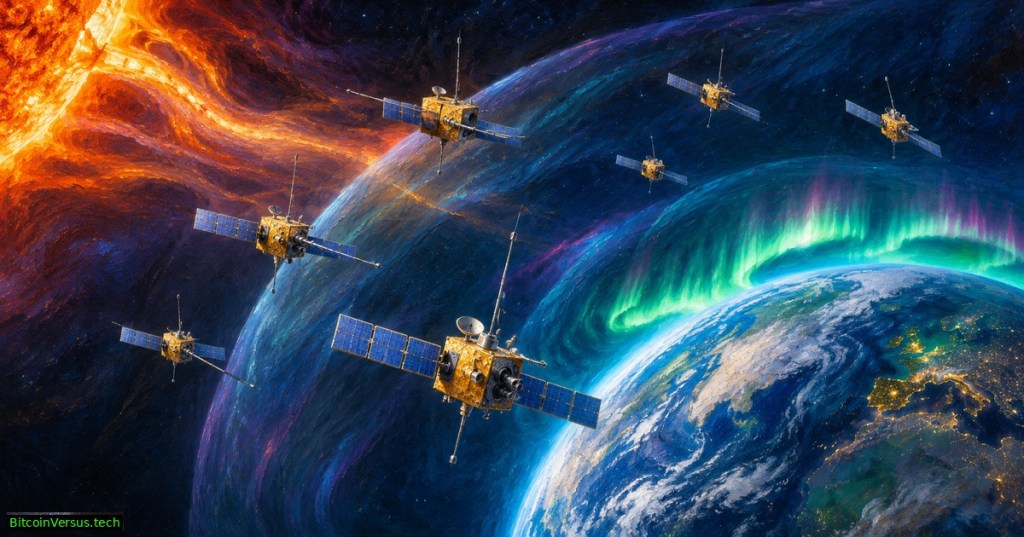
The European Space Agency selected Plasma Observatory as its next medium-class science mission on November 19, 2026. The planned observatory will use seven spacecraft flying in formation to investigate how energy from the Sun moves through Earth’s magnetic shield. The announcement marks a mission selection, not a launch or completion of spacecraft construction. ESA provisionally targets the late 2030s. ESA’s official announcement explains the scientific goal.
Official ESA educational video, March 25, 2026: how Earth’s magnetosphere protects the planet. Background footage, not an animation of the newly selected spacecraft.
Why seven spacecraft matter
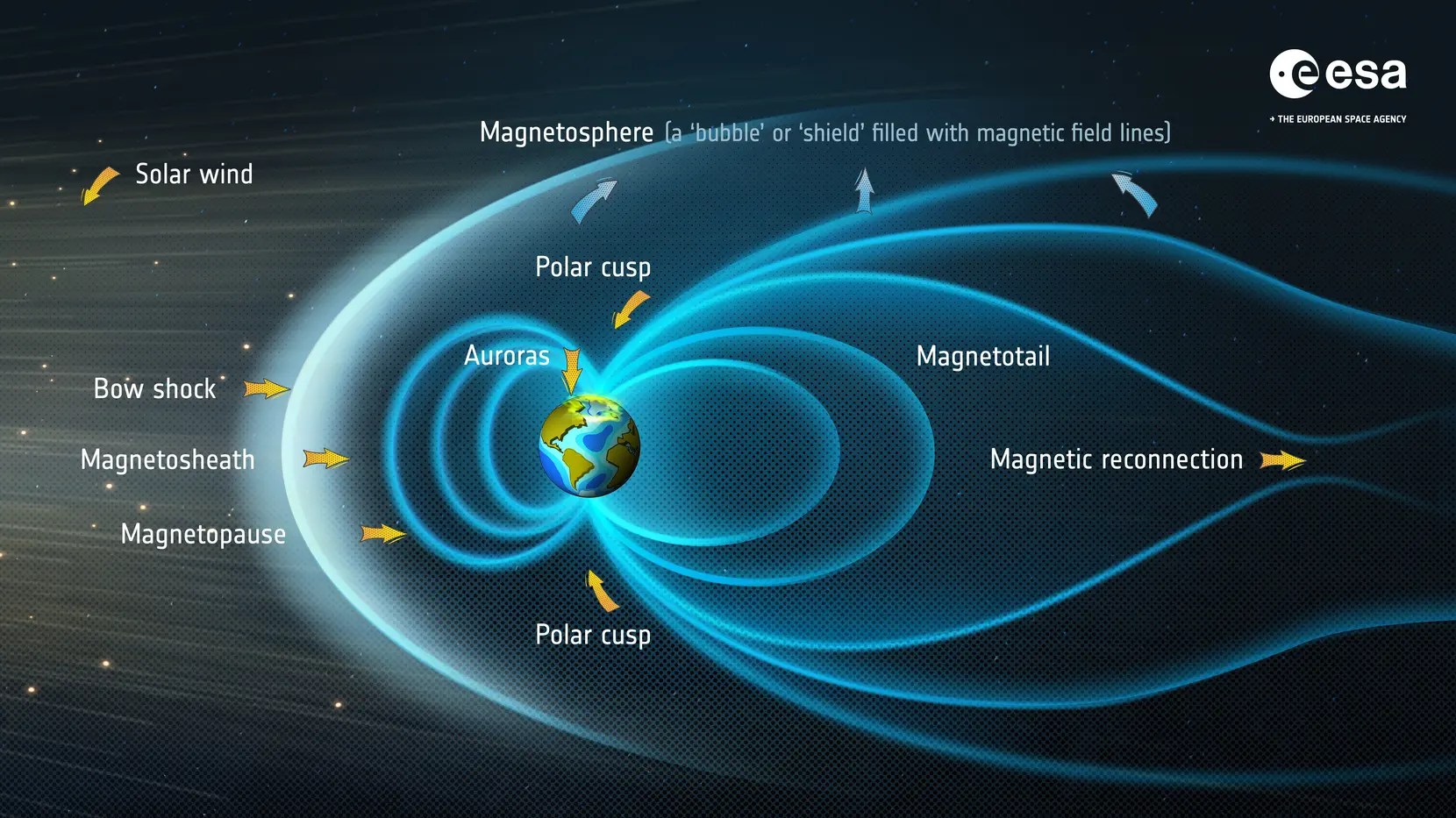
Earth’s magnetosphere is a region dominated by the planet’s magnetic field. Charged particles streaming from the Sun can generate shocks, turbulence and magnetic reconnection at its boundaries. Those processes transfer energy among electric fields, magnetic fields and particles; some of the resulting effects become visible as auroras. ESA says plasma interactions span distances from a few kilometres to tens of thousands of kilometres and times from milliseconds to minutes.
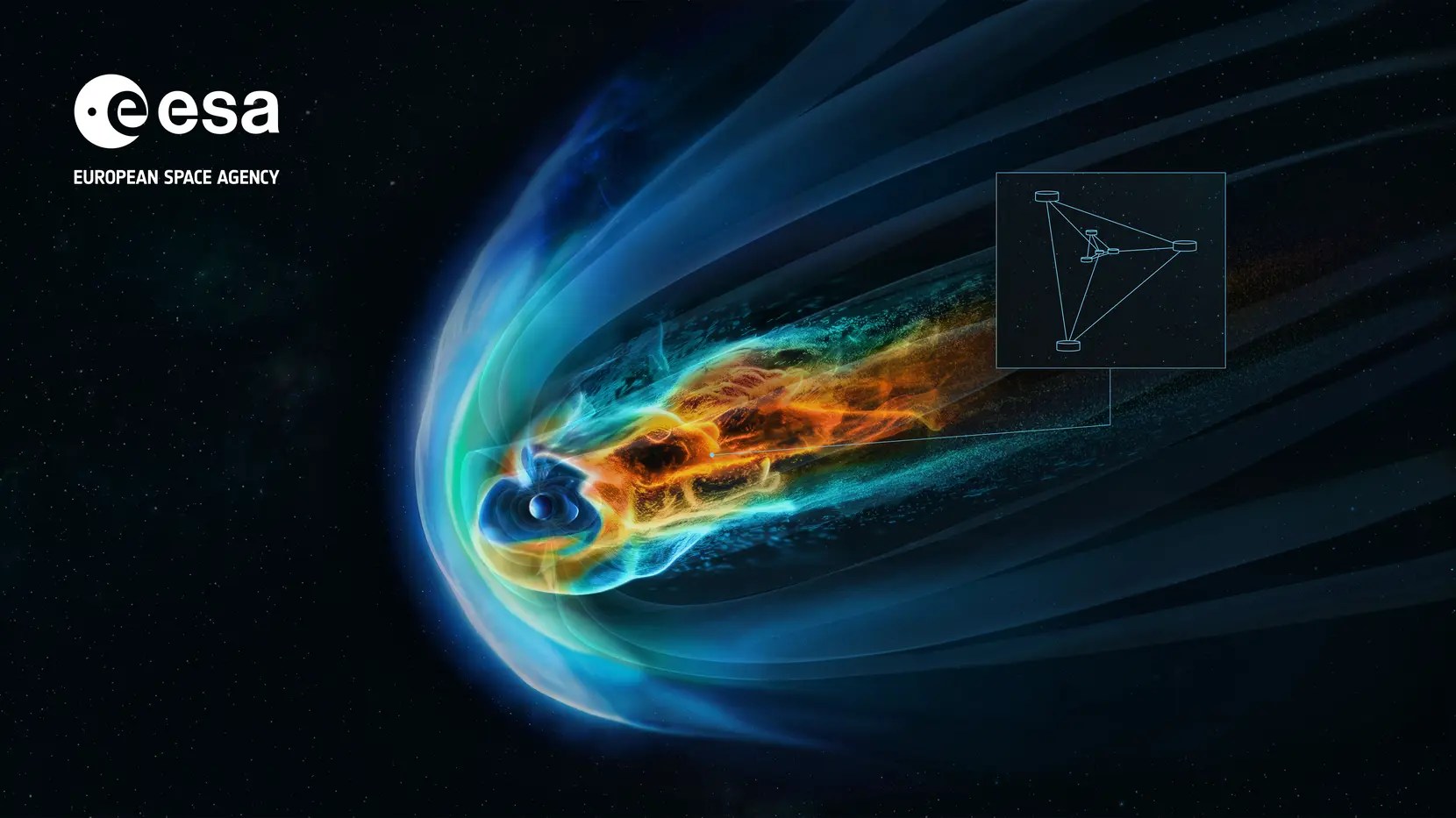
The earlier four-spacecraft Cluster mission revealed many of those phenomena, but could examine only one spatial and temporal scale at a time. Seven simultaneous measurement points could capture two scales in three dimensions during a single event, letting researchers examine how a small disturbance relates to a larger change without assuming events remained static between observations. More probes do not automatically guarantee better science; formation geometry, sensor calibration and timing will determine how effectively the measurements can be combined.
What the satellites will measure
Italy’s National Institute for Astrophysics (INAF), which leads the international mission consortium, describes seven identical satellites following highly elliptical orbits. Instruments will sample electric and magnetic fields and the distribution and composition of charged particles. Italy will contribute an Ion Mass Composition Analyser to identify ion species and investigate their acceleration, along with a digital unit called Box-P for data handling and instrument interfacing.
INAF reports a 2038 target launch year, consistent with ESA’s broader late-2030s projection. Detailed engineering, spacecraft production and launch services remain ahead; the stated date is a plan rather than a demonstrated operational milestone.
ESA’s official 2025 documentary, Seas of the Sun, chronicles the earlier four-spacecraft Cluster mission. Historical context, not new Plasma Observatory footage.
Why the research matters on Earth
Strong solar-wind interactions can disturb satellite operations and, in severe cases, critical electrical infrastructure. Plasma Observatory is designed primarily to establish the underlying physics: where energy enters the magnetosphere, how particles accelerate and how disturbances propagate across different scales. Better physical understanding may eventually improve space-weather models, but the mission has not demonstrated a new forecasting accuracy or avoided any measured grid outage.
Selected, but not yet built
ESA evaluated 27 proposals following its 2021 call before formally choosing Plasma Observatory for the M7 mission slot. Selection must still lead to mission adoption, when ESA commits to full implementation. Instrument readiness, budgets and launch schedules can change. The November decision is significant because the proposed seven-point experiment has cleared scientific and technical selection, not because a seven-satellite fleet is already operating.
The mission extends a wider era of targeted space science. BitcoinVersus.Tech has covered NASA’s ESCAPADE probes studying Mars’ plasma environment, BepiColombo’s mission to Mercury, Euclid’s survey of distant galaxies and Hera’s asteroid instruments. Each probes a different physical system; Plasma Observatory’s distinguishing capability will be synchronized, multiscale measurements of charged particles near Earth.
Sources and official media
- ESA: Seven-spacecraft observatory to study plasma universe, November 19, 2026
- INAF-IAPS: Plasma Observatory selected as ESA mission, November 20, 2026
- ESA: official plasma-environment artwork
- ESA: How Earth’s magnetosphere protects our planet
- ESA: Seas of the Sun — The story of Cluster
Editor’s Note: We volunteer daily to ensure the credibility of the information on this platform is Verifiably True. If you would like to support to help further secure the integrity of our research initiatives, please scan the QR code below

For mobile scanning, open the article on another display and scan the QR code with a Bitcoin wallet. Verify the receiving address 3C9o19EH5HSiwEPyCTmEKzxhNCbo2X6TTb before sending.
BitcoinVersus.Tech publishes science and technology journalism for informational purposes. Selection dates and predicted launch years are subject to change; illustrations and historical footage are identified separately from future mission measurements.


Leave a Reply