
Yes. There is a legitimate statistical argument that Bol Bol has more offensive ability than several NBA power forwards and centers who have received regular playing time. But being better in scoring or shot-blocking statistics does not necessarily mean being the better all-around player.
An important development changes the discussion: Bol last played in the NBA during the 2024–25 season. He subsequently joined TNT in the Philippine Basketball Association in February 2026, where he became a dominant scorer before suffering a reported partial Achilles tear on May 22, 2026. He is currently listed as an NBA unrestricted free agent.
The most defensible comparison therefore uses Bol’s last NBA season against other frontcourt players from the same season, rather than pretending his numbers against Philippine competition are directly interchangeable with NBA statistics.
Bol Bol’s 25-point performance against New Orleans on February 28, 2025 — Phoenix Suns official player highlights. Open the original video on YouTube if the player does not load.
The statistical case for Bol Bol
Points / 36 min: 19.6. Blocks / 36 min: 2.0. Effective FG%: 61.2%.
Bol Bol’s 2024–25 NBA season: 36 games, approximately 12.5 minutes per appearance. The totals are recorded by Basketball-Reference. Effective field-goal percentage incorporates the extra point produced by three-point field goals; it differs from ordinary FG%, which was 52.5%.
His combination of size, perimeter shooting, shot creation and shot-blocking is a genuine NBA skill set. The question is whether those abilities translate into dependable two-way performance over 20–30 minutes every night.
Seven NBA players Bol Bol outperformed statistically
The comparison below uses 2024–25 NBA regular-season numbers for all eight players. Each of the seven comparisons is a frontcourt player on a 2026–27 NBA roster.
| Player (2026–27) | NBA status/team | PTS / 36 | BLK / 36 | FG% |
|---|---|---|---|---|
| Bol Bol | NBA free agent | 19.6 | 2.0 | 52.5% |
| Patrick Williams | Chicago Bulls | 12.9 | 0.7 | 39.7% |
| Keegan Murray | Sacramento Kings | 13.0 | 1.0 | 44.4% |
| Jabari Smith Jr. | Houston Rockets | 14.6 | 0.9 | 43.8% |
| Nikola Jović | Miami Heat | 15.4 | 0.4 | 45.6% |
| Noah Clowney | Brooklyn Nets | 14.5 | 0.7 | 35.8% |
| Oso Ighodaro | Phoenix Suns | 8.8 | 1.0 | 60.4% |
| Ousmane Dieng | Milwaukee Bucks | 12.6 | 0.6 | 43.2% |
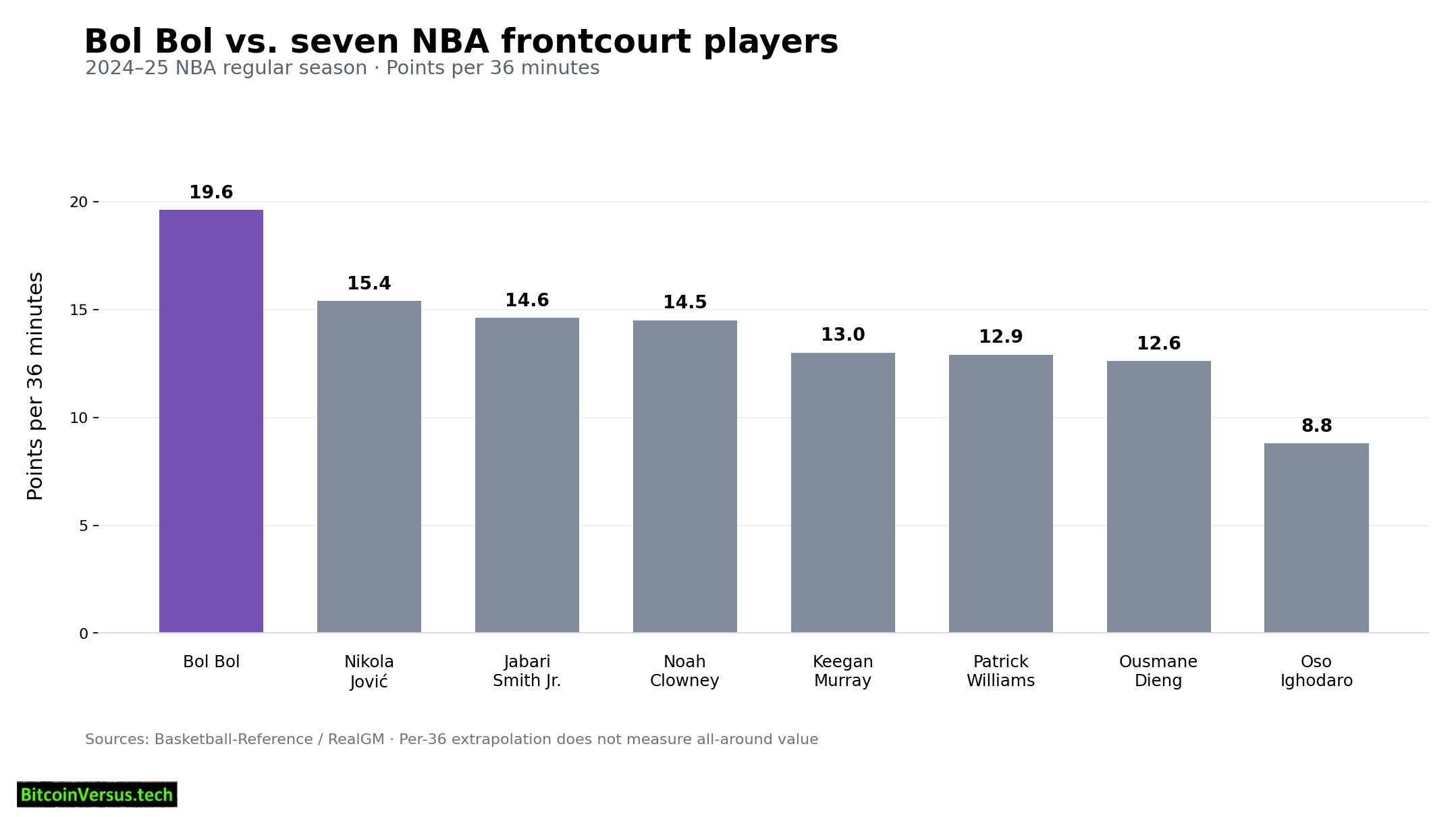
What the figures establish: Bol outperformed all seven in points and blocks per 36 minutes, and six of seven in field-goal percentage.
They do not establish that he is the better defender, passer, rebounder, screen-setter or overall contributor. In particular, per-36 extrapolation from Bol’s 448 minutes may exaggerate what he could sustain as a full-time starter. Compare the broader context in our NBA player-impact analysis.
Why teams might choose those seven instead
1. Patrick Williams — Defensive assignments
Bol’s 2024–25 scoring rate was approximately 52% higher. Williams’ value proposition is positional defensive versatility and taking assignments against opposing forwards. Scoring efficiency alone cannot measure those assignments.
2. Keegan Murray — Established role
Bol produced more points and blocks per minute. Murray has demonstrated an ability to handle significantly larger playing-time responsibilities, and Sacramento has invested in him as a long-term player. A coach is evaluating sustained production, not just projected output.
3. Jabari Smith Jr. — Defensive fit and spacing
Bol had the stronger shooting percentage and scoring rate in the comparison season. Smith’s value includes defending opposing forwards, spacing the floor without requiring plays and functioning in Houston’s established system.
4. Nikola Jović — Playmaking
Bol surpassed Jović in scoring rate, field-goal percentage and blocks. But Jović recorded 4.1 assists per 36 minutes versus Bol’s 1.8. Miami can value another offensive connector even when that player scores less.
5. Noah Clowney — Development investment
Bol’s 2024–25 scoring rate, shooting percentage and blocks rate were all higher. Brooklyn’s decision to develop a younger player with a longer-term roster role is a plausible basketball-business explanation, not evidence of favoritism.
6. Oso Ighodaro — Screens, passing and complementary basketball
Bol generated more than twice Oso’s points per 36 in 2024–25. Ighodaro had a better field-goal percentage and contributes as a screener, rebounder and passer. Phoenix awarded him a reported three-year, $29 million extension in October 2026, demonstrating the franchise’s commitment to his particular skill set.
7. Ousmane Dieng — Upside and organizational evaluation
Bol had stronger scoring, field-goal and shot-blocking numbers in the comparison season. Milwaukee nevertheless signed Dieng to a multiyear contract in July 2026. Such decisions incorporate age, scouting evaluations, development plans and projected fit, beyond historical box-score production.
NBA Politics: Why Bol Bol’s opportunities were limited
Bol’s case is more useful as a question about on-court opportunity than a debate about unrelated events. During a 16-game stretch in February and March 2025, including 10 starts, he averaged 11.3 points, 4.9 rebounds and 1.4 blocks in roughly 21 minutes, according to Arizona Sports. He showed he could score and protect the rim when given a bigger role.
Yet a front office cannot evaluate a player on scoring rate alone. The questions are whether he can stay effective through longer defensive possessions, make reliable rotations, defend stronger opponents, set effective screens and fit alongside the team’s existing starters. The article’s seven comparisons show why coaches sometimes prefer a lower-scoring player for a particular job.
The fair NBA-politics question: Did Bol receive enough opportunity to show his full value relative to players who kept roster spots? His 2024–25 per-minute output supports asking that question. It does not, by itself, prove favoritism or establish that he would outperform every comparison player in the same role. For a separate guard example, see our D’Angelo Russell NBA Politics analysis.
What people call “NBA politics”
Five organizational forces can influence opportunities:
- Coaching trust: Defensive execution, communication, professionalism and relationships affect rotation decisions.
- Contracts and sunk costs: Teams may prefer giving opportunities to players they have already invested heavily in, even though doing so is not always optimal.
- Draft and development priorities: A franchise rebuilding around younger prospects may allocate minutes according to future plans.
- Roster construction: A lower-scoring defensive specialist may make a lineup more effective than another scorer.
- Reputation and relationships: Coaches, executives and teammates form assessments that influence opportunity. Those assessments may be well founded, mistaken or incomplete.
None of these forces is automatically improper. The dividing line is whether a decision genuinely improves team performance or reflects unrelated organizational preferences. Our Kevin Garnett evaluation and Wembanyama statistical analysis show why all-around basketball contribution takes more than one metric.
Final assessment
The evidence supports a narrower but meaningful conclusion than claiming Bol is definitively better than seven NBA players.
Bol Bol demonstrated superior scoring and shot-blocking production per 36 minutes to all seven named frontcourt players in 2024–25. Yet other players’ defensive assignments, passing, dependability and roster fit may justify their opportunities.
Bol’s 2026 Achilles injury also complicates any claim about whether he deserves an NBA roster position today. His most persuasive case comes from measured NBA scoring and shot-blocking, weighed against defense, availability and fit.
The central question for an NBA front office is not simply who has more talent? It is who helps the team win in the role the organization needs filled—and how fairly and accurately does the organization make that judgment?
That distinction is where the discussion of NBA Politics becomes interesting.


Leave a Reply