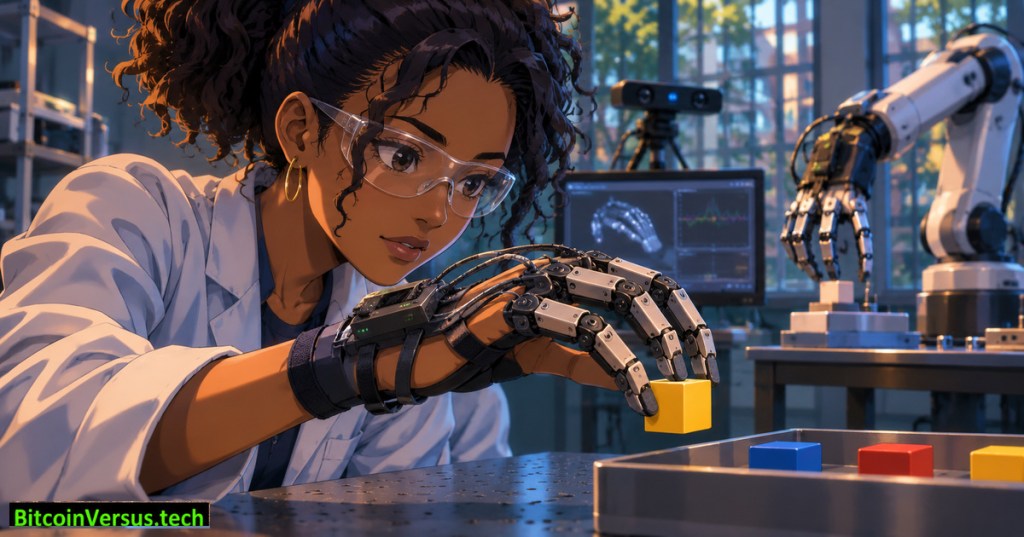
Researchers at UCLA’s Robotics and Mechanisms Laboratory (RoMeLa) have developed a robotic hand that people can wear to teach a machine a task, then remove so the same hardware can perform the learned movement. The prototype, called TriMI, addresses a longstanding robotics problem: a human demonstrator’s fingers and a robot hand rarely move in exactly the same way.
Presented to the robotics community around the November 2026 Conference on Robot Learning (CoRL), TriMI combines three operating modes in one mechanism. The UCLA-led team reports 90% success in a cube pick-and-place test and 75% in a cap-unscrewing test. Those are limited laboratory results, not evidence of a general-purpose robot hand that performs every task reliably.
Official TriMI research demonstration from UCLA RoMeLa: wearable task teaching, robotic execution and teleoperation. The video illustrates the experimental system, not a consumer-ready product.
One hand, three jobs
TriMI—short for tri-modal manipulation interface—has four fingers and 13 degrees of freedom. The thumb accounts for four controlled motions, with three each in the other fingers. Its design allows a person to place a hand inside the wearable mechanism and physically manipulate an object while the system collects motion data. The same device can subsequently be mounted to a robot for execution.
A second mode supports joint-level haptic teleoperation: the user remotely controls manipulation and receives physical feedback from the interface. In the third, a learned control policy drives the robot. The three modes remain distinct; removing an operator’s hand does not automatically convert an arbitrary movement into a reliable autonomous skill.
Ordinary imitation-learning systems must translate human hand movements into different robot joint angles, gripper shapes and force limits. Engineers call the mismatch an embodiment gap. By using shared hardware for demonstration and execution, TriMI can reduce part of the translation problem. The work relates to earlier research into robot training data collected from human motion and touch.
What the tests show
The researchers trained a diffusion-based robot policy on captured demonstrations and tested two tabletop tasks. The robot completed 18 of 20 cube pick-and-place attempts (90%) and 12 of 16 cap-unscrewing attempts (75%). The test sizes are small, and the tasks were selected in advance. The team has not demonstrated equivalent success rates across changing object sizes, unfamiliar environments or long industrial shifts.
The project estimates a materials bill of around $800 for the interface, excluding the external position tracker and wrist camera. That figure is neither a retail price nor a full system cost: robotics arms, assembly labor, computers, training time and maintenance can add substantial expense.
Technical context: UCLA RoMeLa researcher Jun Kim’s May 2026 MIDAS Hand video demonstrates a separate tactile robotic-hand platform. MIDAS and TriMI are different devices; the earlier video does not depict TriMI’s November evaluation.
Why robot hands remain difficult
Physical contact is harder to learn than simply recognizing an object. A cap requires controlled torque; a cube may need a stable pinch without crushing or dropping it. Differences in friction, material stiffness, joint backlash and sensor timing can derail a motion that looks correct on camera. Related projects have pursued other parts of the problem, including Melexis’s 400 Hz fingertip sensor and Carnegie Mellon’s tactile fingertips.
The UCLA device also adds to an engineering landscape that includes Sharpa’s robot hand and haptic-glove system. Those approaches are not direct benchmark competitors; they make different trade-offs between hardware, sensing and training.
Research prototype, not a product launch
The CoRL 2026 UMI Arena accepted TriMI as a research device, and the team reported a top-three finalist finish. As of November 21, its public project page still described the paper and open-source release as forthcoming. Independent replication, durability testing, broader task benchmarks and a complete costed build are needed before the reported prototype can be assessed for production work.
The advance is a practical change in how robots can be taught: the demonstrator and machine can share a physical hand design rather than relying entirely on software to bridge incompatible movements. Whether that reduces real-world training cost at scale remains an open engineering question.
Sources and verification
- TriMI project page — UCLA RoMeLa and collaborators, hardware description, reported evaluation and release status
- CoRL 2026 UMI Arena — official accepted device list, D13 TriMI
- UCLA RoMeLa — official TriMI demonstration on YouTube
- Jun Kim — MIDAS Hand demonstration, May 29, 2026, separate reference project
Cover disclosure: the featured cinematic-anime image is original editorial artwork, not a photograph of TriMI or the UCLA laboratory. The secondary BitcoinVersus.tech logo is copied from the approved reference rather than re-created.


Leave a Reply