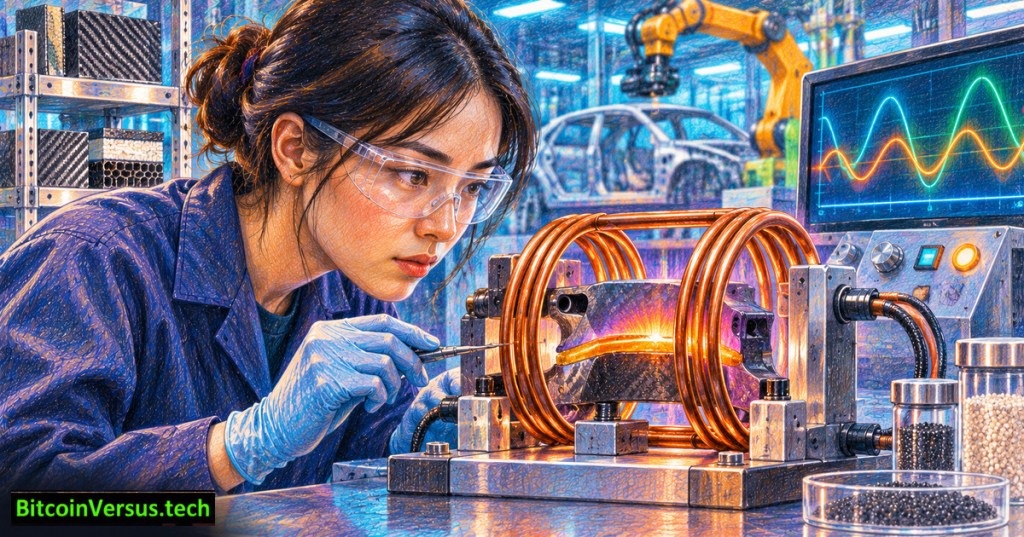
What if automotive adhesive could harden without putting the entire component in a hot industrial oven? Scientists at Nanyang Technological University (NTU), Singapore, and manufacturer Motherson are developing a process called Spinheat that uses magnetic nanoparticles to heat coatings from within. In a November 12, 2026 announcement, NTU reported adhesive samples reaching comparable bonding strength after one hour of magnetic curing versus 24 hours in a conventional oven. The partners are now investigating whether the process works reliably at manufacturing scale.
NTU Singapore’s original 2020 magnetic-glue demonstration. Historic laboratory footage, not a 2026 Motherson factory test. Watch directly on YouTube.
How a magnetic field cures adhesive
Manufacturers bond metal, plastic and composite components using adhesives and resins. Curing allows chemical reactions to form the hardened network that provides a durable joint. Conventional heating may warm an entire oven, its air, tooling and workpiece even though the glue line represents only a small fraction of the assembly.
Spinheat incorporates specially engineered magnetic nanoparticles into adhesives, paints or coatings. An alternating magnetic field makes the particles generate heat locally, accelerating curing inside the treated layer. The coil need not directly contact the glue. Researchers are refining feedback controls that measure temperature and adjust the applied field, helping avoid bubbles, hotspots and thermal damage. The mechanism is localized heating, not adhesive hardening with zero energy input.
One hour versus 24: the real meaning of the test
The laboratory curing durations differ by a factor of 24. Reducing 24 hours to one is a 95.8% reduction in the measured curing time. The tested joints had comparable bonding strength. Those numbers do not establish a 95.8% reduction in factory energy, operating costs or total vehicle assembly time. Industrial throughput depends on preparation, positioning, curing depth, inspection, cooling and equipment utilization.
A separate 2026 peer-reviewed nanoparticle study reported induction curing of a commercial epoxy in five minutes, with approximately 19 MPa lap-shear strength versus 15 MPa for an oven-cured comparison. Its reported energy use was roughly 1.6% of the laboratory oven reference. The five-minute experiment and the one-hour coating trial used different conditions, so the results should not be combined into a commercial performance guarantee.
Can automotive production lines use it?
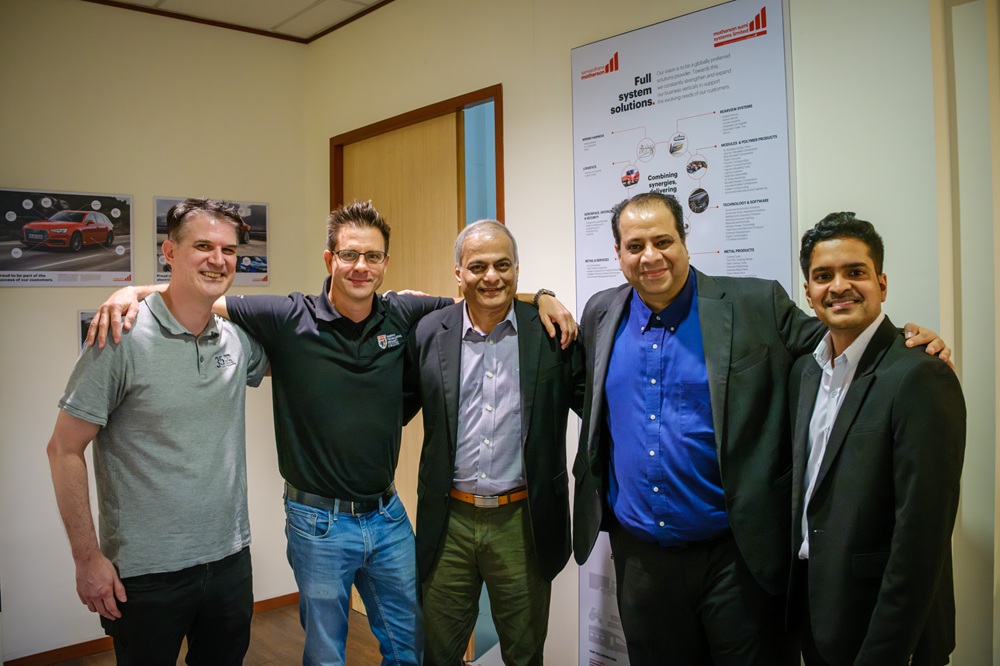
NTU demonstrated an earlier generation of magnetic-field-activated glue in 2020. The new collaboration brings Motherson’s production-engineering experience to coating thickness, component size and geometry, temperature uniformity and quality assurance. The partners are studying automotive and aerospace coatings, composite repair and adhesive bonding rather than announcing a commissioned factory system.
Flanders Make’s 2021 independent demonstration of ferrite-assisted induction curing. Related engineering context, not certification of Spinheat. Watch directly on YouTube.
Scaling up means checking that magnetic particles disperse consistently, induction fields penetrate complex bond lines and joints retain strength through thermal cycles, humidity, vibration and years of service. Coils also introduce electrical, thermal and electromagnetic-compatibility considerations. Independent material qualification, fatigue tests and real metered power measurements will matter more than a single laboratory cure-time result.
Why the energy implications extend beyond glue
Selective heating could reduce one bottleneck on automated production lines. Faster joining might complement robot-made automotive body panels and a manufacturing sector investing in more industrial robots. A quicker curing station, however, cannot raise output if another stage already limits factory production.
Other industries face similar trade-offs. Researchers recently reported faster battery formation with a cycle-life cost, while semiconductor plants carefully control film-processing temperatures and uniformity. Across production systems, improved speed matters only if the finished material still meets durability and safety requirements.
Spinheat is therefore a promising manufacturing research program, not a proven replacement for industrial curing ovens. The next meaningful evidence would be full-sized parts, repeated strength and defect measurements, properly controlled energy comparisons and a documented production pilot.
Primary sources: NTU Singapore, November 12, 2026; ACS Applied Nano Materials, November 2026; NTU magnetic-curing technology description.
We volunteer daily to ensure the credibility of the information on this platform is Verifiably True. If you would like to support to help further secure the integrity of our research initiative, please scan the QR code below.



Leave a Reply