
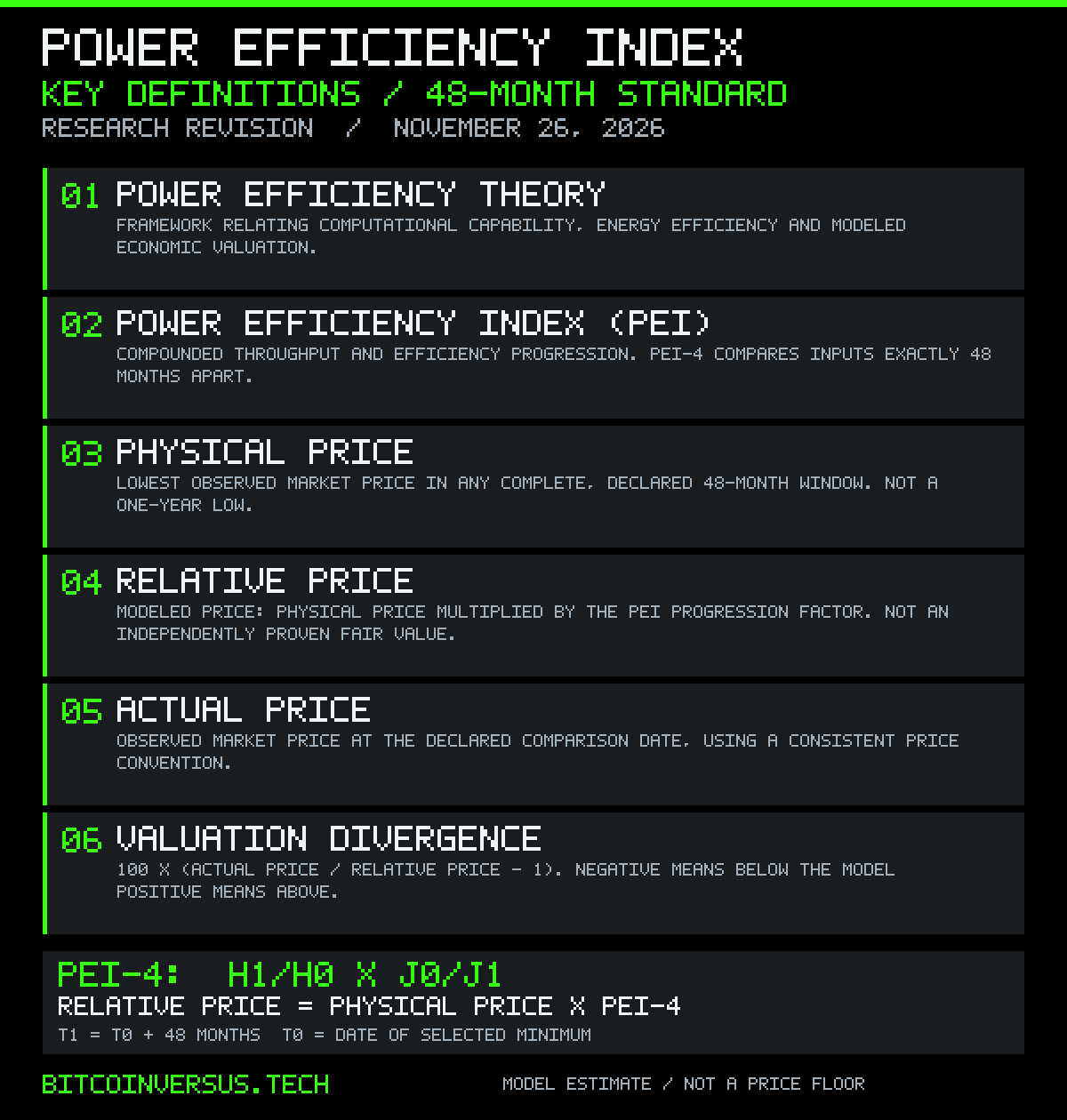
Power Efficiency Theory proposes a mathematical connection between computational progression, energy efficiency and economic valuation. Its comparative application to proof-of-work systems, the Power Efficiency Index (PEI), separates three price points: physical price, relative price and actual price. The January 17, 2026 analytical analogy established the algebraic foundation; subsequent research formalized the 48-month measurement standard. The following synthesis defines the complete framework.
The three price points
| Price point | Definition |
|---|---|
| Physical price | Minimum observed market price in any declared complete 48-month window. |
| Relative price | Physical price multiplied by measured computational and energy-efficiency progression. |
| Actual price | Observed market price at the comparison endpoint. |
The foundational algebraic equation
V(t) = V₀ × (1 + rₚ)t / (1 − rⱼ)t
| Variable | Definition |
|---|---|
| V(t) | Modeled relative price after t elapsed years; currency per coin. |
| V₀ | Physical price: minimum observed market price in a complete, declared 48-month window. |
| rₚ | Annual proportional computational throughput growth rate. |
| rⱼ | Annual proportional reduction in energy per unit of computation. |
| t | Elapsed years from the selected physical-price observation; t = 4 for PEI-4. |
For the standardized four-year reading, V(4) = V₀ × (1 + rₚ)4 / (1 − rⱼ)4. Rates are decimals; both annual factors must be positive. The expression uses constant annual rates or compound annual changes derived from matching endpoints. No calculus is required.
The expanded mathematical expression
W = [a, a + 48 months); Pphysical,4 = minu ∈ W P(u).
t₁ = t₀ + 48 months
R₄ = Pphysical,4 × [H(t₁)/H(t₀)] × [J(t₀)/J(t₁)]
| Term | Complete functional definition |
|---|---|
| R₄ | Four-year modeled relative price; currency per coin. |
| Pphysical,4 | Minimum observed price over window W. |
| W | Complete 48-month selection window. |
| a | First date of W; [ includes a and ) excludes the terminal boundary. |
| P(u) | Observed price at observation time u, using one price convention. |
| u ∈ W | u belongs to W; min selects its lowest observed price. |
| t₀ | Date of selected minimum; earliest observation if tied. |
| t₁ | Fourth calendar anniversary of t₀. |
| H(t) | Computational throughput at date t; Bitcoin hashrate, e.g. EH/s. |
| H(t₀), H(t₁) | Baseline and final hashrate measured consistently. |
| J(t) | Energy per unit of output at date t; Bitcoin J/TH. |
| J(t₀), J(t₁) | Baseline and final energy-per-output values. |
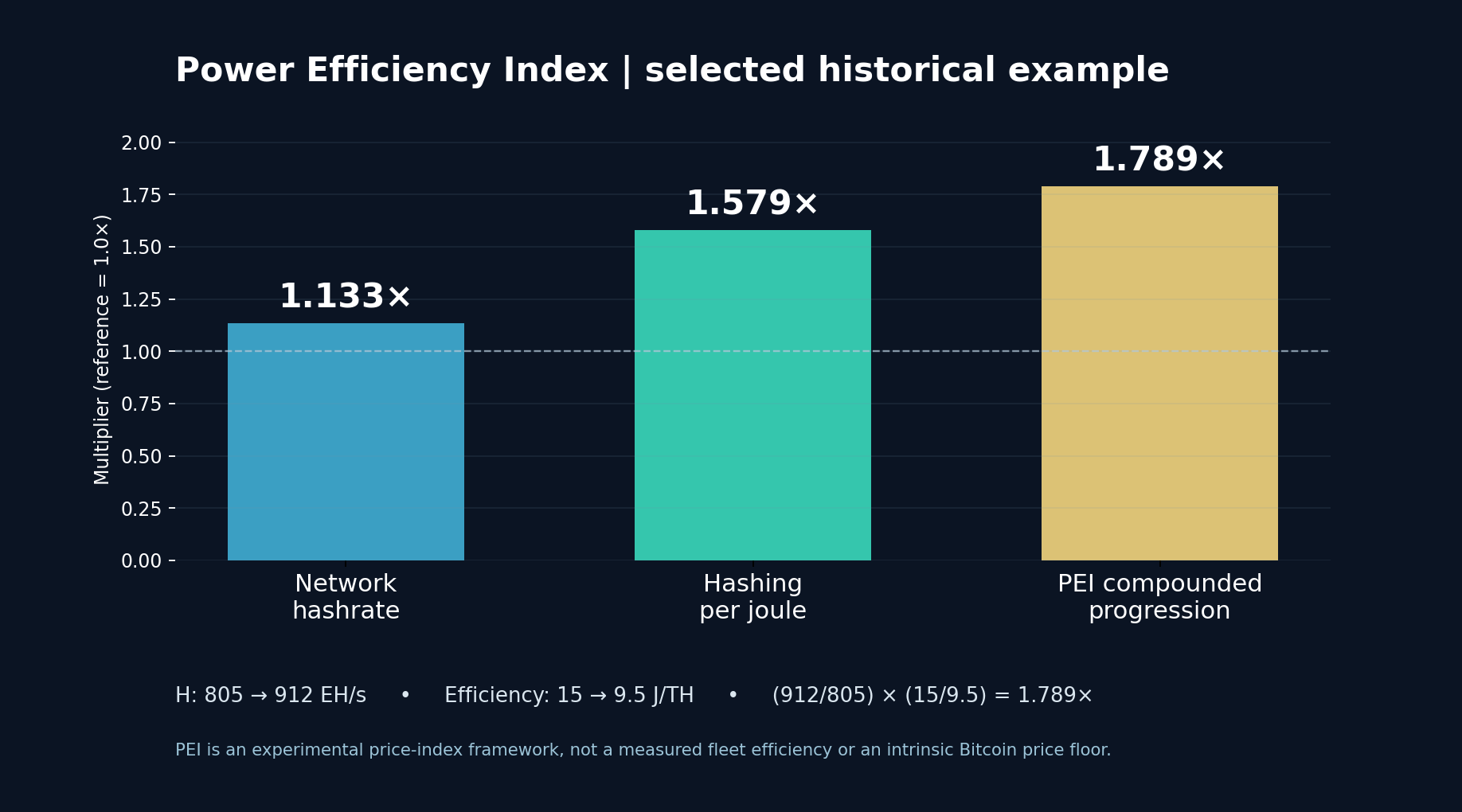
| C₄ = H(t₁)/H(t₀) | Dimensionless computational progression multiplier. |
| E₄ = J(t₀)/J(t₁) | Dimensionless efficiency progression multiplier; inverse energy-cost ratio. |
| PEI₄ = C₄ × E₄ | Combined dimensionless progression multiplier. |
| A(t₁) | Actual observed market price at the comparison date. |
| D₄ | Percentage valuation divergence relative to R₄. |
The energy ratio is inverted because less energy per hash means greater efficiency. The price-selection window and the progression interval need not share endpoints. A full PEI-4 reading requires the final observation to be available; preliminary readings are supplementary. For a February 29 baseline with a non-leap endpoint, use February 28 and disclose the convention.
The four-year standard and actual price
Bitcoin’s subsidy halves every 210,000 blocks, approximately four years. The Four-Year Interval Standard adopts a comparable calendar horizon without requiring halving-year alignment. The 48-month minimum definition supersedes annual-low baseline selection.
D₄ = 100 × [A(t₁) − R₄] / R₄. The subtraction measures the price difference, the denominator normalizes it against relative price, and 100 converts the result into a percentage. Negative divergence indicates a market price below the model; positive indicates above. Zero means parity.
Reproducibility and interpretation
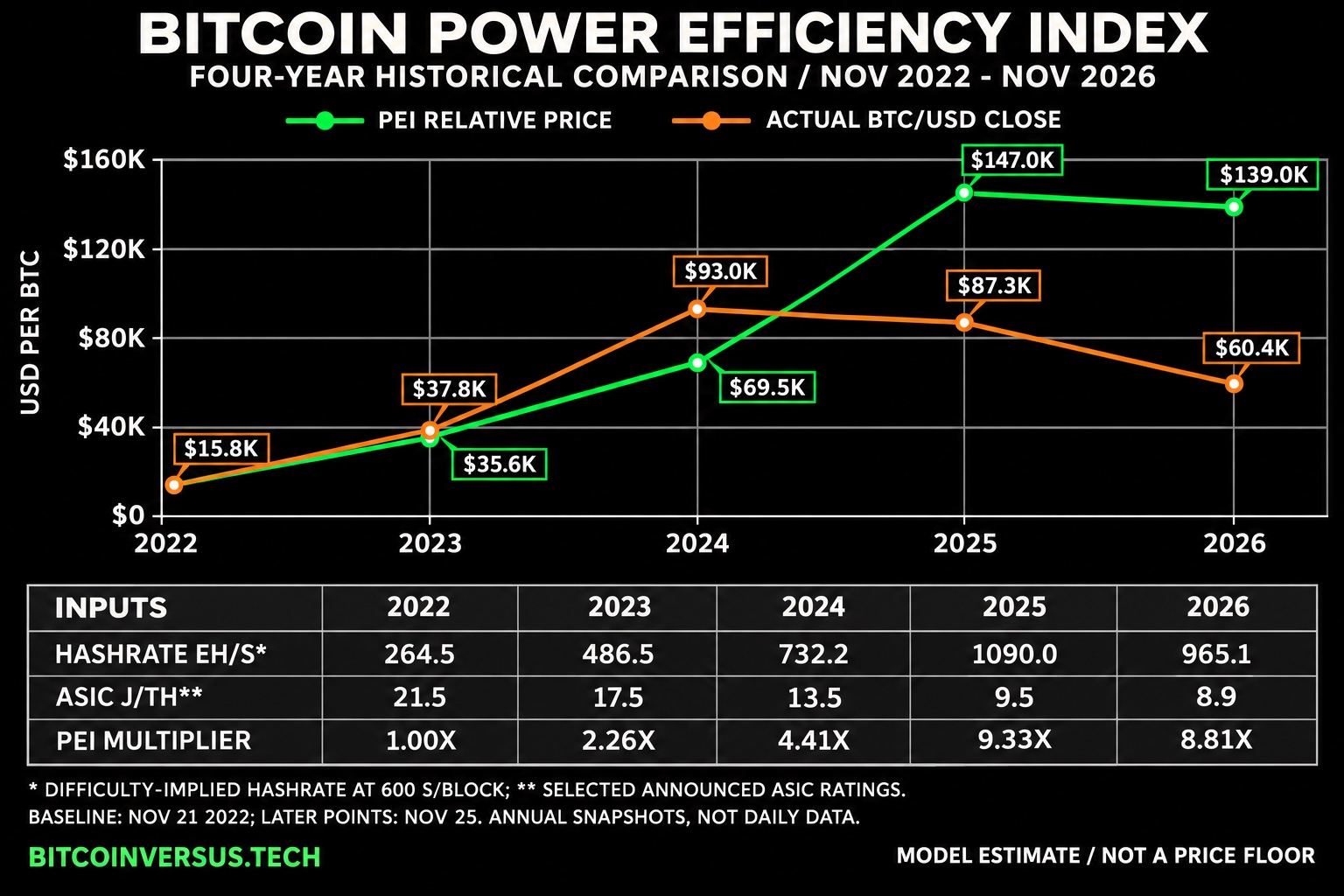
The historical chart illustrates the prior method: its November 21, 2022 to November 25, 2026 interval is four years and four days, and the baseline has not been verified against a complete 48-month series. For standardized readings, declare a currency, venue, price convention, window, hashrate estimator and energy-efficiency metric. Avoid mixing hardware specifications with fleet averages. A hypothetical example with V₀ = $20,000, doubled hashrate and energy cost halved gives PEI₄ = 2 × 2 = 4 and R₄ = $80,000. An actual price of $60,000 gives divergence of −25%.
The physical-price research, relative-price research, Beyond Softwar synthesis and updated Bitcoin Lexicon document the framework. PEI is an experimental valuation model, not a guaranteed market floor, price prediction or independently established fair value. The math is verifiable; the interpretation is experimental.
We volunteer daily to ensure the credibility of the information on this platform is Verifiably True. If you would like to support to help further secure the integrity of our research initiative, please scan the QR code below.



Leave a Reply