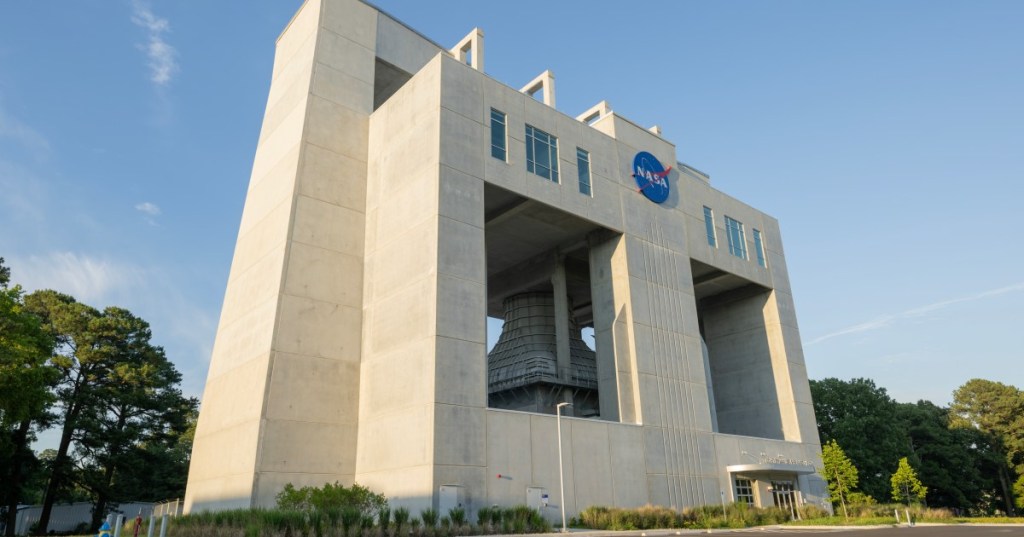
NASA’s newest major wind tunnel is progressing through its final calibration and hardware integration before experimental testing begins. In a November 25, 2026 interview, facility manager Tom Ivanco described the Flight Dynamics Research Facility (FDRF) at Langley Research Center in Hampton, Virginia. Although NASA formally opened the facility on July 31, Ivanco said customer vehicle testing had not yet begun. The vertical tunnel is designed to evaluate aircraft, drones, parachutes and spacecraft during complex atmospheric maneuvers.
Four motors drive a vertical airstream
According to NASA’s opening announcement, four 750-horsepower motors drive 14-foot-diameter fans with carbon-fiber blades. Their combined nominal mechanical output is 3,000 horsepower, equivalent to approximately 2.24 megawatts. Electrical input at rated shaft output would be higher because of conversion losses. Neither figure represents measured facility electricity consumption.
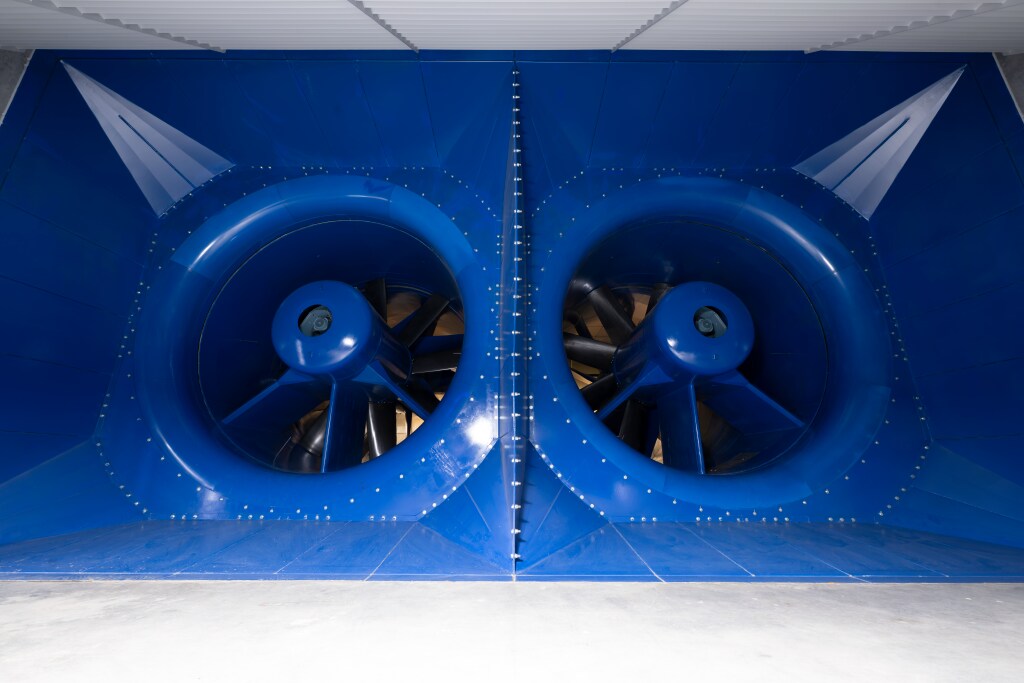
The 25,000-square-foot facility has a test chamber measuring 20 feet in diameter and a maximum airspeed of 117 mph (approximately 52 meters per second). NASA describes that speed as twice the maximum of its predecessors. At equal air density, doubling airspeed quadruples dynamic pressure, calculated as one-half the density multiplied by velocity squared. Greater aerodynamic loading permits researchers to investigate heavier scale models and expand their available test conditions.
Measuring stability rather than speed alone
A conventional fixed-model experiment can measure lift and drag at selected angles. Flight dynamics experiments examine how aerodynamic forces and rotational moments evolve as the model moves. FDRF supports both freely moving models and models attached to measurement rigs, including a rotating balance. Rising air allows researchers to study spinning aircraft and falling spacecraft without requiring a full-scale flight.
Separating aerodynamic loads from gravitational and inertial forces presents a measurement challenge. Ivanco explained that moving-model tests require calibration routines that account for the loads generated by the model and apparatus themselves. Accurate time-dependent measurements can help researchers characterize unstable motion and improve their mathematical flight models. Related principles appear in our coverage of spacecraft attitude control and precision instrument calibration.
From aircraft spins to atmospheric entry
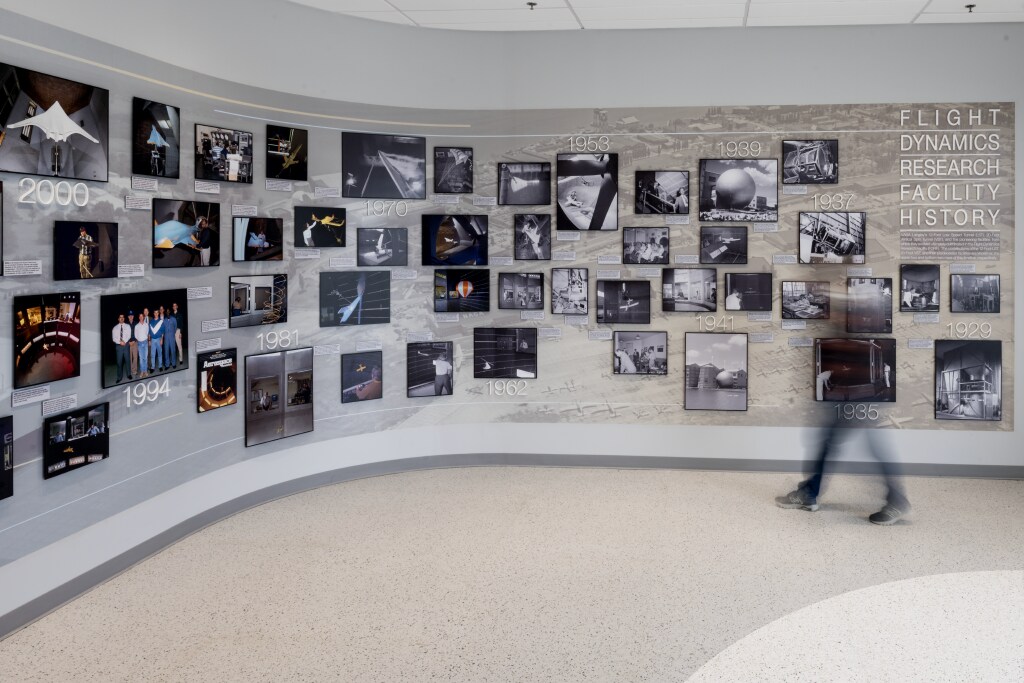
The FDRF replaces two facilities whose operations began in 1939 and 1941. NASA’s historical account describes their contributions to aircraft development and capsule testing. The newer installation consolidates their capabilities rather than introducing an entirely new field of experimentation. Future projects may include atmospheric flight on other worlds, complementing research such as Dragonfly’s Titan rotorcraft and autonomous spacecraft landing technology.
A subsonic wind tunnel cannot reproduce the intense heating of hypersonic atmospheric entry. It can, however, investigate aerodynamic stability within its operating envelope. Physical experiments and computational fluid dynamics provide complementary evidence, particularly when separated flow and rapid changes in orientation complicate numerical prediction. The immediate milestone for NASA’s new facility is completing calibration and demonstrating repeatable measurements in customer test campaigns.
Cover photograph: Flight Dynamics Research Facility at NASA Langley. Credit: NASA/Mark Knopp.
We volunteer daily to ensure the credibility of the information on this platform is Verifiably True. If you would like to support to help further secure the integrity of our research initiative, please scan the QR code below.

BitcoinVersus.tech is not a financial advisor. This media platform reports on financial subjects purely for informational purposes.


Leave a Reply