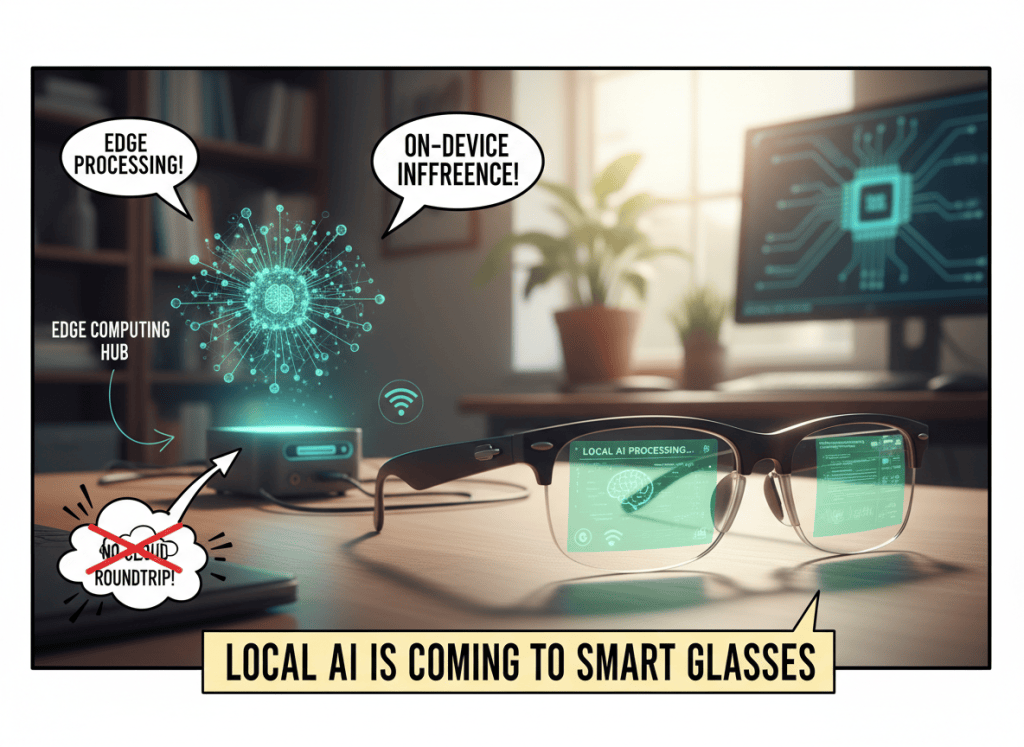
Artificial intelligence normally depends on powerful computers and large data centers. A new technology demonstration shows how some AI models are becoming small enough to run directly on smart glasses.
PrismML demonstrated an AI system running locally on smart glasses powered by Qualcomm’s Snapdragon AR1 Gen 1 platform. The system combines a roughly 1.7-billion-parameter language model with a smaller vision model that helps the glasses understand what their cameras see.
Why Local AI Matters
The important part is simple: the glasses can perform more AI processing themselves instead of sending everything to a data center.
That could make future AI glasses faster, more private and less dependent on an internet connection. Smart glasses have very limited space for memory, batteries and cooling, which makes running modern AI models on them difficult.
PrismML is addressing the problem by reducing how much computer memory its AI model requires. Its 1-bit language model used about 0.43 GB of weight memory in testing, compared with 1.66 GB for a 4-bit version, a reduction of roughly 74%.
PrismML and Qualcomm testing also showed the smaller model generating about 15 tokens per second, compared with about seven tokens per second for the tested 4-bit version. These are company-reported benchmark results, so independent testing will still be important.
AI Could Move From the Cloud to Your Glasses
Today, many AI applications send requests across the internet to large servers. Smart glasses could increasingly do more of that work themselves.
A pair of glasses equipped with efficient local AI could eventually look at an object, understand what it is and answer questions about it without constantly sending camera information to a remote server.
The same approach could help phones, robots, vehicles and other small devices run more AI locally. That does not mean AI data centers are going away. Large models and AI training still require enormous amounts of computing power.
This Is Still a Demonstration
Consumers cannot currently buy PrismML-powered smart glasses. The technology remains a demonstration, and no commercial smart-glasses product using the system has been announced.
The next challenge is proving that local AI can maintain useful performance while delivering the battery life, accuracy and reliability consumers expect. The AI hardware race is no longer only about building bigger computers. It is also becoming a race to make useful AI small enough to fit almost anywhere.
Related BitcoinVersus.tech coverage: Qualcomm on-device AI · Rover AI glasses · Microsoft Copilot AI OS · QBit physical AI
BitcoinVersus.Tech Editor’s Note: We volunteer daily to help ensure the credibility of information on this platform is verifiably true. BitcoinVersus.tech is not a financial advisor. This article is independent reporting and educational content for informational purposes only.


Leave a Reply