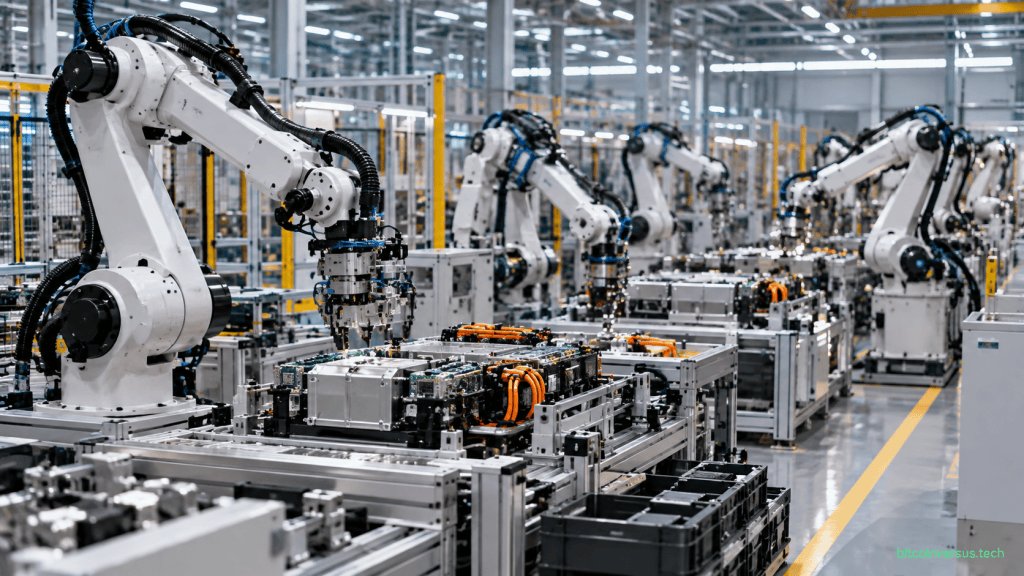
More than five million industrial robots are now operating in factories worldwide, according to the International Federation of Robotics’ new World Robotics 2026 report.
The global operational stock reached 5.079 million industrial robots in 2025, up 9% from the previous year. Factories installed a record 603,000 new robots during the year, an 11% increase and the first time annual installations surpassed 600,000 units.
China installed 354,000 robots
China accounted for 59% of global industrial robot installations in 2025, installing 354,000 units. The United States moved ahead of Japan to become the world’s second-largest robot market, with installations rising 12% to nearly 38,500 units.
India installed almost 10,500 industrial robots, up 15%, while Brazil recorded one of the sharpest increases at 38%. Germany remained Europe’s largest market, although installations there declined 8% to fewer than 25,000 units.
AI is expanding what factory robots can do
The IFR says advances in artificial intelligence, machine vision and sensing are expanding the range of tasks robots can perform. Easier programming and system integration are also reducing deployment barriers for manufacturers.
Electronics and automotive robot installations each increased 10% in 2025. Metal and machinery installations grew 22%. Collaborative robots reached 66,000 new installations and represented 11% of the industrial robot market.
Automation is still expanding
The IFR expects global industrial robot installations to rise another 9% to about 655,000 units in 2026 and reach roughly 806,000 units by 2029. The organization points to labor shortages, manufacturing relocation, AI and improved machine vision as long-term drivers of automation.
Sources
BitcoinVersus.Tech
Advertisement: Follow BitcoinVersus.Tech for independent coverage of Bitcoin, mining hardware, artificial intelligence, robotics, data centers, semiconductors, energy, gaming and emerging technology.
Disclaimer: BitcoinVersus.Tech provides news, analysis and educational information for general informational purposes. Nothing in this article is financial, investment, legal or professional advice. Readers should independently verify information and make their own decisions.
Related BitcoinVersus.tech coverage: Agility Digit 5 · Qualcomm PickNik robotics · NVIDIA Isaac ROS 5 · PAL Robotics TIAGo Pro


Leave a Reply