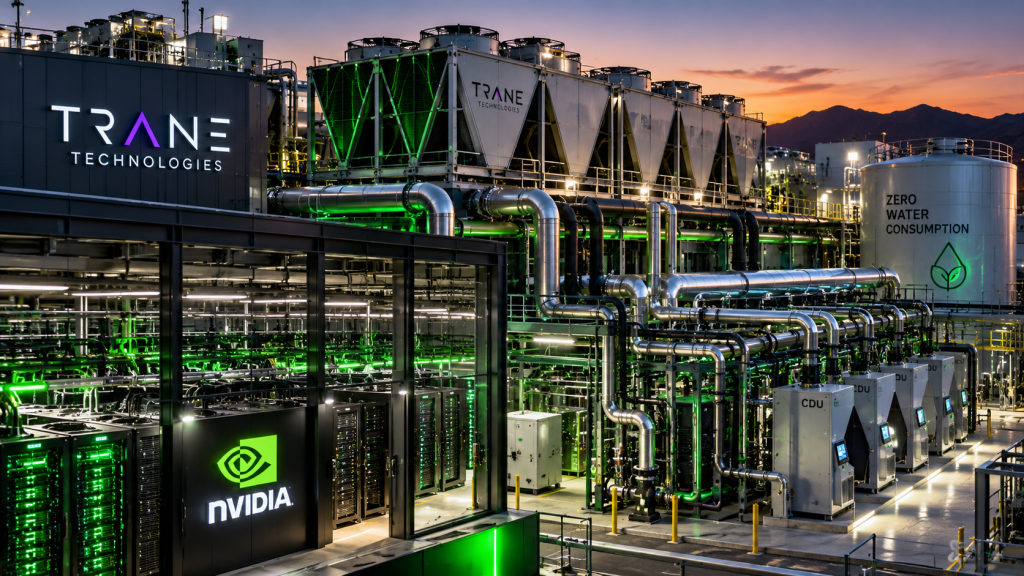
Trane Technologies has introduced two 250-megawatt cooling reference designs for NVIDIA’s DSX AI Factory platform, pushing data-center thermal engineering toward a model where more of a site’s electrical budget can be redirected from cooling equipment into compute.
In the September 28 announcement, Trane said both designs target zero water consumption while integrating technologies from LiquidStack and Stellar Energy. The company is treating cooling, electrical capacity and AI compute as one coordinated system rather than separate facility layers.
Reference Design 506 moves 22 MW toward compute
The first architecture, Reference Design #506, combines direct-to-chip liquid cooling with Trane Ascend ACR air-cooled chillers and integrated free cooling. Trane says the configuration can improve cooling efficiency by up to 25% and reallocate as much as 22 MW of power to compute inside a 250 MW AI factory.
Its annualized partial PUE is listed at 1.083, down from 1.201 in the comparison design, without consuming water. Independent engineering coverage published September 30 confirms the two 250 MW architectures, the zero-water approach and the 22 MW compute-power figure.
The emphasis on reclaiming electrical headroom follows a wider shift BitcoinVersus has tracked through NVIDIA’s DSX Ready power and cooling program. As accelerator racks become denser, facility infrastructure increasingly determines how much installed grid capacity can actually reach GPUs.
A 14 MW CDU moves liquid cooling toward campus scale
Both new Trane designs integrate LiquidStack’s GigaModular coolant distribution platform. The CDU has received NVIDIA DSX Ready qualification and scales to 14 MW at a 4°C approach, according to Trane. The company also claims up to 20% lower capital expenditure compared with conventional row-based CDU installations.
A public X post covering the launch highlighted that 14 MW capacity and the DSX Ready qualification as key pieces of the announcement.
The scale is notable beside other cooling hardware entering the same ecosystem. BitcoinVersus recently covered Vertiv’s 2.3 MW DSX Ready cooling unit, illustrating how vendors are approaching the same rack-density problem at different levels of the facility.
Reference Design 507 turns the cooling plant into a module
Reference Design #507 takes a different path. It uses factory-built Stellar Energy modular cooling plants instead of a conventional central utility building. Trane combines CenTraVac water-cooled chillers with stacked dry fluid coolers and dedicated dual-temperature loops.
Trane says the closed-loop architecture reaches a Water Usage Effectiveness of zero, improves chiller power by up to 16% and can redirect 8 MW of electrical capacity to AI workloads. In a temperate climate such as Chicago, the company says integrated waterside economizers can provide full free cooling for more than 98% of annual operating hours.
Those numbers make the design part of a broader engineering competition around megawatt-scale heat removal. BitcoinVersus also recently examined Schneider Electric’s 3.5 MW WCDU, another example of cooling distribution equipment expanding alongside AI rack power.
Cooling efficiency is becoming compute capacity
The practical takeaway is that cooling efficiency is no longer only a facilities metric. At 250 MW scale, a design that cuts auxiliary power can make additional megawatts available for accelerators without requiring the same increase in utility capacity.
Trane’s figures are vendor-reported design targets rather than operating results from a completed 250 MW deployment, so real-world performance will depend on climate, load profile, commissioning and site configuration. Even with that limitation, the new reference designs show how quickly AI infrastructure engineering is shifting from individual chillers and CDUs toward coordinated, campus-scale thermal architectures.
BitcoinVersus.Tech
Advertisement
Editor’s Note:
We volunteer daily to ensure the credibility of the information on this platform is Verifiably True. If you would like to support to help further secure the integrity of our research initiatives, please donate here: 3C9o19EH5HSiwEPyCTmEKzxhNCbo2X6TTb
BitcoinVersus.tech is not a financial advisor. This media platform reports on financial subjects purely for informational purposes.


Leave a Reply