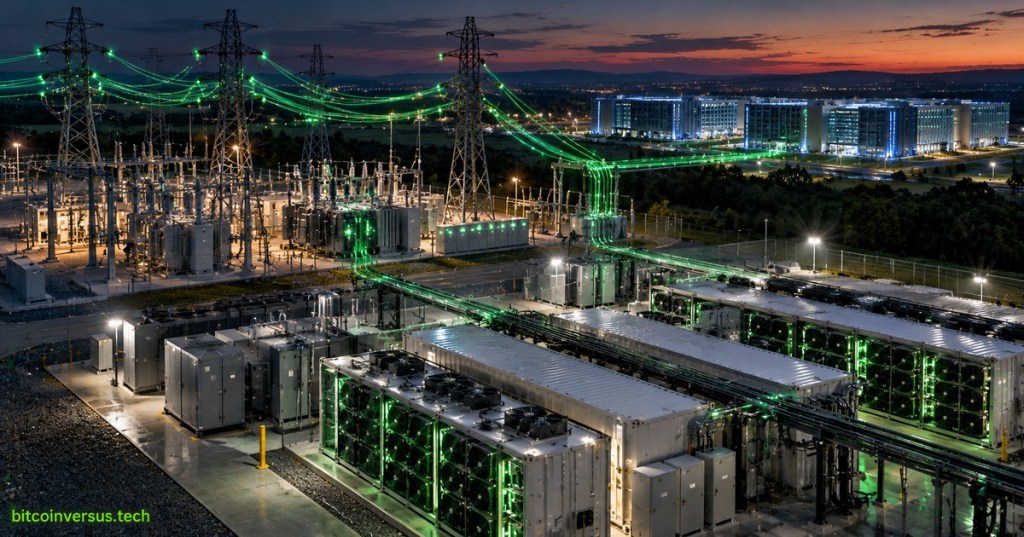
Bitcoin mining just received an unusually positive vote of confidence from the broader digital-infrastructure industry. On October 8, the Digital Power Network expanded its mission beyond Bitcoin mining into the energy infrastructure behind AI, cloud computing, and large-scale data centers—but explicitly kept miners at the center of the organization’s work.
The reason is simple: Bitcoin miners have already spent years solving problems that the AI industry is now running into at scale—finding power, interconnecting large loads, navigating permits, building in rural and industrial locations, managing community relationships, and learning how to turn compute down when the grid needs relief.
Mining Experience Is Becoming Data-Center Experience
In its October 8 announcement, the Digital Power Network said Bitcoin miners remain “at the core” of its work even as the organization broadens to include AI, cloud, digital-asset networks, and other forms of large-scale compute.
The group’s argument is that miners were among the first companies to repeatedly site, permit, energize, and operate industrial compute facilities in places where power—not office space—was the main constraint. That operating history increasingly overlaps with the same capacity-planning, power-contract, cooling, transmission, and interconnection questions facing AI data-center developers.
Six Priorities Put Mining Lessons Into the AI Buildout
- Energy access: speed up interconnection while rewarding flexible loads that can reduce demand when the grid is tight.
- Ratepayer protection and community investment: make large-load customers pay their fair infrastructure costs while ensuring host communities see visible economic benefits.
- Environmental stewardship: measure emissions, water use, equipment reuse, and other impacts instead of treating all compute loads as identical.
- Innovation and domestic manufacturing: strengthen U.S. production of the hardware, power electronics, transformers, and infrastructure needed for digital growth.
- Site-specific permitting: create predictable approval paths for suitable locations, including reused industrial land.
- Compute markets and access: make computing capacity easier to compare, finance, buy, and sell.
That agenda is broader than Bitcoin, but miners are directly relevant to almost every item. Mining companies already negotiate demand charges, build around transmission limits, optimize whole-site efficiency, and treat electricity availability as a first-class engineering variable rather than a background utility service.
Flexibility Is the Mining Industry’s Biggest Advantage
A conventional hyperscale data center is designed to stay online continuously. Many Bitcoin mining loads work differently. Operators can reduce hashrate quickly when electricity becomes expensive or grid reserves tighten, then return when conditions improve.
BitcoinVersus has already explored whether Bitcoin mining can stabilize the power grid. The important distinction is not that every mine automatically helps a grid. It is that mining hardware is unusually interruptible compared with many other industrial loads, giving operators and grid planners another tool when properly integrated into demand-response markets.
That idea is also supported outside the mining industry. Oak Ridge National Laboratory researchers published “Flexible Load and the Electricity Grid: A Bitcoin Story” in IEEE Power & Energy Magazine, examining Bitcoin mining as an elastic electrical load and the operational relationship between miners and grid operators.
Mining Built the Power-First Data-Center Playbook
One reason this matters is that Bitcoin mining inverted the traditional data-center siting model. Instead of choosing the perfect metro location and then finding enough power, miners often followed the electrons first.
That is why mining expanded around hydroelectric systems, wind farms, underused substations, stranded gas, and rural utility infrastructure. BitcoinVersus’ explainer on stranded energy describes the same location-agnostic feature: SHA-256 computation can move toward available power instead of requiring power to move toward a traditional city-centered workload.
AI cannot copy that model perfectly because inference latency, fiber routes, uptime requirements, redundancy, and customer service agreements can be much stricter. But the physical infrastructure layer—land, substations, transformers, switchgear, cooling, permits, generation, and high-voltage interconnection—is increasingly familiar territory for mining companies.
The Shift Does Not Mean Bitcoin Mining Is Being Replaced
The important detail in DPN’s announcement is that the organization did not describe mining as an obsolete stepping stone to AI. It said miners remain at the core of the expanded mission.
That makes sense because mining and AI have different economic profiles. Mining can monetize interruptible or geographically awkward power that may be unsuitable for a high-availability AI customer. AI may support higher revenue per megawatt at certain sites, while Bitcoin can remain the more flexible customer at others.
The emerging model is therefore less “Bitcoin versus AI” and more which workload best fits which megawatt. That is already visible across sites combining Bitcoin mining and GPU compute, and in facilities where mining infrastructure gives developers a head start on roads, substations, transformers, fiber, and energized land.
A Policy Upgrade for Bitcoin Mining
For years, Bitcoin miners have had to argue that their power use should be evaluated by how facilities actually operate rather than by annual consumption alone. DPN’s expanded mission effectively exports that argument into the larger compute industry.
That is a meaningful shift. As AI pushes utilities toward new tariffs, generation projects, capacity planning, and multi-gigawatt interconnection queues, mining’s experience with flexible demand is moving from a niche crypto-policy discussion into mainstream infrastructure policy.
What Comes Next
DPN’s next test will be whether its broader coalition can turn mining’s operating lessons into actual rules for interconnection, large-load tariffs, community investment, domestic equipment supply, permitting, and flexible-load markets.
But the October 8 announcement already says something important about the industry’s evolution: Bitcoin miners are no longer being discussed only as unusual electricity consumers. Their operating model is increasingly being treated as part of the blueprint for America’s next generation of digital infrastructure.
BitcoinVersus.Tech
Editor’s Note: The Digital Power Network is an industry advocacy organization. Its policy positions represent its members and should be distinguished from independent grid-operator findings or regulatory determinations. The ORNL/IEEE work is included as independent technical context on flexible Bitcoin-mining load.
We volunteer daily to improve the credibility of the information on this platform. If you would like to support the research, please donate here: 3C9o19EH5HSiwEPyCTmEKzxhNCbo2X6TTb
BitcoinVersus.tech is not a financial advisor. This media platform reports on technical and financial subjects purely for informational purposes.


Leave a comment