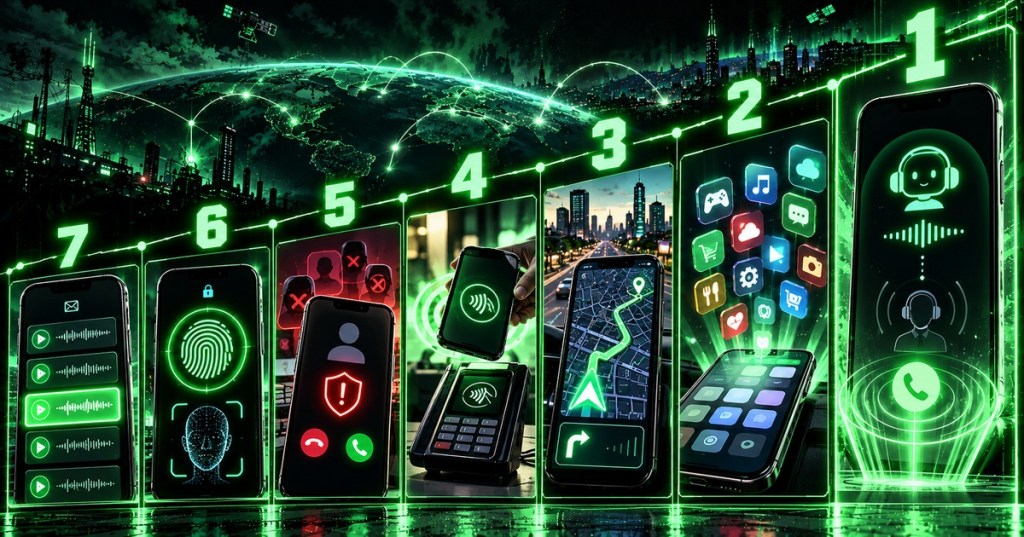
Some smartphone features changed entire industries. Others simply removed one annoying part of everyday life so completely that it became difficult to imagine going back.
This ranking focuses on the best individual mobile-phone features introduced or popularized during roughly the last 20 years. That is different from ranking the most important phones. The App Store probably had the largest economic impact on this list, but our #1 pick wins because it solves one of the oldest frustrations in telecommunications: wasting your own time waiting for another person to answer.
7. Visual Voicemail
Before visual voicemail, checking messages often meant calling a mailbox and listening sequentially. Apple and Cingular introduced Visual Voicemail with the original iPhone in 2007, letting users see a list of messages and jump directly to the one they wanted. It sounds ordinary today precisely because the idea worked.
6. Biometric Unlock
Fingerprint and face authentication removed hundreds of tiny daily interruptions. Apple’s Touch ID launch on the iPhone 5s in 2013 helped normalize the idea that secure authentication could be nearly instantaneous. Biometrics later expanded into payments, password managers and app authentication. Modern phones now build far more computing around these experiences, including increasingly powerful silicon such as the A20 Pro generation of iPhone hardware.
5. Call Screening and Spam Protection
Robocalls made the basic act of answering a phone less trustworthy. Google’s Pixel 3 introduced Call Screen in 2018, allowing Assistant to ask who is calling and why while transcribing the response on the phone. Modern versions can automatically screen suspicious calls and help users decide whether a human deserves their attention.
Google Help demonstrates how Pixel Call Screen identifies a caller and the reason for the call before the user answers.
4. Tap-to-Pay Mobile Wallets
Contactless phone payments turned the smartphone into a practical wallet. Apple announced Apple Pay in 2014, combining NFC, a Secure Element and biometric authentication. Similar wallet systems now make it normal to buy groceries, board transit and pay at restaurants without pulling out a physical card.
Apple Support shows the modern Apple Pay flow across supported Apple devices.
3. Free Turn-by-Turn GPS Navigation
Dedicated GPS units used to be a separate product category. In 2009, Google Maps Navigation arrived on Android 2.0 with voice-guided turn-by-turn directions, automatic rerouting, live map data and search integrated into a phone. Navigation has since become one of the most consequential everyday smartphone utilities, and the data behind mapping apps remains valuable enough that we have argued drivers should share in the value of real-time road data.
Google’s original 2009 demonstration shows how radical free internet-connected turn-by-turn navigation looked when it first arrived.
2. The App Store
If this were a ranking of industry impact, the App Store would probably be #1. Apple launched the iPhone App Store in July 2008; more than 10 million apps were downloaded in its first weekend. Centralized app distribution turned phones into expandable computing platforms for banking, games, transportation, communication, work and nearly every other category. The software ecosystem ultimately became as important as the hardware itself—a trajectory that continues as languages such as Swift expand beyond Apple’s original platforms.
1. Hold for Me
This is our #1 because it does something unusually valuable: it returns time to the user. Google introduced Hold for Me with the Pixel 5 and Pixel 4a (5G) in 2020. When a business puts you on hold, the phone can listen for you, distinguish hold music or recorded messages from a live representative, and alert you when somebody is actually ready to talk.
Google later said the feature saved about eight minutes per enabled call on average. Unlike many smartphone features that make an existing task slightly faster, Hold for Me changes who performs the waiting. You can put the phone down, do something else and return when the conversation becomes useful.
Made by Google introduced Hold for Me as a way to escape hold music while Assistant waits for a representative.
Made by Google’s official Hold for Me demonstration shows the feature handing the waiting job from the person to the phone.
The next phase of mobile innovation may look similar: fewer features that demand more attention, and more features that quietly remove chores. Satellite connectivity, live translation, AI call handling and increasingly capable on-device models are all moving phones toward that role.
BitcoinVersus.Tech Editor’s Note:
We volunteer daily to ensure the credibility of the information on this platform is Verifiably True. If you would like to support to help further secure the integrity of our research initiatives, please donate using the QR code provided

For best QR-code scanning results, please scan this donation code from a desktop or larger screen. Mobile screens may prevent camera recognition.
BitcoinVersus.tech is not a financial advisor. This media platform reports on financial subjects purely for informational purposes.


Leave a Reply