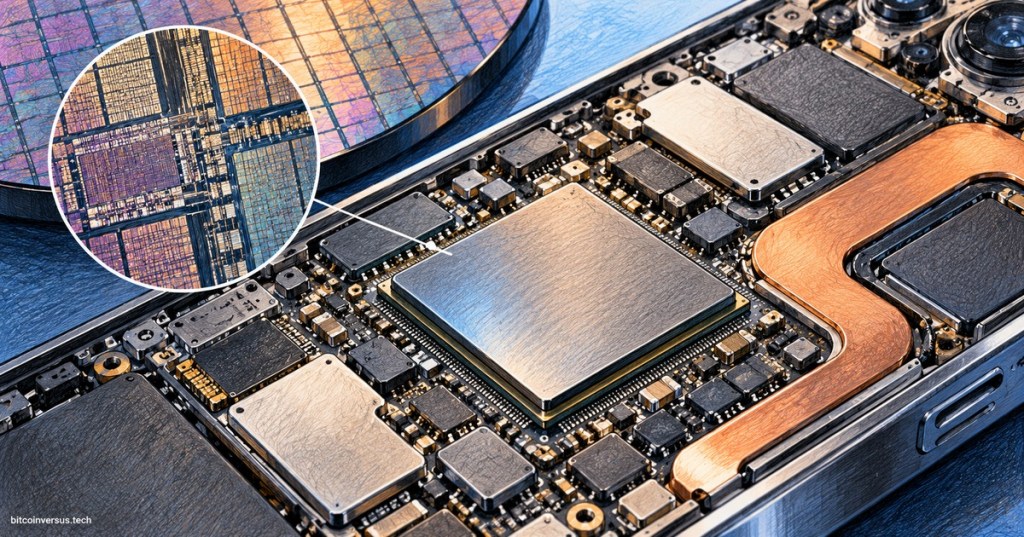
Apple’s newest iPhone processor is not just a faster annual refresh. The Apple silicon roadmap has now moved the iPhone onto a 2-nanometer-class manufacturing process while expanding the CPU, GPU, memory, and AI hardware inside the phone at the same time.
The new A20 Pro powers iPhone 18 Pro and iPhone 18 Pro Max. In Apple’s September 9 announcement, the company said the chip uses its latest 2nm process technology, a 6-core CPU, a 7-core GPU, 50% more memory bandwidth than A19 Pro, and a dual 16-core Neural Engine for 32 total AI-processing cores.
A20 Pro Moves the iPhone to 2nm
The process-node change is the headline semiconductor shift. Apple’s A19 Pro was manufactured on a 3nm-class process; A20 Pro moves to a 2nm generation. In modern chip manufacturing, “2nm” is a process-family name rather than a literal measurement of every transistor feature, but moving to a newer node still gives chip designers more room to trade transistor density, power, frequency, and die area against one another.
That puts Apple into the same broader 2nm transition BitcoinVersus.Tech has been tracking across the semiconductor industry. MediaTek’s Dimensity 9600 Pro is also pushing mobile silicon into 2nm-class manufacturing, while Rapidus is building an entire Japanese foundry ecosystem around 2nm production.
For Apple, the smaller process is useful because the company is asking one phone SoC to do more work locally than ever before: CPU tasks, graphics, camera processing, ray tracing, machine learning, large-model inference, and security all compete for power and thermal headroom inside a thin battery-powered device.
The CPU Still Uses Six Cores — but the Cores Changed
A20 Pro keeps a familiar six-core CPU layout: two high-performance “super cores” plus four efficiency cores. Apple says the new super cores are up to 20% faster than the previous generation. That matters because smartphone performance is often limited less by raw core count than by how much work a single fast core can finish within a tight power budget.
The distinction is easier to understand through the basic CPU versus GPU versus NPU split. The CPU handles general-purpose instructions and operating-system work. The GPU handles highly parallel graphics and compute workloads. The Neural Engine is specialized for machine-learning operations. Apple’s design increasingly uses all three rather than expecting one processor block to do everything.
This is also why how a CPU executes software still matters even in an AI-heavy phone. Faster branch prediction, caches, instruction execution, and memory access can improve everyday responsiveness even when the Neural Engine is handling the most specialized AI math.
The 7-Core GPU Gets a 40% Performance Claim
The A20 Pro’s GPU grows into a new 7-core design. Apple says graphics performance is up to 40% faster than A19 Pro. Each GPU core also carries Neural Accelerators, continuing Apple’s strategy of blending graphics hardware and AI acceleration instead of isolating every machine-learning workload inside one dedicated block.
That matters for games, computational photography, creative software, and local AI. Modern mobile GPUs are not just frame-rendering engines; they are large parallel processors that can accelerate matrix math, image pipelines, and other workloads. Apple’s direction mirrors the wider industry trend visible in Qualcomm’s latest Snapdragon chips, where CPU frequency, GPU capability, and on-device AI are all being developed together.
The Neural Engine Is Now Two 16-Core Engines
The most obvious AI hardware change is the Neural Engine. A20 Pro includes two 16-core Neural Engines, for 32 total cores. Apple says that doubles AI-processing capability compared with A19 Pro. The chip is intended to support larger and more demanding on-device models while keeping more work local to the phone.
This is the mobile version of the same local-AI trend Apple is pursuing on the Mac. The M6 Mac mini increases local AI performance on the desktop, while experiments such as four Mac Studios running a trillion-parameter model over Thunderbolt 5 show how far Apple’s unified-memory systems can be pushed when workloads stay close to the hardware.
The iPhone cannot match a workstation’s memory capacity or power envelope, but the architectural goal is similar: execute as much useful AI work locally as practical, reduce dependence on remote inference for every request, and keep latency and personal data closer to the device.
50% More Memory Bandwidth May Matter as Much as the AI Cores
Apple says A20 Pro has 50% more memory bandwidth than A19 Pro. That number is easy to overlook beside CPU and GPU percentages, but it may be one of the most important changes for AI workloads.
Processors can only calculate on data they can reach. Large AI models repeatedly move weights, activations, images, and intermediate results between memory and compute blocks. More bandwidth helps feed the CPU, GPU, and Neural Engine instead of leaving expensive execution units waiting for data.
This is the same reason memory bandwidth has become a defining constraint in AI servers. The scale is completely different, but the principle is identical: more compute is useful only when the memory subsystem can keep it supplied.
Cooling Is Part of the Chip Story Now
A fast chip inside a phone is only useful if it can stay fast. The iPhone 18 Pro pairs A20 Pro with a next-generation vapor chamber so the phone can spread heat away from the processor more effectively during sustained workloads.
That connects directly to thermal throttling. When silicon becomes too hot, clocks and power must be reduced to protect the hardware. Better cooling therefore does not magically make the architecture faster, but it can let the chip remain closer to its intended operating point for longer.
Ars Technica’s iPhone 18 Pro review found the improved thermals noticeable in everyday use and described the A20 Pro plus vapor-chamber changes as the most important under-the-hood upgrade. That is a useful reminder that real device performance depends on packaging and heat removal, not only benchmark peaks.
Apple Is Also Replacing More Companion Silicon
A20 Pro is not the only Apple-designed chip inside the new iPhone generation. Apple also introduced N1, a wireless networking chip supporting Wi-Fi 7, Bluetooth 6, and Thread, plus the C2 cellular modem system.
Apple says C2 provides faster uploads than C1X while using 15% less energy, and it adds U.S. mmWave support. That means Apple is controlling more of the phone’s silicon stack itself: application processor, AI engines, graphics, wireless networking, and cellular modem technology.
The long-term strategy lines up with BitcoinVersus.Tech’s earlier argument that technology giants will keep moving toward proprietary hardware. Owning more of the silicon lets a company tune hardware and software together instead of accepting every tradeoff built into third-party chips.
A20 Pro Is Really Three Stories at Once
The A20 Pro launch can be read three ways. First, it is a process-node story: Apple has moved its flagship phone into a 2nm generation. Second, it is an AI story: 32 Neural Engine cores, GPU Neural Accelerators, and 50% more memory bandwidth give on-device models more hardware to work with. Third, it is a systems-engineering story: the chip is paired with better cooling and a growing set of Apple-designed companion processors.
That systems view matters more than any single benchmark. A smartphone SoC sits inside a power-limited, thermally constrained computer that also has to run cameras, radios, displays, storage, security, and an operating system all day. Improving one block without improving memory, cooling, or power delivery can simply move the bottleneck somewhere else.
The Bigger Apple Silicon Direction
Apple now has a clear silicon ladder stretching from the iPhone’s A-series into increasingly powerful Mac processors such as M6 and future high-memory systems like the reported M7 Ultra direction. The products differ enormously in power budget and scale, but the design philosophy is consistent: custom CPU cores, increasingly capable GPUs, dedicated AI acceleration, high-bandwidth memory paths, and tight integration with Apple’s operating systems.
A20 Pro matters because it shows that the smartphone version of that strategy is still accelerating. Apple is not only shrinking the process node. It is trying to make the phone a more capable local computer for graphics, AI, communications, and computational photography without giving up the battery and thermal constraints that define mobile hardware.
BitcoinVersus.Tech
BitcoinVersus.Tech covers semiconductors, processors, AI hardware, operating systems, data centers, and the infrastructure behind modern computing.
Editor’s Note
We volunteer daily to help keep the information on this platform verifiably accurate. Support our independent research through the support options available on BitcoinVersus.Tech.
BitcoinVersus.tech is not a financial advisor. Content is provided for informational purposes.


Leave a comment