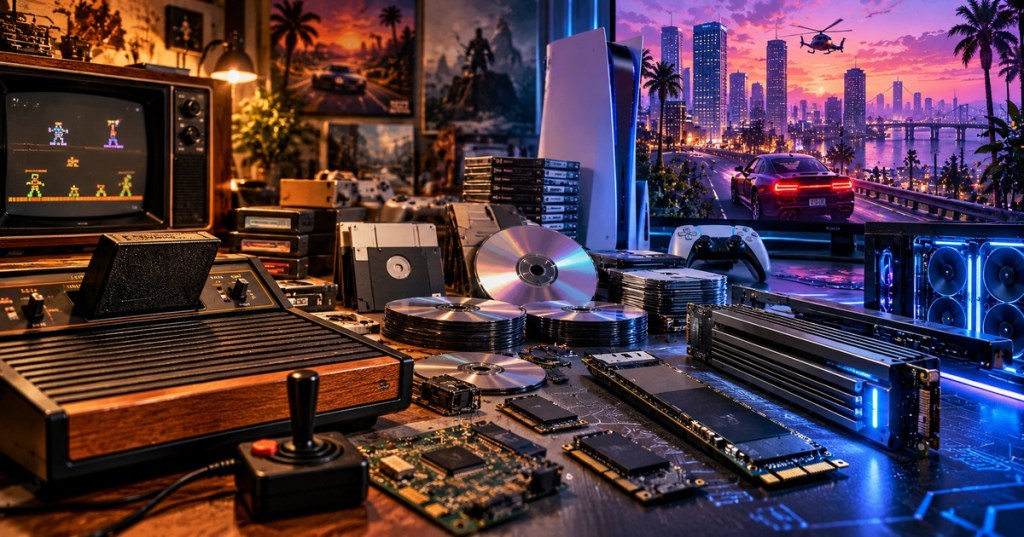
A game that once fit into a few kilobytes can now be compared with a reported 210-gigabyte download. That is the technological leap behind an October 27 NikTek video comparing Grand Theft Auto sizes from 1997 to 2026 and Grand Theft Auto VI. The PS5 size comes from PlayStation Game Size reporting, subsequently corroborated by Insider Gaming; Rockstar has not publicly confirmed a final 210 GB requirement.
Key Takeaways
- Early Atari cartridges held 2–4 KB of game code; GTA VI is reportedly a 210 GB PS5 download.
- At 4 KB versus 210 GB, the difference is approximately 52.5 million times, using decimal units.
- Game file size measures storage, not RAM demand, electrical power or entertainment quality.
From kilobyte cartridges to vast game worlds
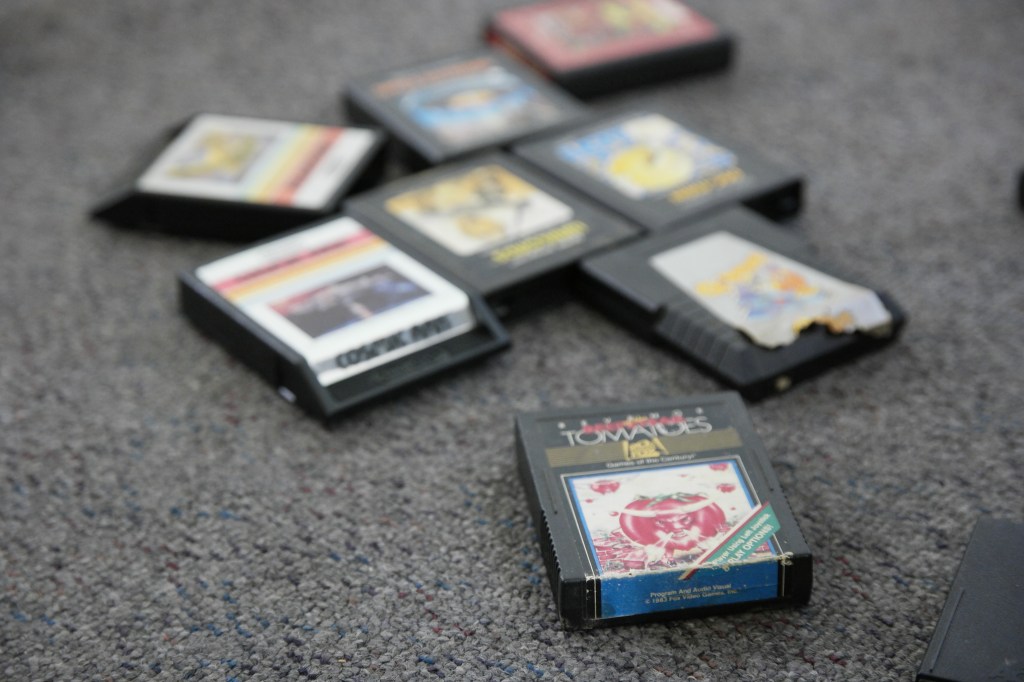
IEEE Spectrum’s history of the Atari 2600 describes early 2 KB cartridges. The 1980 Space Invaders conversion eventually fit in a 4 KB ROM cartridge. Such machines also had tiny working memories: the Atari 2600 had just 128 bytes of RAM. Those figures describe different hardware resources and must not be treated as interchangeable.
Magnetic disks, optical discs, hard drives and eventually dense NAND flash storage radically expanded how much software developers could ship. High-resolution textures, cinematic dialogue, audio, animation and entire simulated cities all consume capacity. File size also depends on compression, duplicate assets and engineering choices; more bytes do not guarantee a better game.
Storage density, electrical power and value
An SSD’s nonvolatile capacity is different from the DRAM and SRAM used while a game runs. Faster processors and storage can feed larger worlds, but power and cooling constrain how much computation can occur each second. BitcoinVersus.Tech’s Power Efficiency Theory explores this broader progress in useful computing work per joule. More efficient chips make richer simulations practical without requiring power consumption to increase in direct proportion to their complexity.
That is a more meaningful way to think about value: increasingly affordable storage and greater computing efficiency allow developers to offer worlds impossible on early consoles. How enjoyable those worlds are remains a creative judgment. And until Rockstar confirms the final install requirement, 210 GB remains a reported figure, not an official specification.
BitcoinVersus.Tech Editor’s Note: We volunteer daily to help ensure our reporting is Verifiably True. To support independent research, scan the QR code below to donate 5,000 sats (0.00005 BTC).
Open this page on another screen and scan the QR code below with your mobile Bitcoin wallet. If your wallet supports scanning a saved image, save the QR image and scan it from your phone.

For best scanning results, display the QR code on a larger screen and scan it with another device.


Leave a Reply